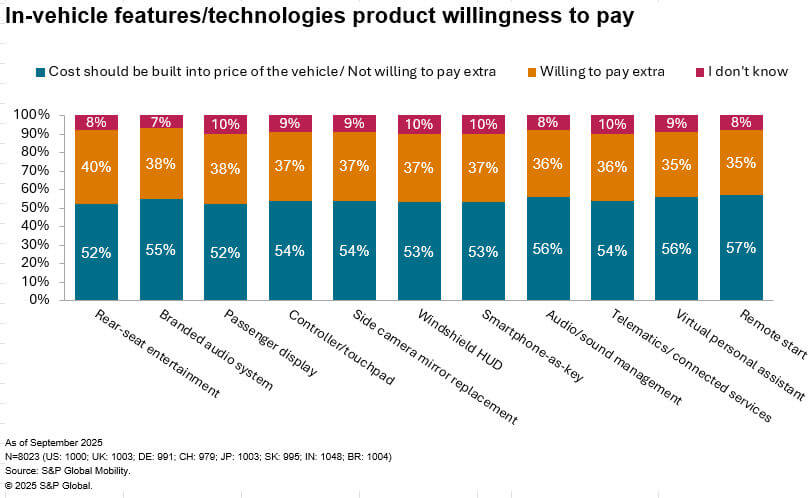
S&P Global’s piece is blunt about HMI. Based on 8,023 vehicle owners in the U.S., Germany, Japan, mainland China, and India, drivers don’t want more screens, they want less friction and more clarity.
The most mainstream feature is not in-car AI, it’s smartphone mirroring, used by 88 per cent of respondents. Willingness to pay is modest: 11 per cent for a voice personal assistant, 5 per cent for infotainment, 4 per cent for HUD, and 4 per cent for digital keys. Clearly, customers like features that feel familiar (phone-like) and don’t trigger subscription fatigue.
Voice control is now habitual; 80 per cent use speech recognition at least occasionally, with a tilt toward smartphone-based platforms (40 per cent) over OEM solutions (35 per cent). The most desired commands are practical: navigation, phone, and infotainment (>90 per cent) and regional ecosystems matter – AliGenie and Baidu Duer in China, for example.
Safety is central; S&P explicitly connects the survey to growing evidence that touchscreen-only controls increase distraction, and references Euro NCAP’s penalties for essential functions buried in menus, versus top ratings tied to physical/tactile controls for core operations (indicators, hazards, wipers, horn, SOS).
For cockpit teams, that’s a pivot from screen-size wars to confidence UX: controlled latency, coherent interaction logic, muscle-memory critical controls, and software that doesn’t try to outsmart the driver.


