Gentex delivers 45 million auto-dimming electrochromic mirrors per year, for 600 vehicle models around the globe. They use electricity to change the visible-light transmissivity of a transparent gel sandwiched between two glass or film substrates with transparent, conductive coatings.
As electricity passes through the conductive coatings and across the substrates, the gel darkens. Removing the current returns the gel to its transparent state, and the voltage can be precisely controlled to vary the light transmittance through a wide opacity range. In its fully darkened state, the dimmable glass blocks more than 99.999 per cent of visible light, and innovative thin-film coatings block the majority of harmful IR and UV light.
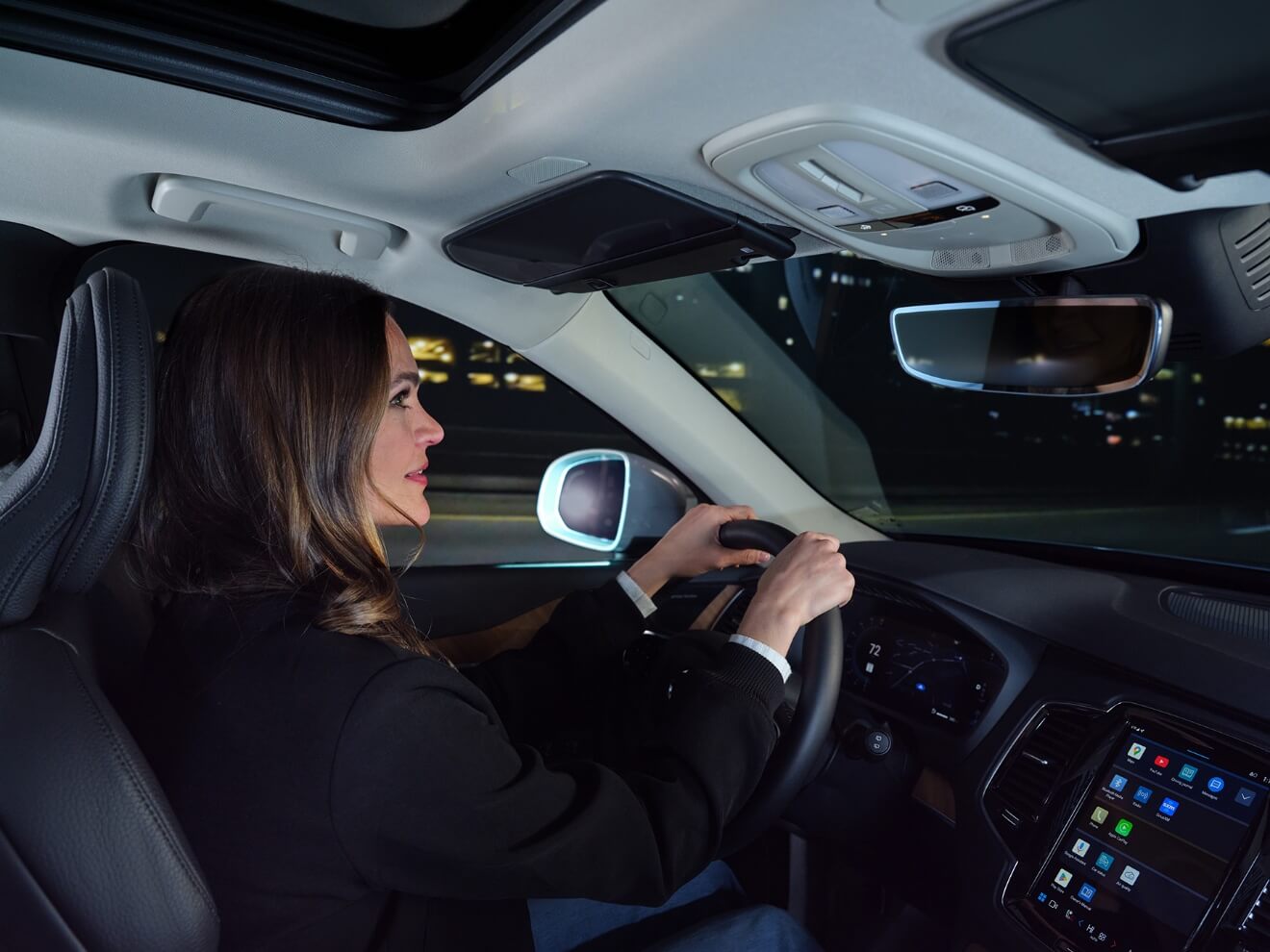
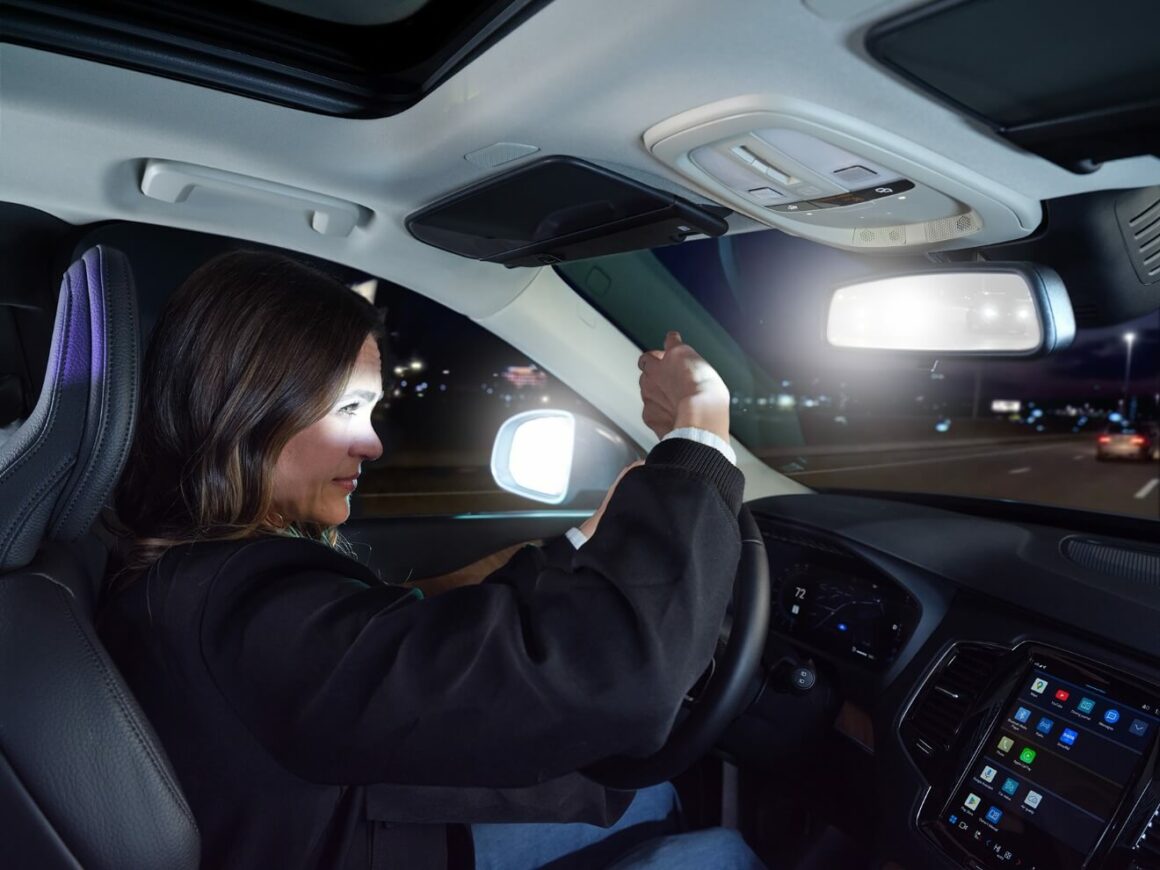
Now, Gentex is working to broaden the scope of applications for electrochromic dimmable glazing. They’re working on sunvisors, which fold down like a traditional visor, but rather than an opaque panel it’s a clear one which can variably darken as desired by the driver or passenger – on demand or automatically. This reduces glare while maintaining forward vision, unlike conventional visors.
That, in turn, suggests new ways of integrating technology like this. Here’s a comparison chart of the relevant U.S. versus rest-of-world UN regulatory requirements:

In Europe, the regulatory structure is comparatively explicit. For category M1 and N1 vehicles (passenger vehicles, most light-duty vehicles) the reference framework is UN Regulation № 125, which controls the driver’s 180-degree forward view. This is meant to ensure an adequate field of vision through the windshield and other glazed surfaces. The same regulation also caps the obstruction angle of each A-pillar at 6 degrees, which is a reminder that compliance is not only about transparency but also about the geometry of direct vision. In parallel, UN Regulation № 43 on safety glazing requires a regular light transmittance of at least 70 per cent for windshields and, more broadly, for glazing required for the driver’s forward field of vision. In practice, that means dimming functions can be developed in Europe, but they enter a tightly regulated zone as soon as they affect glazing that is homologated as necessary for forward vision.
In the United States, the framework is more distributed. There is no single federal passenger-car rule that mirrors UN Regulation № 125 as a direct geometric forward-vision standard. Instead, compliance is built through several MVSS requirements. FMVSS (and CMVSS) № 205 on glazing materials is intended to ensure the degree of transparency necessary for driver visibility, and NHTSA has repeatedly stated that, in passenger cars, glazing “requisite for driving visibility” is generally required to provide at least 70-per-cent light transmittance, apart from the permitted upper shade band. This sits alongside FMVSS № 104 on windshield wiping and washing systems and FMVSS № 103 on defrosting and defogging, which govern whether the useful vision area remains available in real operating conditions.
The industrial implication is straightforward: in the US as well, darkening a primary approved vision zone is a very different proposition from darkening a movable visor or a roof panel.
The Gentex proposal is relevant from a cockpit and HMI standpoint. It does not try to overlap regulation; it looks for areas where active light management can add user value without interfering with primary forward-vision glazing. The dimmable visor is therefore less a windshield revolution than a smart relocation of the anti-glare function. The core question is not whether glass can darken, but where, by how much, and under which control logic, without colliding with homologation.

Beyond the regulations, it will be interesting to investigate a number of use cases, in particular (see the images from Gentex) the unobstructed area near the base of the rear-view mirror, which is a critical area both when the sun is low in the sky and when overtaking vehicles on bends.


