21. OREkON _
(this story is part of an ongoing series introducing automotive interiors as an evolution of our habitat)
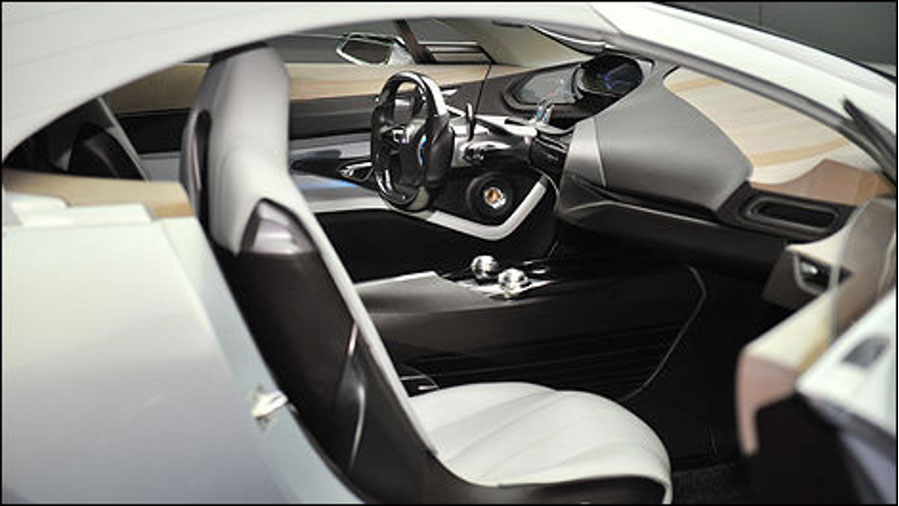
Carbon fiber, wood, anodized aluminum, ostrich skin, fish scales, crystal, orekon, genuine leather, recycled paper, carbonized fossil bamboo, porcelain, acoustic composite wool, silk, stone, anything recycled and 3D printed, is just a snapshot of a persistently updated portfolio of shades, tints and textures that constitute, beyond form, the hedonistic kingdom of car interiors. Soft, hard, warm and cold, a tactile universe that contrasting any other is not only to be looked at but to be felt. Unlike car exteriors, interiors can ‘live’ in the absence of light. Science and design got together fusing matter into senses.
CMF designers, a sort of ‘materials alchemists’ are infused with the peculiar talent of sensing the invisible, investigating the unseen world around us, stepping beyond sensory experience. They are raised, through a very special right-versus-left-mindset, to fulfill an uncomprehensive task: dial knowledge into physical substance. Whether they are creative scientists or artist genii, they are the extraordinary ones in the league of the most compelling industry trends. It is like fashion extravaganza liberated from its business sector and like garment augmented into surrounding space, cocooning and interactive at one go. Although contradictory, this is what happened when fashion invaded mechanics. Fashion and technology are not the most intimate bedfellows; one is soft and warm the other cold and hard. However, we remain stunned on their willing of coexistence in the domain of car interiors.
With the launch of the Mercedes EQS sedan 56-inch door-to-door screen, we have reached a peak screen-level in car interiors. From now on, car interiors are segregated in two zones: the visible part destined to become screen-per-square-inch and, anything else in less visible angles, or otherwise ‘the car interior itself’. Most observable forms, materials and textures are substituted by a constantly updating graphic, shuffling endlessly according to its algorithmic protocols. This performing and versatile ‘layer of technology’ is somehow cognitive-neutral in physical terms yet highly adaptable.
Our mobile adventure started early on from the ground up, mastering traction, mass and gravity through inventive mechanic analogies and compositions that matured over time remaining engraved in our saga of progress (wheels and tires, chassis, suspensions.). It took time to put in place all necessary controls to major performance (engine, steering, breaking.) and settle human factors (seats, consoles, interiors.) adding continually new layers of technology from the tarmac all the way to our fingertips. Today, on the last few millimeters of surface thickness, we created the most adaptable item that acts though as a disconnection screen of anything analog we could rely on, anything that directly connects us to motion. Yet, it ends up shaping us by shaping our itinerant environment.
Deeper technologic layers change slowly, surface layers ‘learn’ and adapt faster. The challenge is how to manage and redirect every single time this new powerful and reactionary sheet of technology. What if there was no screen to the benefit of all senses? Open-source innovation is often referred as the 3rd industrial revolution. In a world where a mirror doubles as a speaker and a plant can have its own twitter account updated by its feelings, what are the limitations to open-source car interior? A disproportionate development of screens within in the pluralism of inventions is overwhelming to the deficit of other sensations.
The constant friction between art and technology to such extend, makes car interiors the master of all crafts, creating form that is more than just function and beauty is more than style. Art is discovery and when applied, reveals a lot about ourselves.
There are places where humans have easier access to smartphones than clean water. Within an open-source technological polyphony, the cognitive overload through anything ‘screen’ is stepping singlehandedly on one only aspect of our multifaceted existence: addiction. After all, there is only two industries that call their clients Users, illegal drugs and software.
_to be continued…
__________________________________INDUSTRIOUS__


