Following on from last week’s overview of how Volkswagen went from the 5-seat Touareg to their current 7-seat Atlas, let’s look at the origins of the SUV ‘Family Truckster’ that happened in the early 1990s.

The beginnings of these vehicles started with 5-seat SUVs built on truck chassis as a ‘lifestyle’ alternative to the booming minivan market: minivans were marketed to moms; SUVs to dads. Automakers were figuring out what usage and needs this new kind of vehicle should provide. Was real off-road capability required, or was just the image and appearance enough as long as it was an adequate all-weather family hauler? Four contenders emerged; their descendants still dominate the market today: the Jeep Cherokee (XJ), Ford Explorer, Nissan Pathfinder, and Toyota 4Runner.


The Ford, Toyota, and Nissan were based on their respective pickup truck chassis; the Jeep was the other way round (the Cherokee SUV spawned the Comanche pickup truck). In all four cases, off-road capability was an inherent priority but the daily driving and liveability is what brought consumers to this new segment. This included space, durability, and creature comforts transferred from then-typical sedans. This ability to add carlike comfort features to trucklike off-road capability (whether or not buyers ever actually went further off the road than the shopping mall parking lot) is what made this new segment successful and continues to fuel its ongoing evolution.
For this week’s Design Lounge, we will look at how Nissan and Toyota have evolved their vehicles to their present-day 7-seater offerings. By comparing the Nissan Pathfinder and the Toyota 4Runner interiors, we can see how Toyota incorporated a deep soft-touch instrument panel surface borrowed from their passenger cars, while Nissan opted for a more utilitarian hard-surface execution. From 2021’s perspective it’s clear Toyota’s passenger car approach was the winning one.


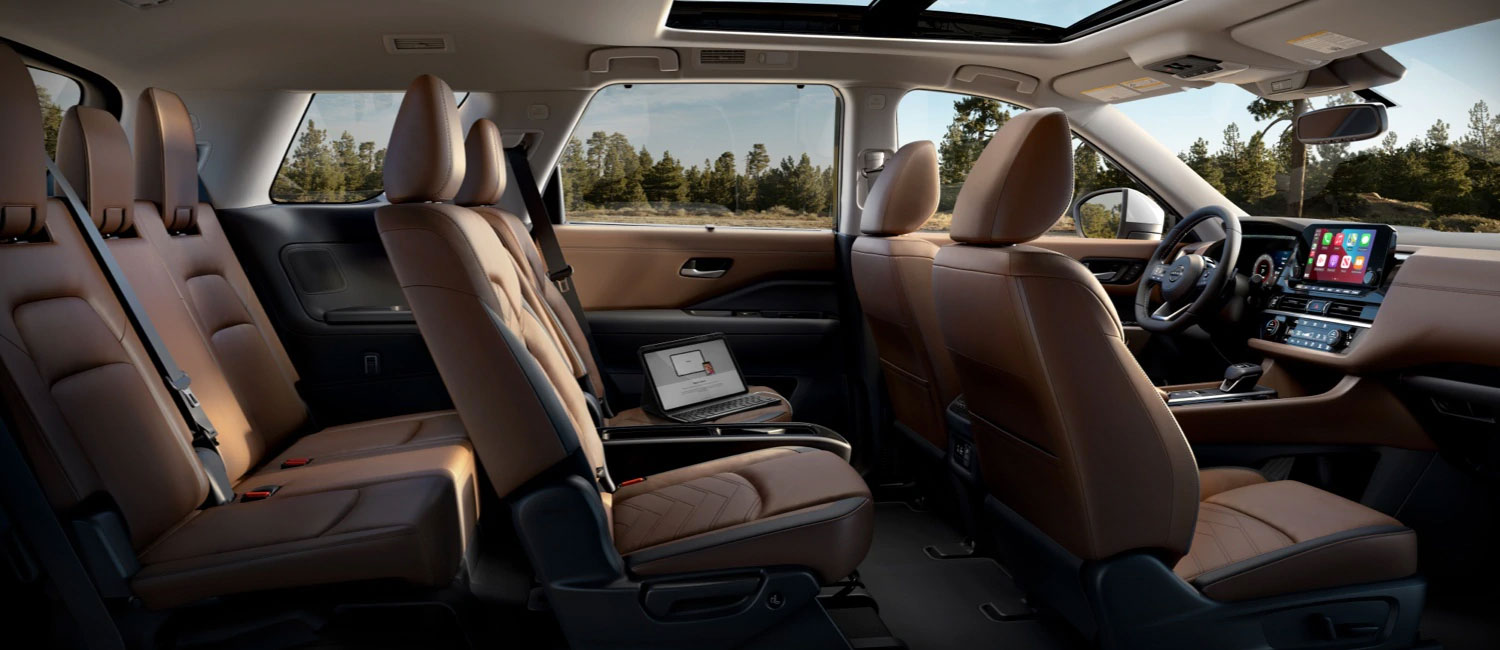
For 2021, Nissan has fully embraced the passenger car approach with their interior materials and feature seats without sacrificing the 7-seat practicality of an SUV.

A far cry from the hard plastic instrument panel form their 1990’s Pathfinder, the 2021 model has a leather/vinyl type of instrument panel covering along with contrasting stitching and seams that cover the entire surface.

Also, the floor console with its storage and interface switching, is now integrated into the instrument panel as opposed to just covering the base of the shifting and 4-wheel drive actuation levers.
Although the central UX/HMI display screen is located at a high position, the use of leather/vinyl for the surface coverings are what give it an upscale craftsmanship appeal.


The driver’s cockpit and displays offer amenities typical of a 2021 vehicle, including full-color displays for the cluster, a head-up display, and the central UX/HMI screen and interface.
No real off-road functionality is emphasized, as these vehicles are people haulers first, with all-weather usability.

The off-road functions, such as they be, are controlled by a rotary dial in the center console.

Rear passengers have their comfort features integrated into the rear portion of the floor/center console for easy direct control.


Toyota has a de luxe approach with the 2021 Highlander’s interior. There’s a high mounted center UX/HMI display and leather/vinyl coverings for the lower portions of the instrument panel. The floor/center console is also a dominant element for their interior design theme.


Toyota chose to place the HVAC ducts and switches into their UX/HMI display while also integrating it into a horizontal theme towards the passenger compartment. This thematic element can be seen in all of Toyota’s new cars offerings for 2021.

A full-color digital display is also used in the Highlander…

…and decorative stitched and perforated leather trim adds more detail to the seating surfaces and trim covers. Very carlike, near luxury-oriented materials and functionality move the Highlander completely away from its truck-based SUV origins and firmly into the family-car category.

A more aggressive and sportier colorway is also available for the seating trim covers in the Highlander…

…to add a bit of flair versus the standard trim offerings.
The lineage from humble SUV origins to 7-seater family car is now complete with their 2021 models, which face fierce competition in the marketplace from nearly all automakers. Next week we will look at the 7-seat SUVs from Hyundai and Kia.


