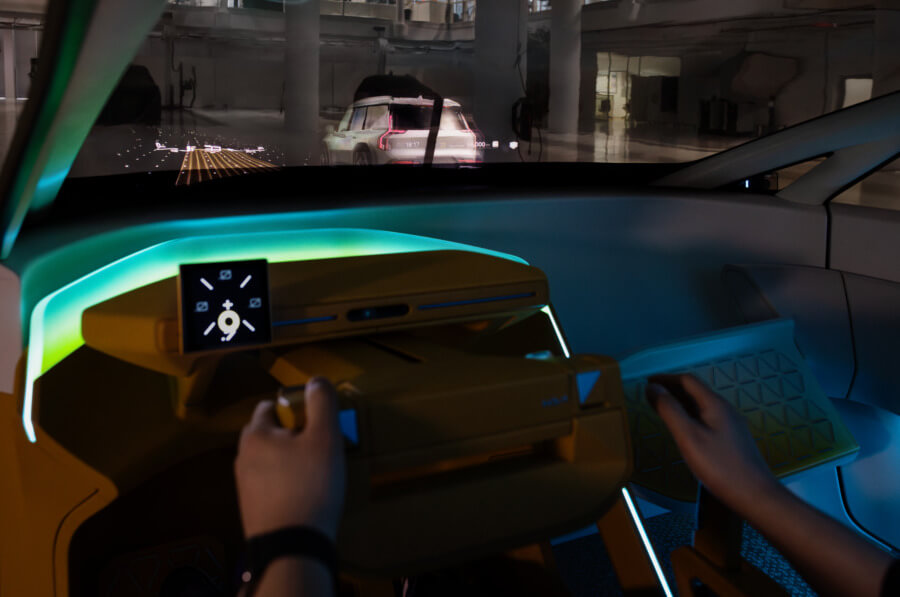
The Kia Vision Meta Turismo concept, shown at Milan Design Week, is interesting because it does not simply add more screens. Kia describes an interior clearly separating the driver cockpit and passenger zones, designed for a generation at home with gaming, simulation, and immersive interfaces. The concept offers three usage worlds – Speedster, Dreamer, Gamer – with AR HUD, AR glasses, and digital interaction.
The useful cockpit lesson is the return of physicality. Kia’s Add-Gear is a modular interface combining game controllers, audio and smart displays to adapt interaction to different driving situations. Other reports describe haptic analogue controls, a 180-degree rotating passenger seat, and AR modes. Even as a concept, the logic is that the cabin must become sensory again.
The link with BMW is obvious. BMW is industrializing a curated haptic approach through the shy-tech steering wheel, while Kia is exploring a more emotional and gaming-inspired version with augmented physical controls. Both respond to the same issue: the tablet-for-everything cockpit is reaching ergonomic limits (many might say it’s past those limits). For frequent, dynamic, or emotional functions – drive mode, assistance, sound, virtual gear selection, boost – gesture and tactile feedback remain superior to menus. Haptics is becoming a UX language, not a cosmetic vibration.
Distance Technologies adds another layer. The company announced the integration of a panoramic lightfield HUD into the Kia concept, using technology intended to transform transparent surfaces into a 3D light field. The idea is to make digital content appear at different depths in the real world without a headset.


