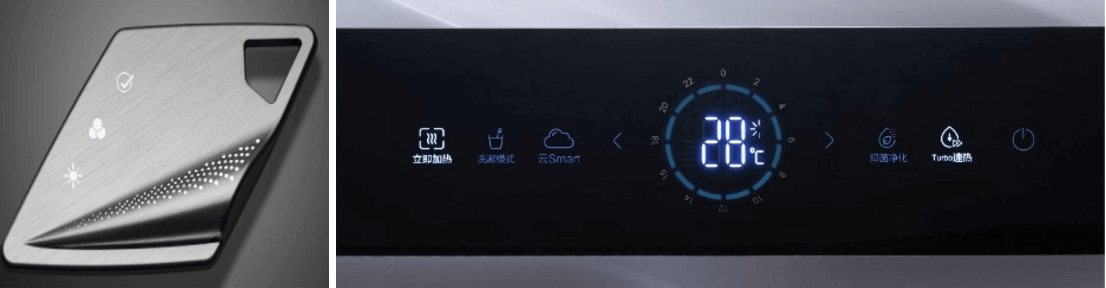
The trend towards seamless, intelligent, and highly integrated interior surfaces is accelerating. Consumers expect vehicle cockpits which provide not only aesthetic refinement but also intuitive and reliable human–machine interfaces (HMIs). This is why Baier, Kurz, and PolyIC devised what they call Functional Foil Bonding (FFB) to embed capacitive sensor functionality into complex decorative plastic components.

FFB is a thermo-mechanical process that integrates capacitive sensor foils into decorated plastic parts such as HVAC panels, center consoles, or door trims where parts are constantly exposed to varying temperatures, humidity, and user interaction.
Unlike optically-clear adhesive lamination, FFB uses heat and pressure to directly bond the sensor mesh onto the substrate without adhesives, ensuring stable adhesion and optical clarity under harsh automotive climate conditions.
The process can be integrated either offline or inline, directly after injection molding and decoration, allowing automotive tier-1 suppliers to streamline production flows.
The process involves precise positioning of the foil, embossing through heated tools or rollers, removal of the polyethylene terephthalate (PET) carrier, and inline quality inspection. This method supports 2D and 3D geometries, aligns sensors with backlit icons, and guarantees long-term robustness against humidity, temperature cycles, and mechanical stress.
Furthermore, electrical integration requires robust routing of flexible connectors, ESD-safe handling during bonding, and appropriate shielding strategies when the sensors operate close to RF antennas or high-current harnesses.
Optically, the transparency of the PolyTC metal-mesh structure allows the seamless integration of backlit icons into plastic components. Designers can create deep-black surfaces that remain functionally active yet invisible when not in use.
For manufacturers, it providesinline integration after molding,scalable automation, and reduced risk of delamination compared to adhesive-based alternatives.
The substrate material—typically PC, ABS, or PC-ABS—must be compatible with the thermal and mechanical window of the process.


