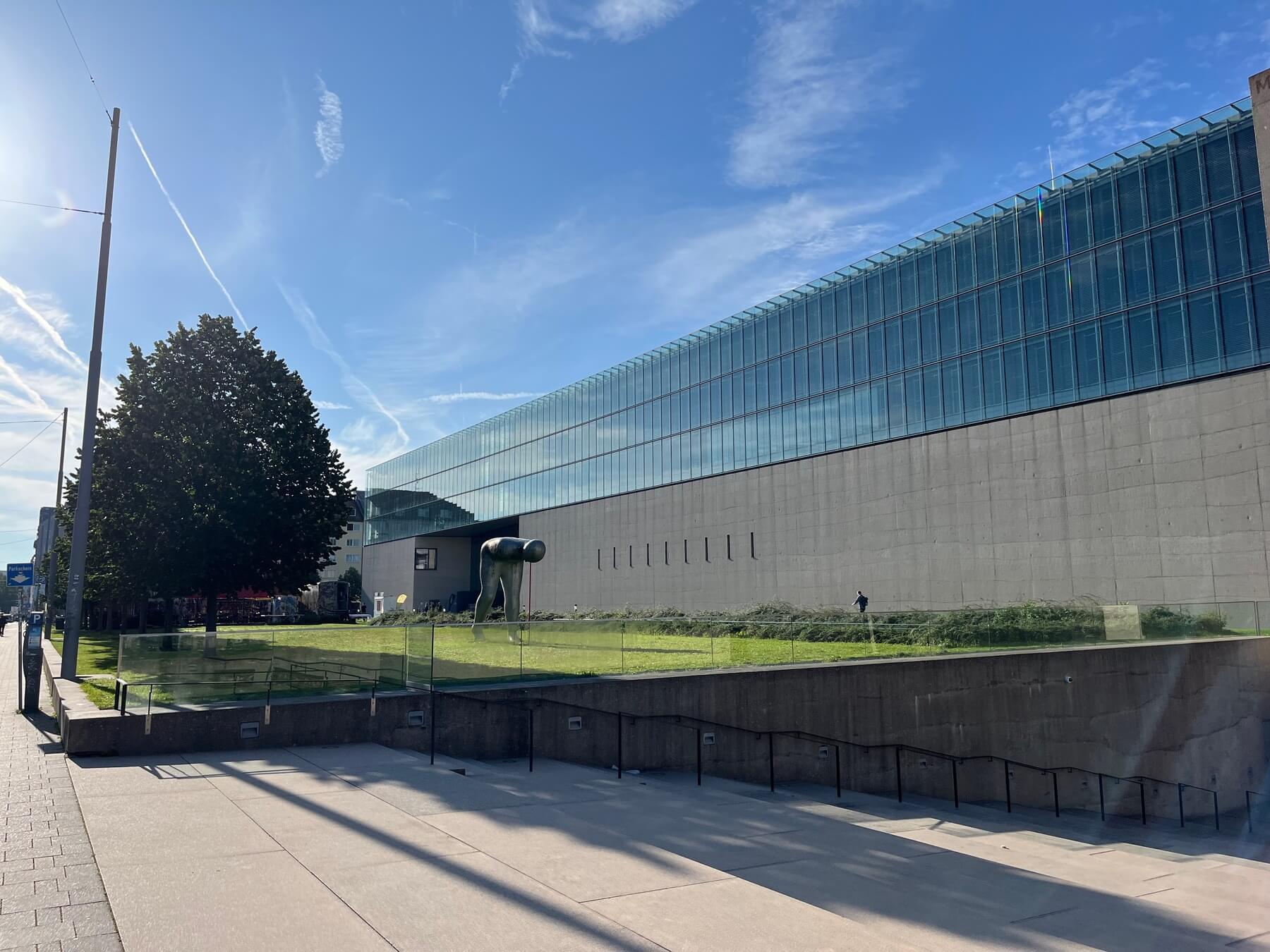
On 8 September during the beginning of IAA, Konzepthaus held their Mobility Design Conference at the Hochschule für Fernsehen und Film München (HFF München). HFF is in the Kunstareal München area where there are a lot of museums and universities, a very good context for a design conference. DVN Senior Advisor Andreas Friedrich was there.


There was also a small exhibition with a few partner companies exhibiting interesting stuff relevant to design and especially CMF.

One of the companies was Rheolight. They have a unique dispersion for adding to normal paint, which enhances the visibility of any object painted with that paint. It’s not a luminescent material (glow in dark), nor is it conventional reflective material. It´s much more subtle, based on crystal glass pigments.


Autodesk was there together with Hololight, and showed a MR experience using Apple Vision Pro goggles with Alias + VRED driving the headset via cable (enabled by Hololight).
Any change in the Alias model would be visible directly in VRED and the goggles and any change in VRED would of course also be visible directly. Very impressive setup and the quality of the MR experience was absolutely the best I have ever seen. On a level where you could seriously evaluate graphics in screens or maybe even ambient light in cars…?

The conference part had 12 different sessions that partly overlapped each other, which gave one a hard time to choose, since there was so many good topics.
The future of UX Design in the Car Design World.
Moderator: Christian Eckert. Panelists: Derek Jenkins (Lucid), Florian Teufel (Deerstreet) Philipp Römers (Polestar) and Ruben Rodriguez Bosch (Cupra & Seat)

Key takeaways were:
• Common Misconceptions About UX
UX is not just UI/UX design: It encompasses the entire user experience, including hardware, software, and services. True integration requires a shared vision, strong communication, and collaboration across all levels and departments. UX is not just digital: It includes physical interactions, service experiences, and emotional connections.
• Achieving Cohesive Brand Experience
Design-driven culture: Brands like Polestar and Lucid prioritize design at the executive level, ensuring UX gets attention and resources.
Collaboration is key: Short communication paths and a culture of collaboration help maintain consistency across all touchpoints.
Efficiency vs. Uniqueness: Sharing platforms and software (e.g., media players) across brands can increase efficiency, allowing more resources to be devoted to unique brand experiences.
• Future of UX in Automotive
AI and voice interfaces: These could reduce reliance on touchscreens, enabling new interior designs and more natural interactions.
Beyond the basics: The next five years will focus on creating unique, branded experiences that go beyond basic functionality.
Sustainability: Material choices and sustainability are increasingly important, especially for premium brands, and must be integrated into the design process from the start.
Emotional connection: Even as cars become more digital, emotional and branded experiences will remain crucial for customer loyalty.
• Customer Loyalty & Brand Identity
Loyalty is evolving: Younger generations may be less brand-loyal, focusing more on product quality and experience.
Emotional purchase: Cars are still emotional purchases, and brands that create strong identities and communities will retain loyal customers.
Shared mobility: UX must adapt to new usage models (e.g., car sharing), where quick, intuitive interactions are essential.
Final Thoughts
UX is about relationships: Between people, technology, and departments.
Identity and emotion: The future of automotive UX lies in creating unique, emotionally resonant experiences that reflect brand values and connect with users.
A Digital CMF Process – An Open Discussion between Designers, Modellers and Visualisation Artists.
Moderator: Laura Burstein. Panelists: Julie Schwieder (Toyota Europe), Mark Gutjahr (BASF Coatings), Pierre Maheut (Adobe Substance 3D) and Quirin Friedl (NIO)

Key takeaways:
• First reflection: Progress and Pain Points?
Julie: CMF is evolving from a siloed, physical process to a more integrated, digital-first approach. Speed and flexibility are now critical, especially post-COVID, as development cycles shorten.
Mark: BASF has been digitizing color and material processes for decades, but only recently have tools matured enough to be trusted by designers. The goal is to create digital twins that accurately represent physical materials, reducing the need for endless physical samples.
Pierre: Adobe’s tools (like Substance 3D) are bridging the gap between digital and physical, enabling designers to visualize and iterate materials in real-time, even in VR/AR environments.
Quirin: Digital tools are essential for speed and flexibility, but the industry still relies on physical validation. The challenge is to integrate digital workflows without losing the tactile, human-centered essence of CMF.
• Collaboration and Interdisciplinary Work
Cross-industry learning: Insights from video games, fashion, and industrial design are enriching CMF processes. For example, Adobe’s collaboration with Gran Turismo’s designer showcased how digital tools can close the loop between virtual and real-world design.Team integration: CMF designers must work closely with interior/exterior designers, engineers, and suppliers from the start. Trust and communication are critical, especially as teams become more global and diverse.Supplier collaboration: Suppliers like BASF are developing digital tools to help designers visualize and validate materials early, but physical samples remain essential for final approval.
• Future of CMF Design
Hybrid workflows: The future lies in hybrid processes, combining digital efficiency with physical validation.AI and automation: AI can help generate and iterate material options, but human judgment and creativity will remain central.Sustainability and new materials: Digital tools can support the development of sustainable materials by simulating performance and aesthetics before physical production.Marketing alignment: There’s a disconnect between in-house CMF development and marketing materials (e.g., configurators). Closer collaboration between design and marketing teams is needed to ensure consistency and quality in customer-facing visuals.
Conclusion
Digitalization is revolutionizing CMF design, offering unprecedented speed, flexibility, and collaboration opportunities. However, the human touch, material expertise, and physical validation remain irreplaceable. The future of CMF lies in hybrid workflows, where digital tools enhance—not replace—traditional craftsmanship, and where communication, trust, and interdisciplinary teamwork drive innovation. The core in CMF will still be the knowledge of how material is produced.
A new role for CMF within the design organization
Moderator: Laura Burstein. Panelists: Bozhena Lalova (Avatr), Laetitia Lopez (Freelance CMF) and Nisha Pillai (Audi)

Key takeaways:
The Evolving Role of CMF (Color, Material, Finish) in Automotive Design
CMF as a Strategic Discipline: CMF designers are increasingly integral to the automotive design process, moving from a late-stage “cover-up” role to being involved from the very beginning—shaping brand identity, design vision, and customer experience.
Collaboration & Integration: Successful CMF teams collaborate closely with marketing, interior/exterior design, and engineering. This integration ensures a unified vision and avoids disconnects between design and marketing goals.
Cultural & Market Sensitivity: CMF must adapt to regional tastes and cultural differences, especially in global markets like China, Europe, and the US. Understanding local values and lifestyles is crucial for resonating with customers.
Innovation & Technology: AI and digital tools are changing CMF workflows, but the tactile, emotional, and human-centered aspects remain irreplaceable. CMF designers must adapt to new tools while preserving the essence of materiality and craftsmanship.
Future Outlook:
CMF’s role will continue to grow, especially with the rise of autonomous vehicles and new mobility concepts. The discipline may evolve into a standalone strategic function, depending on the brand and organizational structure.
A different UX Understanding in different Markets
Moderator: Christopher Butt. Panelists: Guan Yang (Diconium), Ivo van Hulten (Porsche), Michal Matuska (Kiska) and Sidney Levy (Amazon Smart Vehicles)

Key takeaways:
The End of the “World Car” ConceptThe idea of a single, globally uniform car (or UX) is outdated. Even in the past, cars were adapted for local markets (e.g., longer wheelbases in China).Digital UX is even more regionally diverse due to different digital ecosystems, regulations, and user behaviors. Global UX may exist, but only as a highly flexible, modular system that adapts to local needs and regulations.
China vs. Europe/US: Divergent Priorities
China: Focuses on digital integration, connectivity, and transportation efficiency. Driving pleasure is less emphasized; cars are seen as practical tools.Europe/US: Driving experience, brand heritage, and mechanical excellence remain central. There’s resistance to fully digital cockpits and a preference for physical buttons.Regulation & Culture: China’s rapid digital adoption and different legal frameworks (e.g., data privacy, autonomous driving) create unique UX challenges and opportunities.
Legacy vs. Digital-First Brands
Legacy automakers (e.g., Porsche, Audi) struggle to balance heritage with digital innovation. Their strength is brand loyalty and mechanical excellence, but they risk falling behind in software and UX.Digital-first brands (e.g., Tesla, Chinese EV startups) prioritize software, OTA updates, and user-centric digital experiences. They are less burdened by legacy systems and can iterate faster.Hybrid approach: Some brands (e.g., Porsche) are creating sub-brands or models that cater to different user needs—analog purists vs. digital natives.
The Role of UX in Automotive Design
UX is becoming as important as exterior/interior design. It’s no longer just about aesthetics but about the entire user journey—before, during, and after the drive.
Personalization & Flexibility: Future UX must adapt to different users, generations, and contexts (e.g., driving vs. being driven, work vs. leisure).
Accessibility & Inclusivity: Current UX often neglects older users, people with disabilities, and non-drivers. Future systems must be more inclusive.
Autonomous Driving & the Shift from Driver to Passenger
Dual-mode UX: Cars will need to switch between “driver mode” (focused on control, safety, and performance) and “passenger mode” (entertainment, productivity, relaxation).New Opportunities: Autonomous driving opens possibilities for in-car experiences (e.g., content consumption, social interaction, wellness) and new business models (e.g., subscriptions, services).
Generational Differences
Older generations value simplicity, familiarity, and driving pleasure.Younger generations expect digital integration, personalization, and sustainability. They are more open to new mobility models (e.g., sharing, subscriptions).Flexible UX: Cars must adapt to different age groups, possibly through customizable interfaces or AI-driven personalization.
The Future: AI, Data, and New Business Models
AI & voice interfaces will reduce reliance on screens and enable more natural, context-aware interactions.
Data-Driven UX: Real-time user data will allow for dynamic, personalized experiences.
New revenue streams: software updates, subscriptions, and in-car services will become major profit drivers, shifting the focus from one-time sales to long-term customer relationships.
Europe’s Chance to Catch Up
European automakers are investing in software-defined vehicles and advanced SOCs (System on Chip).Advantage: New entrants can leapfrog legacy issues and build modern, flexible platforms from the ground up. Risk: If they don’t act fast, they may lose ground to Chinese and American tech-driven competitors.
Key Takeaways for the Industry
Embrace flexibility: UX must be modular, adaptable, and culturally sensitive.
Invest in software and UX talent: Empower UX designers and integrate them early in the process.
Balance heritage and innovation: Legacy brands must preserve their DNA while embracing digital transformation.
Focus on the user journey: UX is not just about the car—it’s about the entire ecosystem, from pre-purchase to post-drive services.
Prepare for autonomy: Design for both drivers and passengers, and explore new in-car experiences and business models.


Final Thought: The future of automotive UX is not about creating a single global standard, but about building systems that are intelligent, adaptable, and deeply human-centered—whether in Shanghai, Paris, Berlin, or Detroit.


