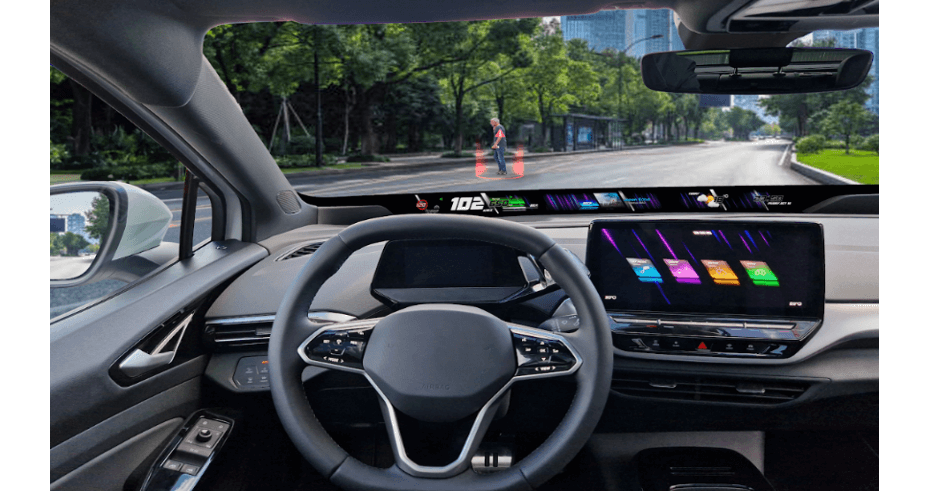
In July 2025, Valeo secured a strategic contract to equip a leading Chinese automaker’s models with a new panoramic head-up display. The schedule has already been set; the first equipped vehicles will go into production in mid-2026.
The P-HUD is already a market trend, as demonstrated by two examples of series production vehicles (Xiaomi and BMW iX3 unveiled at the IAA).
It is a pillar-to-pillar HUD, covering the entire width of the windshield by dint of an optical treatment applied to the lower part of the glass. The principle behind the technology is infinite adjustment, which means that the driver does not have to adjust their eyesight because the screens are located at the bottom of the dashboard and therefore project images to infinity.
This vision allows all front passengers to see all the projected information.
With a modular architecture comprising one to three miniLED TFT screens, This solution can be deployed from an entry-level version with one screen to a top-of-the-range version with three screens, and can therefore be applied to the entire windshield base.. Each screen, with some 300 miniLEDs, offers resolution and rendering quality close to that of OLED, while ensuring controlled energy consumption thanks to local backlight management. The whole system is controlled from the vehicle’s center console, offering a smooth and consistent user experience.
Behind this technical proposal lies particularly demanding engineering work. Integration in the lower part of the windshield, previously concealed by black screen printing, requires careful management of heat flows to prevent any risk of condensation. Image distortion correction, an area in which Valeo guarantees perfect readability in all circumstances. Another distinguishing feature is its compatibility with polarized sunglasses, a unique advantage that makes the solution accessible to all drivers.
The Valeo solution is designed for gradual upscaling. Its modularity allows it to be fitted in both sedans and SUVs, and to be adapted to the specific needs of heavy transport, buses, and trucks. In the latter case, the angle of the windshield, which is often very vertical, still represents a technical limitation from now.
Beyond technological performance, Valeo’s strategy is to give car manufacturers the freedom to define priority use cases, the type of messages and their location on the display, while ensuring strict compliance with regulatory constraints.
In this sense, the panoramic HUD becomes an open, modular platform ready to meet the diverse needs of the global market.


