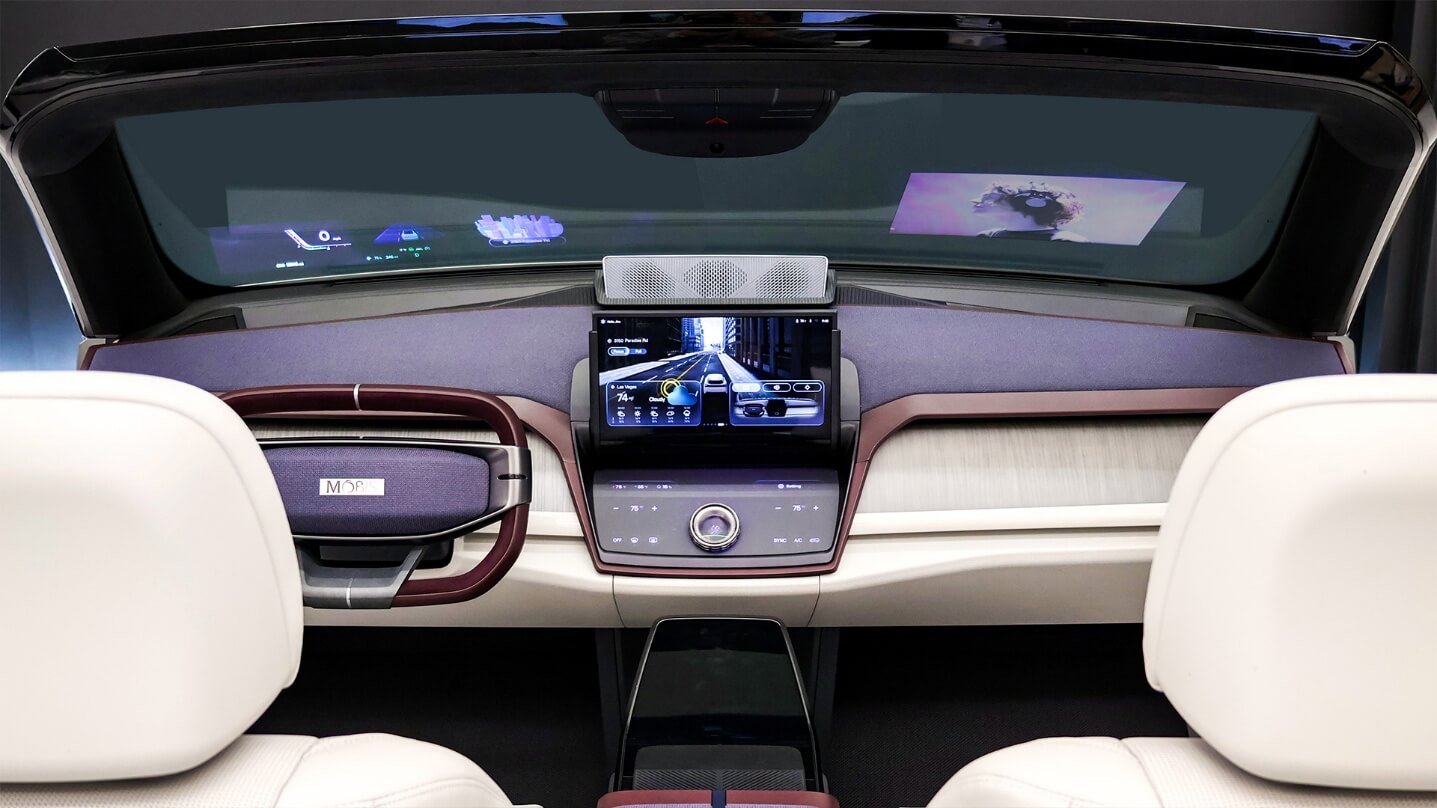
The most interesting part of Hyundai Mobis’ holographic windshield display story is a industrial seriousness. Mobis has formalized QuadAlliance with Zeiss, Tesa, and Saint-Gobain Sekurit to build what they describe as a full, production-ready supply chain for holographic windshield displays (HWD), with mass production targeted by 2029.
They’re working to turn the windshield into a large, transparent information plane that can separate driver and passenger content zones; a direct response to the current ‘Christmas tree’ trend wherein screens are multiplying faster than trim codes. Mobis’ messaging is explicit: today’s information is often outside the driver’s direct sightline, and the industry has answered with more displays; HWD is pitched as a way to consolidate and relocate critical content back into a more natural field of view.
What makes QuadAlliance credible is the way it maps cleanly onto the real pain points of taking optical magic to SOP. Zeiss brings the holographic/optical competence to control image quality, ghosting, contrast, and stray light; Sekurit has the glazing expertise and facilities to work on durability, lamination, repair ecosystem, and compliance, and TESA covers bonding and film integration for yield and long-term stability. The goal isn’t ‘HUD, but bigger’, but a system wherein optics, films, adhesives, and glass converge.
HWD is a UX governance move. Once you can partition content by seating position on the primary glass plane, you can reduce the temptation to add yet another tablet. But you also inherit new constraints: homologation, comfort, replacement costs, serviceability, and the fine line between being informative and being distracting or annoying. The 2029 horizon signals a program cadence measured more in validation gates and supply-chain readiness, and less in demo cycles.


