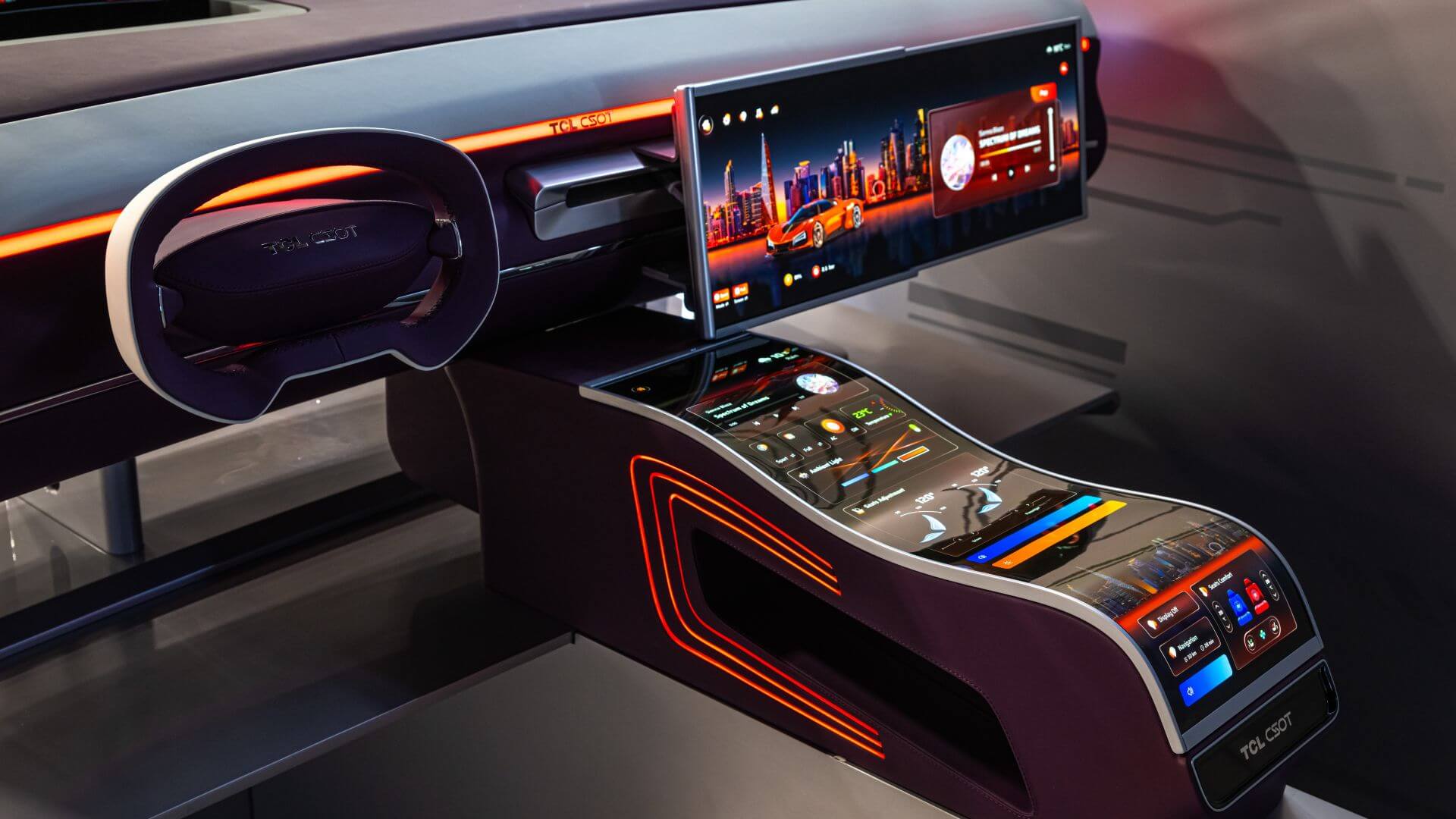
TCL CSOT has realeased what they’re calling the world’s first sliding and multi-curved IJP OLED automotive display. The set consists of a 28-inch inkjet-printed RGB OLED display which can physically slide from about 16″ to 28″ wide, targeting the center console / shared front-row display, and a true RGB pixel layout (not WRGB). The maker claims a luminous area ratio around 50 to 60 per cent, with automotive-grade brightness and color, as well as higher contrast, deeper blacks, a thinner module, and more flexible form.
The mechanical system is built to slide & curve. It expands from ~16″ to ~28″, and is multi-curved with bending radius < 4 mm. It is rated for over 100,000 sliding / roll operations, using a reinforced sliding mechanism.
TCL CSOT talks about it as part of their APEX philosophy (Amazing experience / Protective eye health / Eco-friendly / X-unlimited imagination).
From an interior / UX expert perspective, this setup straddles the big-screen-versus-clean-IP tension. Retracted to the 16″ setting, it’s more driver-centric and less distracting, giving a visually lighter cockpit Extended to 28″, it presents as a full panoramic display shared with passenger for more content – a larger screen with more playful use.
The UI can finally change its spatial grammar with the hardware: not just switching themes, but switching screen geometry tied to drive / assist / lounge / cinema modes.
For integration, the thin, flexible, multi-curved OLED can actually follow the IP surfacing instead of forcing the dashboard to be flat and rectangular. That gives designers freedom to blend screen edges into trim, light blades and physical controls, making the whole fascia feel like a digital material, not a bolted-on TV.
Whether OEMs will accept the mechanical complexity and durability risk is another question. But it seems strong as a concept direction for premium cockpits, especially Chinese-market top models which pretty much have to have ‘wow’ screens.


