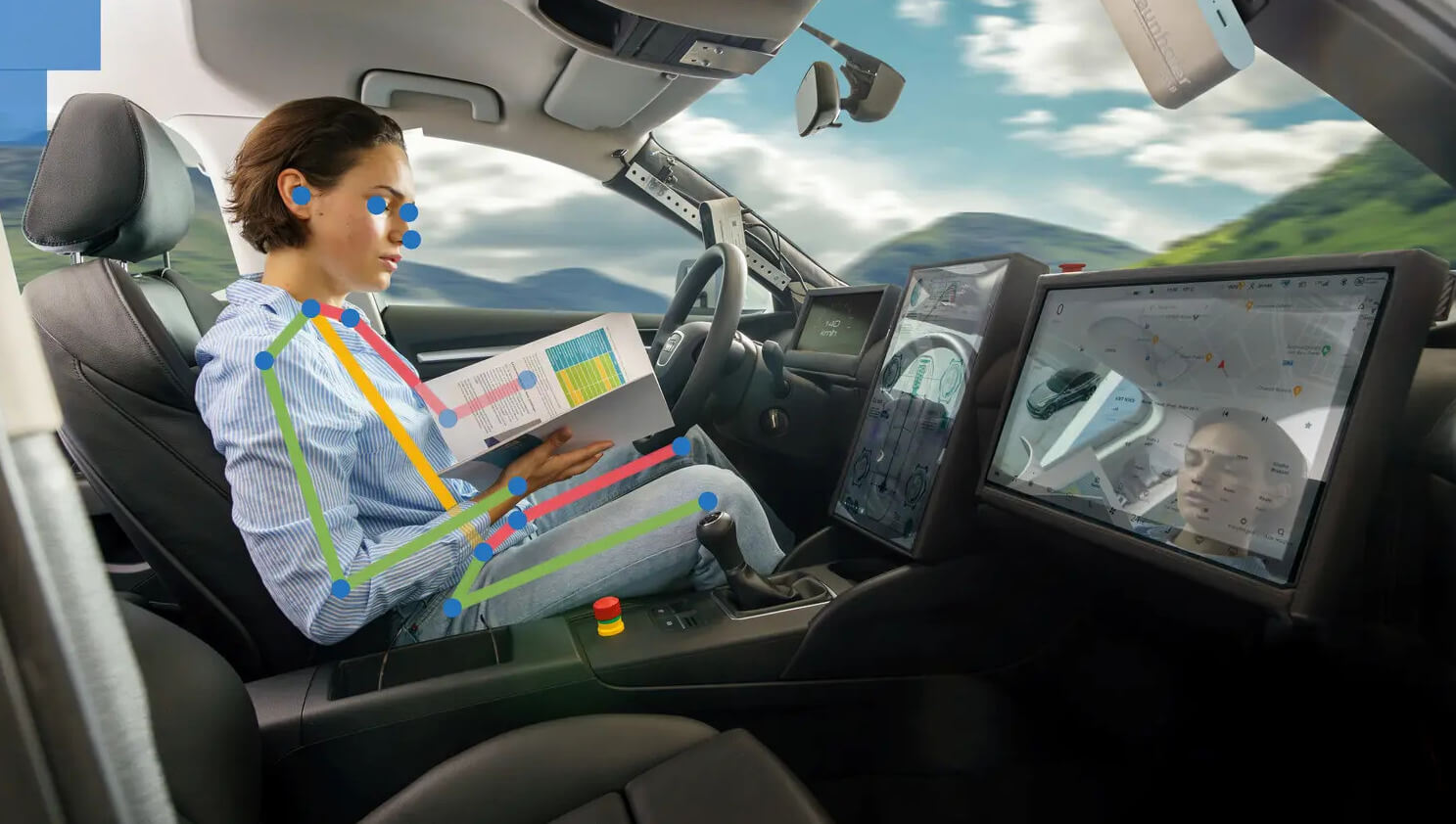
Fraunhofer IOSB’s Aktimeter is designed to analyze human movements in the vehicle, as they happen. The AktiMeter’s algorithms detect activities such as reading with high accuracy in real time and enable local evaluation of the collected data.
What is the seating position, what movements and gestures are made, what activities and intentions do passengers have in vehicles? The Aktimeter from the Fraunhofer Institute of Optronics, System Technologies and Image Exploitation is designed to record and analyze this automatically and with the help of AI, of course. The system complements eye tracking systems to capture the entire body of the occupants: Where are the arms and hands, in which direction does the driver’s head turn and which objects inside the vehicle are being used.
The Aktimeter combines computer vision methods based on AI with a 3D model of the vehicle. With the AI trained on body postures and objects, further conclusions can be drawn using machine learning methods. Complex interior situations are to be captured by supplementary vision-language models. The resulting digital twin makes it possible to generate statistics on actual usage behavior in the vehicle. Conclusions are drawn directly in the vehicle from this data source, meaning that GDPR-relevant image data does not need to be stored.
The Aktimeter is set to become a prototype development tool for car manufacturers and their research departments. Among other things, the analyses can support the training of new AI functions. Market research institutes could collect and automatically evaluate data on the use of new vehicle functions. The field of automated driving in particular could benefit by evaluating user behavior during automated driving in order to optimally adapt the interior. The system is already being tested in prototype development, with a market launch planned from mid-2026.


