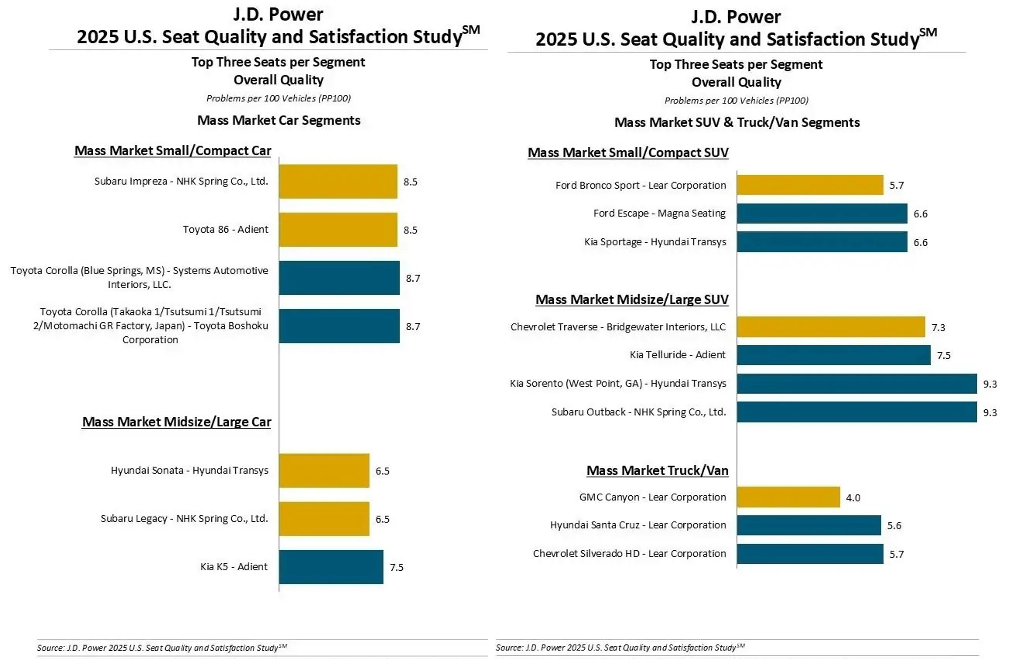
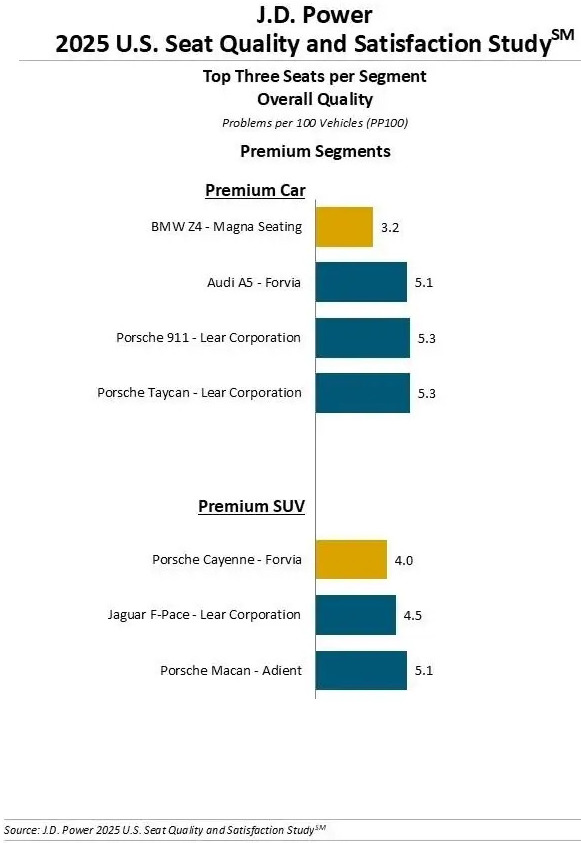
Seat quality worsened by 0.3 problems per 100 vehicles (PP100) from 2024, marking the first increase in the category’s share of all vehicle issues in nine years, according to the J.D. Power 2025 U.S. Seat Quality and Satisfaction Study, in a recent release.
The most frequently cited seat problems are seat range adjustment, headrest comfort and seat material scuff/soil, each increasing 0.1 PP100 from a year ago. Design-related issues such as these account for eight of the top 10 seat complaints.
“Seat and powertrain are the two categories that most influence vehicle appeal and satisfaction,” said Lisa Boor, senior manager of auto benchmarking and mobility development at J.D. Power. “When vehicle owners experience issues with their seats, these problems have the second-highest effect on their APEAL rating among all measured vehicle areas. Increasing concerns regarding seat controls, particularly those that are complex or difficult to operate, such as memory and massage functions, are being observed in both premium and mass market segments.”
Seat quality is measured by the number of problems and level of satisfaction experienced per 100 vehicles during the first 90 days of ownership, with a lower score reflecting higher quality.
The 2025 U.S. Seat Quality and Satisfaction Study is based on responses from 92,694 vehicle purchasers and lessees of new 2025 model-year vehicles who were surveyed after 90 days of ownership. The study was fielded from June 2024 through May 2025.
For more information, see the U.S. Seat Quality Satisfaction Study.


