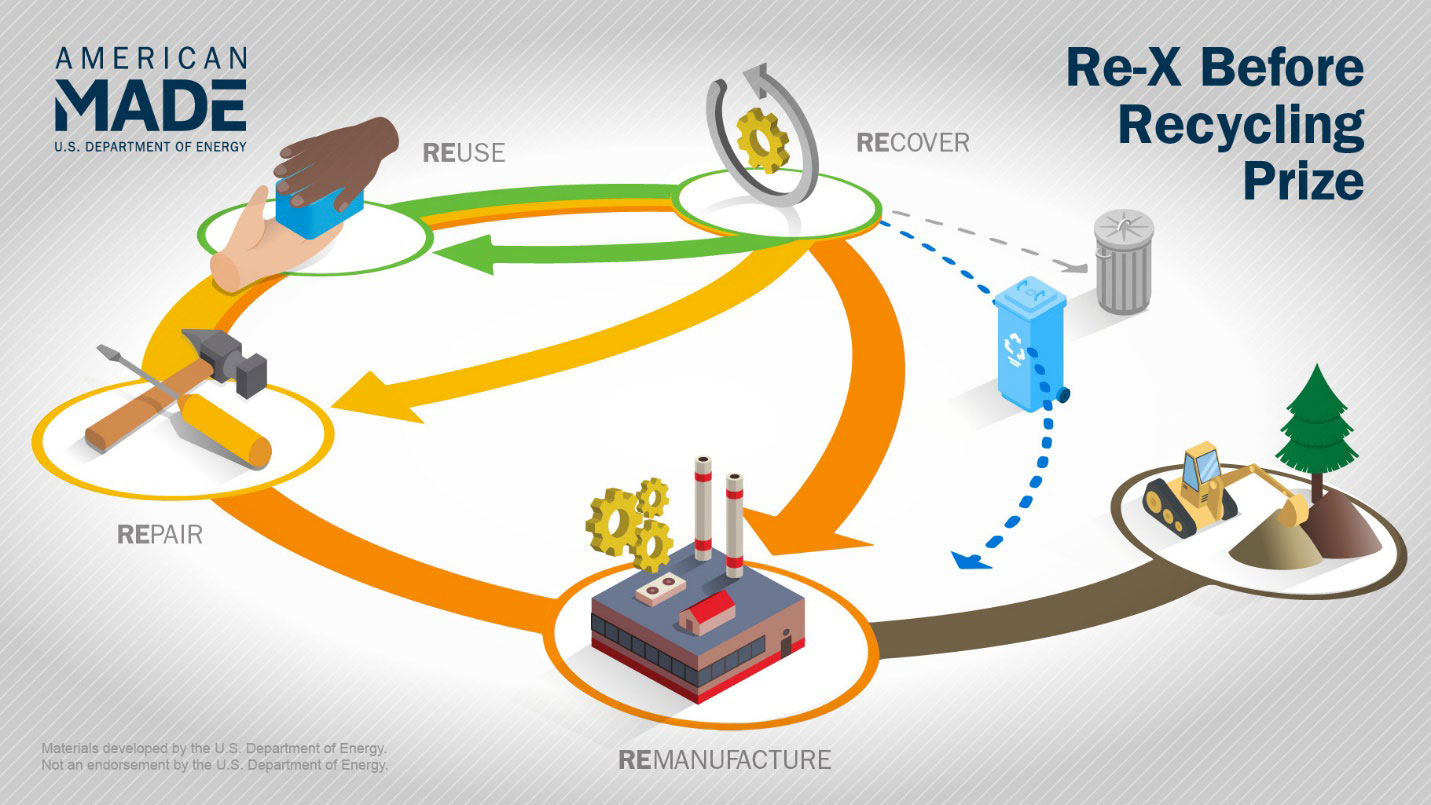
Llink Technologies, a tier-1 supplier; manufacturer of custom automotive interior and exterior products, have been named a phase-1 winner of the Re-X Before Recycling Prize by the DOE (U.S. Department of Energy) for their innovative automotive headlamp remanufacturing program. The program remanufactures damaged headlamps to OEM specifications, easing supply chain issues, returning valuable chips to the market, cutting 95 per cent of waste per headlamp, and extending vehicle lifespans.
The first-of-its kind program currently remanufactures headlamp assemblies for more than a dozen GM vehicles. Out of the 20 phase-1 winners, Llink are the only automotive supplier and the only Michigan-based winner.
The recognition highlights the program’s ability to deliver significant environmental and economic benefits by extending product lifespans, fostering circularity, and advancing the United States’ transition to a circular economy.
This three-phase competition launched by the DOE’s Advanced Materials and Manufacturing Technologies Office aims at promoting innovative approaches to extending the useful life of products and components through reusing, repairing, refurbishing, remanufacturing, or repurposing—collectively known as ‘Re-X’.
Llink’s headlamp remanufacturing program exemplifies these principles by providing automakers with a reliable supply of collision replacement parts, addressing capacity and supply chain challenges, and returning valuable chips to the market. The US-patented process, with international patents pending, remanufactures exterior vehicle lighting assemblies to OEM specifications, achieving an impressive 95-per-cent waste reduction per headlamp while significantly extending vehicle lifespans. When integrated into an expanded re-X supply chain, this innovative program has the potential to deliver transformative environmental and economic benefits.
Llink Technologies was awarded USD $50,000 in cash and $5,000 worth of consultation from National Renewable Energy Laboratory to support the refinement of their program during Phase 2 of the competition. CEO Jeff Goulet says, “As the world’s first remanufacturer of automotive headlamps, we are honoured to receive recognition for the environmental and economic benefits of this program. Our team put a significant amount of work into bringing this program to life and we’re proud of the role we play in advancing sustainability practices within the automotive industry”.
DVN’s Paul-Henri Matha comments: I talked with CEO Jeff Goulet, CEO and General Manager Lisa Spencer to have a better understanding of what they are proposing. Circular economy is one of the major issue we will face in the next decade, and it is really interesting to see this sort of initiative and try to understand how it works. All lighting engineers know how complex it can be—lamp diversity management including subcomponents, end-of-line calibration, ECU software flashing, and more. Here’s an extract from a Llink paper:


“Following a vehicle collision, many internal components of automotive lighting assemblies remain in near-new condition and are suitable for reuse. Premature disposal of damaged lighting assemblies cuts short their useful lifespan, leading to the underutilization of valuable resources embedded within the assemblies and exacerbating the demand for new materials.
“Moreover, the industry standard practice of disposing of damaged assemblies in landfills has significant environmental consequences. The decomposition of these materials releases toxic substances, potent greenhouse gases, and microplastics, all of which can disrupt ecosystems and contribute to long-term environmental damage.
“To ensure the sustainability of the automotive lighting industry must adopt innovative strategies. Llink Technologies has developed a (…) process for remanufacturing automotive lighting assemblies. Through partnerships with multiple tier-1s and OEMs, Llink has successfully established the industry’s first circular supply chain.
“OEMs utilize core collection programs to send cores to Llink, where they are sorted, and packaging is retained for later reuse. Core details, including the model, condition, and origin source, are recorded in a database. Each core undergoes model-specific functionality testing, with results assigned to the respective core using Industry 4.0 strategies. On average, up to 83 per cent of incoming cores are deemed eligible for remanufacturing.
“Ineligible cores are recycled, while eligible cores undergo a component extraction process that recovers up to 95 per cent of reusable components. These components are then assembled into new OEM housings and sealed beneath new OEM lenses, which are provided by tier-1s. Each remanufactured headlamp is rigorously tested to meet regulatory and OEM standards before being packaged in the original core return packaging.
“Llink works closely with OEMs to develop comprehensive quality and testing plans. Testing is conducted in compliance with regulatory and OEM specifications, including vibration, dust, and humidity requirements. Llink’s internal photometry testing capabilities, along with partnerships with external laboratories, provide flexibility to accommodate evolving regulatory standards and emerging OEM technologies.
“Llink Technologies exterior vehicle lighting remanufacturing patented process scans and verifies the part number and level of each core return, including tracking acceptance and responsibility of the company(dealership) returning the part to ensure credits for core returns are accurate. Llink tests each core and content to determine harvestability. Test results are communicated via scannable barcode to the harvest cell, where the lens is robotically separated from the housing, clearing the way to harvest the internal components deemed mechanically and visibly acceptable for reuse. These valuable components are then assembled in a new housing and sealed with a new lens, resulting in a lamp that looks brand new and meets all federal and OEM requirements.
“Llink Technologies collaborates in advance with the OEM engineering team to review the proposed lamps, conduct harvest trials and determine the feasibility of each variation through determination of harvestability. Once determined feasible, Llink and the OEM Engineering group review the change history and determine the core identifications of those parts which would be considered useable for remanufacturing. In cases where the driver module is required to be updated, the production level tier-1 supplier may provide re-flashing or replacement.
“Llink is currently remanufacturing 32 variations for GM, U.S.A, and in launch on another 16. We are also nearing an agreement with another OEM in the U.S on an initial 48 variations of Headlamp, and in initial collaboration with several other OEM’s.
“The OEMs provide direct source of the tier-1 production supplier components that may need replacement, such as lens and housing. This allows the negotiation leverage of the OEM and the exact same components supplier of production level parts. This allows the remanufactured lamp to be the same content as production.
“Llink Technologies is located in Brown City, Michigan, U.S.A. and is currently engaging potential partners in Europe and other countries.
“The cost-effective remanufacturing strategy developed by Llink enables all model platforms and technologies to be processed using the same equipment, eliminating the need for significant investments in platform-specific capital. Additionally, material costs are substantially lower compared to new lighting assemblies. These cost savings allow OEMs to offer replacement lighting assemblies at prices highly competitive with aftermarket alternatives, while still maintaining profit margins.
“Llink supports the development of the business case for each model by reviewing key factors, including core volume availability, the value and harvestability of components, and market demand. Llink also collaborates with OEM lighting designers and engineers to provide valuable insights into future design considerations, helping to optimize the harvestability of components for remanufacturing.

“Based on Llink’s historical data, for every 100,000 remanufactured headlamps, up to an estimated 440 tons of cores and 76,000 cubic feet of packaging are diverted from landfills. Llink reports sustainability metrics through EcoVadis, Manufacture2030, and DRIVE, and is consulting with National Renewable Energy Laboratory to establish carbon savings metrics. Remanufacturing eliminates the environmental impacts associated with both production and disposal of lighting assemblies. When remanufactured assemblies are reintroduced into the market, a new revenue stream is created from existing resources. Llink offers this innovative solution to help OEMs strengthen sustainability efforts while driving profitability.”
To read more, you need to log in as a DVN Lighting member.
Not a DVN member yet? Contact us now to join the DVN Community!


