France-based microLED developer Aledia have finished construction of their USD $200m microLED production line in Grenoble, and the company now are starting to produce AR microLED microdisplays based on their 3D Nanowire platform.
The full-colour µLED microdisplays are based on native red, green, and blue devices monolithically grown on 8-and 12-inch silicon wafers, and the fab can ramp up to almost 20,000 wafers a month. Aledia say their 3D GaN nanowire material platform is more efficient and brighter than regular 2D LEDs.
In May 2024, Aledia announced breakthrough advances including a 1.5-µm microLED device with 32 per cent EQE (external quantum efficiency). Aledia say this is the world’s most efficient microLED under 2 µm, and that this new device leads to a WPE (wall-plug efficiency) of 320 milliwatts of visible light output per watt of electrical power input.
Aledia was spun off from CEA-Leti to commercialize 3D nanowire LED technology. They’ve raised almost USD $600m to date, with the latest $129m funding round in October 2023. The company have almost 300 patents (granted or in application), and two nanowire LED platforms.
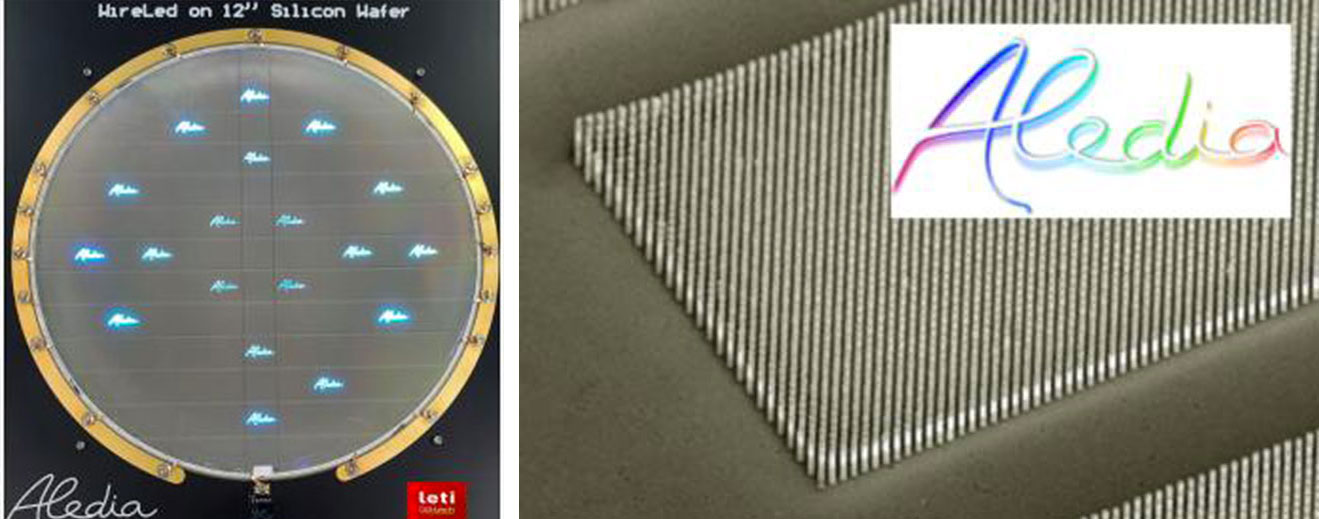
The more mature platform, now being optimized for volume manufacturing, is based on blue-emitting GaN nanowires on 8″ silicon wafers, using colour conversion to obtain green and red. This platform has one of the smallest µLEDs (ø1.2µm) with up to 30 per cent WPE, and has demonstrated the first 12″ µLED wafers fully operational. With this platform, Aledia are releasing their first product, a 160-µm RGB single-chip LED for fine- pitch video walls and luxury TVs.
Their next-generation platform, still in R&D, allows direct emission in RGB—all colours obtained with GaN, no need for conversion—with a controlled emission angle; most of the light can be emitted in a ± 20° cone. This platform targets 6,500-ppi (2µm subpixel) single-chip RGB arrays for AR applications.
Aledia’s epiwafer production uses Veeco’s CVD production equipment.


