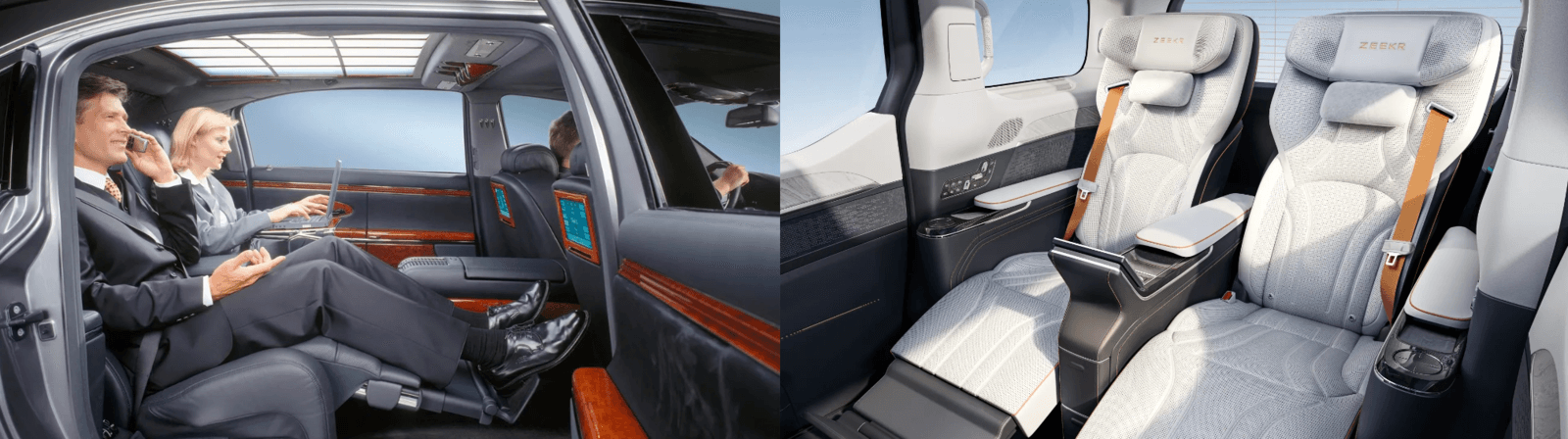
The first application of what we now call zero-gravity seat concept in an automobile was developed in Europe and brought into series production: the rear seat system of the Maybach 57/62 in 2003. Mercedes and their development partner Keiper‑Recaro put a great deal of thought into the occupant restraint function during driving. Their preferred solution involved various types of belt tensioners.

Chinese supplier Yanfeng later coined the catchy term ‘zero‑gravity seat, and have popularized the concept since 2020 through widespread use in high‑volume models. Once these seats become more common in Europe, Euro NCAP will surely take up the topic as well.
But in the meantime, Chinese regulators are gearing up to put some safety constraints on seats like this. This is most interesting, and exemplifies China’s shift from auto safety regulatory follower to leader: after many years of adopting ECE technical prescriptions, sometimes several revisions behind the rules used in Europe, Chinese regulators are no longer waiting for Europe. We’re unaware of any government‑driven approach to zero-gravity seat regulation in Europe or elsewhere so far; for now, the usual ECE requirements apply to zero‑gravity seats.
So, China is working on regulations for automotive wide-angle seats. The public-announcement start date was a couple of weeks ago on 4 February, with an expected release date of 30 September, 2027.
“Wide-angle seat” means one which can adjust the posture of the human body riding on the seat to a large angle riding posture through a multifunctional adjustment mechanism. wide-angle seats include high-comfort (zero-pressure) and regular types.
Influenced by intelligent networking and electrification technologies, high-comfort (zero-pressure) wide-angle seat products are gradually becoming popular in the industry. As of the end of 24 years, nearly 40 models have been launched on the market.
The recommended comfort of some products is that the riding angle is close to 130 degrees, and the human body is already lying down. Existing vehicle instructions generally remind that this type of angle cannot be used in the driving state. But in reality, more than 80 per cent of vehicle users will do so anyhow, which is a large safety risk.
At the same time, as the product is loaded and used, its comfort and quality/reliability issues are constantly being raised by consumers, and product quality urgently needs to be improved. Currently, there is a lack of product definitions for wide-angle seats, a lack of seat detection and assessment indicators for large-angle riding attitudes, and a lack of requirements for the likes of safety reminders. This has led to uneven product quality and huge differences in product definitions on the market. In addition, large-angle seats lack effective detection and verification methods.
Therefore, it is necessary to study and formulate reliability requirements and testing methods for high-comfort (zero-pressure) large-angle seats as soon as possible to better meet the R&D and design needs of enterprises for smart seats under the rapid development of intelligent connected technology, improve product quality and product competitiveness, and ensure the safety of occupants’ lives while promoting the industry.
The document in progress applies to wide-angle seats installed on M-category vehicles. Large-angle seats on other vehicles can be implemented with reference to this document, as well. It sets forth terminology and definitions, common requirements, and test methods for large-angle seats in cars. Included are general requirements, static requirements (adjustment angle requirements, leg rest length, headrest travel, headrest support, seat cushion support, backrest support), driving requirements, and related test methods. This standard also gives the technical requirements for large-angle HPM devices for measuring attitude angles.


