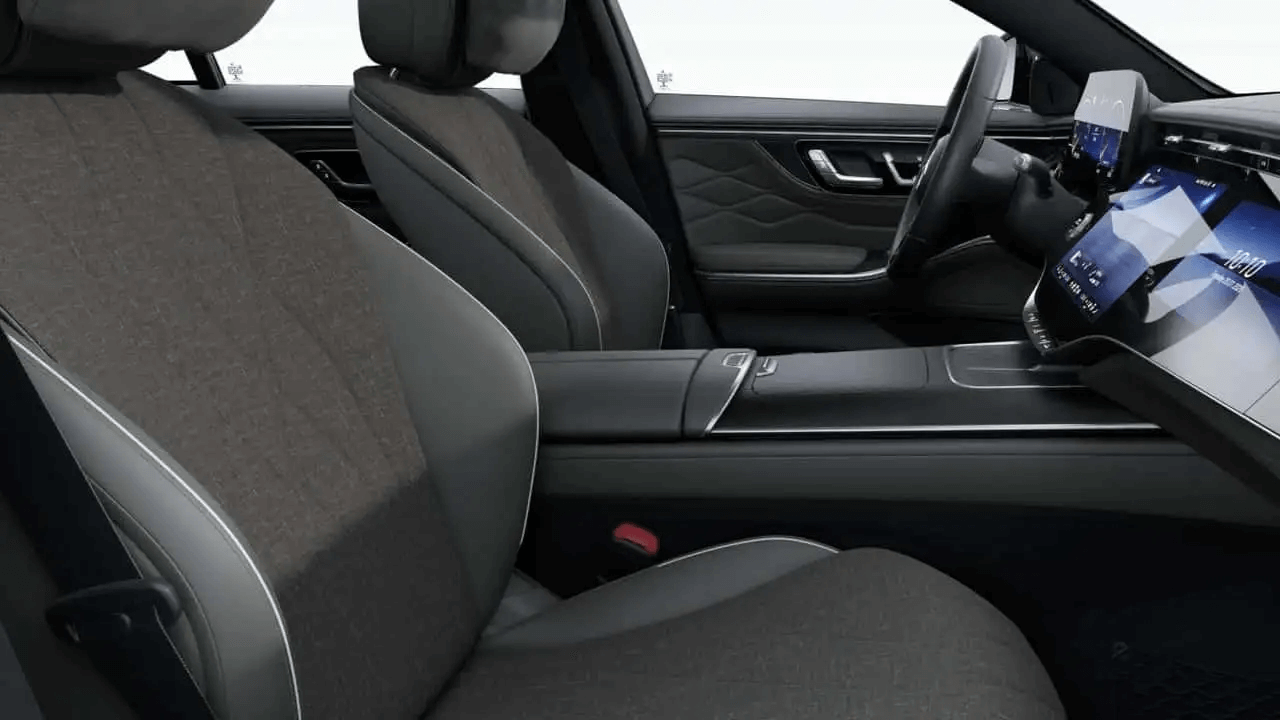
Mercedes has introduced a textile upholstery option on the S-Class. It’s positioned not as a budget downgrade but as an alternative trim choice comfortably in tune within the top-of-the-line context. The availability is reported in Germany on the entry-level S350d configuration, and the material composition called out is particularly relevant for DVN’s interior sustainability coverage: the seat centers combine linen with recycled polyester, paired with Artico leatherette bolsters rather than a fully textile wrap.

Leather remains a no-cost option, while choosing the fabric reportedly requires bundling with a rear-seat electric adjustment package, making the textile practically more expensive.
Mercedes appears to be testing a hypothesis: in the highest segments, ‘leather-free luxury’ can be sold as a premium choice when it is framed around material sophistication and sustainability, rather than cost cutting. With the experiment being done on the top-line model, this is the kind of thing that influences supplier discussions on textile performance…and could easily set a new trend.
This is something of a quietly disruptive interior move: it challenges the longstanding assumption that top-tier luxury must have leather by default. Linen and recycled polyester paired with Artico leatherette doesn’t read as cost cutting, it reads as a controlled experiment in premium sustainability where the material selections are designed to feel intentional and sophisticated.
For the cabin supply chain, that matters because it opens room for higher-value textile engineering: weaves, coatings, stain resistance, durability under abrasion, perceived warmth, and acoustic comfort can all be engineered as luxury attributes. Linen also carries a natural-material crown that many OEMs want, but it comes with performance challenges – wrinkling, wear, staining – which must be addressed through textile development and finishing.

This looks like a strategic alignment with broader market realities: premium customers increasingly ask for luxury without the baggage of animal-based leather, and OEMs want visible sustainability wins that don’t look or feel like ‘eco-sacrifice’. If the S-Class can normalize textile at the top of the line, it creates permission for other high-end models to push sustainable cabin materials further.


