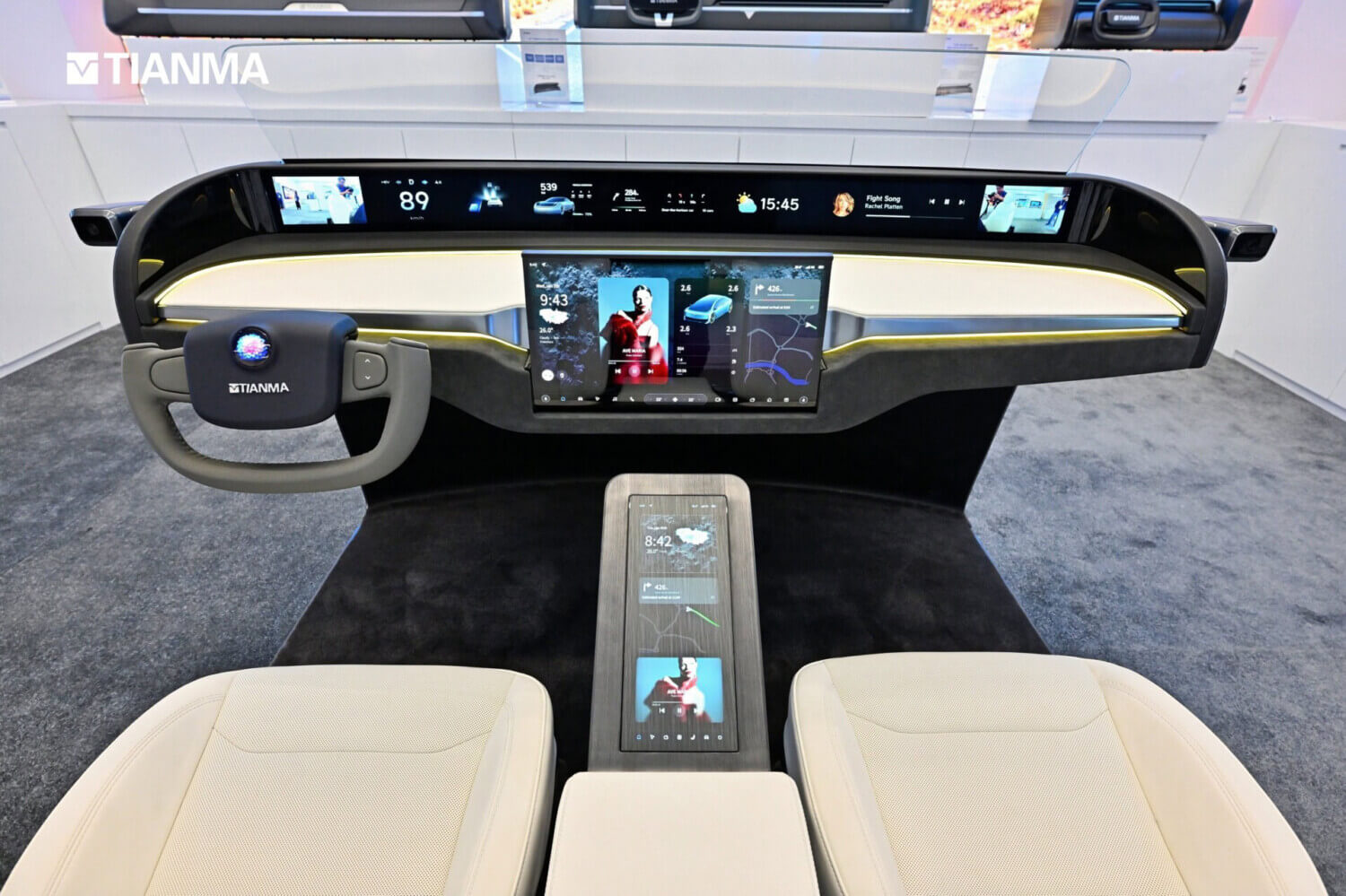
Tianma Microelectronics has introduced a 49.6-inch curved panoramic display designed as a single, continuous cockpit surface rather than multiple stitched screens. Integrated into the company’s smart cockpit concept, the solution targets immersive visuals while meeting automotive safety and interior design constraints.
It’s a 1.25-meter, C-shaped curved display which spans the instrument cluster, central stack, passenger area, and CMS visuals. It features pixel-level local dimming (210,000+ zones) and up to 100,000:1 contrast. It’s made with ultralow-reflectivity glass (AR ~0.2 per cent), so windshield reflections are kept below safety thresholds. It’s designed to visually integrate with A-pillars and interior trim rather than sit as a floating screen, and if offers a one-piece black appearance when on and off alike, supporting premium interior consistency.
It seems to represent a move from interface fragmentation to perceptual continuity by removing visual breaks between driver, center, and passenger displays. The cockpit feels calmer and more spatially coherent, reducing cognitive switching while still supporting rich information layers.
For automakers, this architecture enables clearer information zoning. Driving-critical data remains in the driver’s visual priority, while entertainment, navigation, and ambient content can flow laterally without competing for attention. When paired with CMS and surround-view systems, the wide field of view also supports better situational awareness rather than pure visual spectacle.
From an interior design perspective, the display-as-architecture approach raises perceived quality without adding decorative complexity. The consistent black surface and curved full-width design allow screens to disappear when inactive, aligning with a growing preference in China for integrated, calm tech luxury rather than aggressive screen presence.
For global automakers, Tianma’s solution highlights how China is pushing smart cockpits toward spatial UX, not feature stacking.


