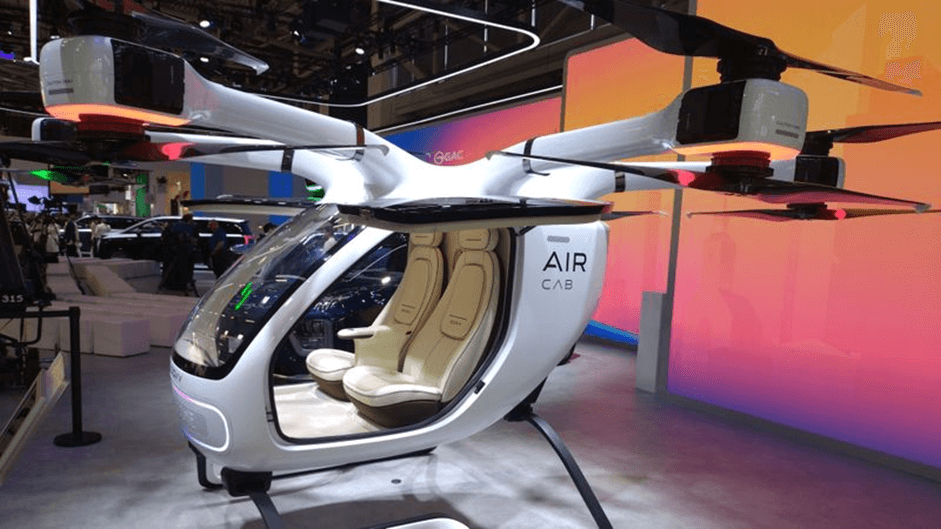
Two eVTOL (electric vertical takeoff and landing) air cabs collided at an air show, injuring one passenger. It’s a black eye for China’s pursuit of the air taxi market said to be potentially worth €190bn.
And the pursuit is serious; China’s aviation regulator CAAC has created a new department specifically for the low-altitude economy, including air cabs. At the beginning of 2025, the State Council once again explicitly reaffirmed its support for the young industry.
Accordingly, there are many local projects all over the country. Six cities, including Hefei, Hangzhou and Shenzhen, are being officially supported by the Civil Aviation Commission in Beijing as pilot cities for air cabs and drones.
Each of these cities is now testing its own scenarios. Hefei has launched pilot projects for eVTOL passenger routes, Hangzhou is building delivery corridors for drones and Shenzhen is enabling its cab company Meituan to make city-wide delivery flights by drone. More than 30 provinces and cities have now included the topic in their development programs.
Legislation is also making rapid progress. At the end of 2024, the Ministry of Transport and CAAC jointly proposed a draft amendment to the legislation for civil aviation in order to legally secure the new low-altitude economy nationwide.
At a local level, regions are enacting accompanying regulations. In Guangzhou, for example, a new regulation came into force on 1 March 2025, which prepares cities for vertiports, infrastructure and the promotion of the new aviation industry.
Hangzhou is the first city to draw up its own rules for licensing, take-off sites and emergency management in low airspace. Shenzhen has passed a special law to promote inner-city and inter-city routes for eVTOL passenger and cargo traffic.
The strong tailwind from government circles is encouraging more and more investors to invest in the production of eVTOL. In the first half of 2025, China counted almost 100 new financing rounds in the low-altitude sector with a total of more than C¥75bn in fresh capital (~€9.5bn).
Xpeng AeroHT, a subsidiary of e-car manufacturer Xpeng, is particularly active. The company presented its first model, a ‘Land Aircraft Carrier’, at an air show in November. It was precisely this model that crashed at the latest air show in Changchun.
In the middle of this year, shortly before the crash, the startup had secured financing rounds totaling $750m. They are building a factory for 10,000 eVTOLs per year in the greater Guangzhou area.
At the end of 2023, EHang was the first company to be awarded a type certificate for an autonomous eVTOL. The company later also received a production license for its EH216. The eVTOL is already being produced in small series, for example for providers of tourist sightseeing flights who have placed large orders.
The low-altitude economy will most likely remain an important future project for China’s authorities and companies despite the unfortunate crash, which insiders expect will spur more regulations for flight safety.


