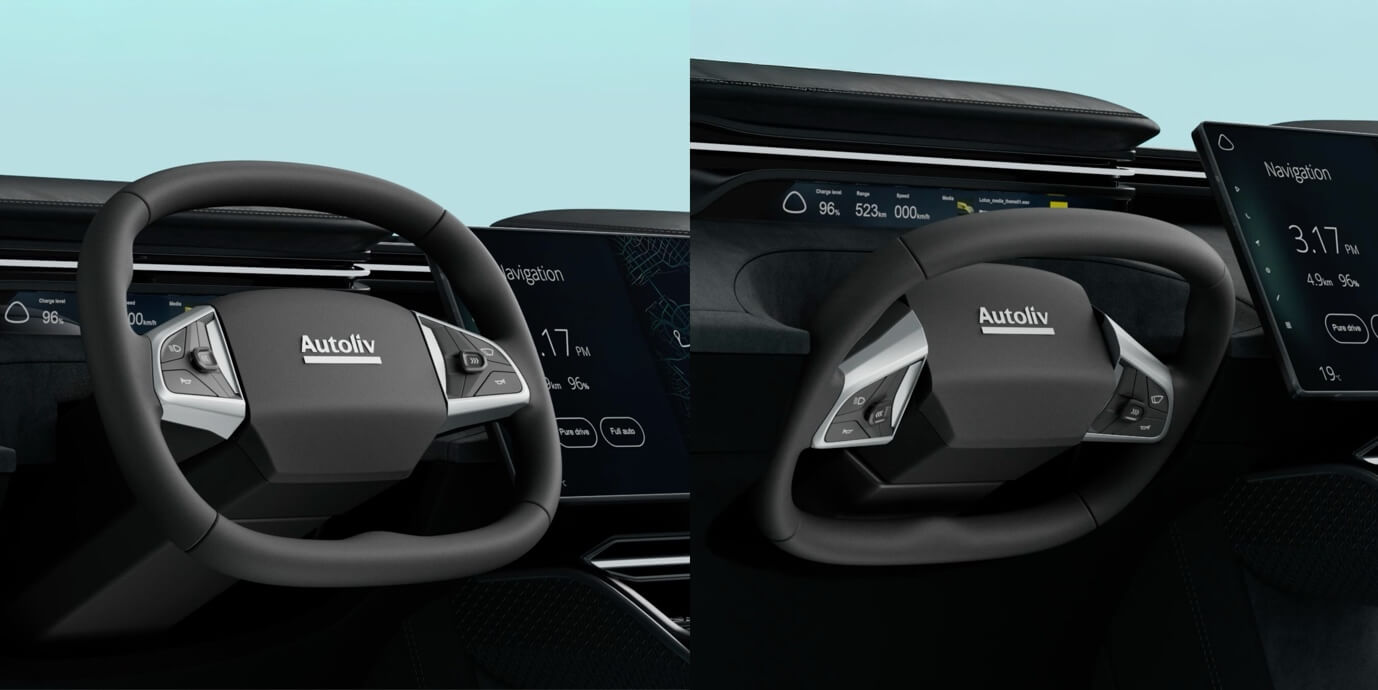
Autoliv and Tensor are collaborating to develop the world’s first foldable steering wheel designed specifically for passenger autonomous vehicles. The new wheel is slated to debut on Tensor’s robocar platform. This innovation signals a shift from traditional fixed-wheel cabins to adaptable controls that match drive mode and interior use cases.
It’s engineered to collapse or retract when not needed, creating more flexible interior space. It’s also designed to maintain safety and ergonomic integrity when in use. It represents a convergence of active safety (Autoliv) and autonomous UX design (Tensor).
From a design standpoint, a foldable steering wheel is a clear indicator that the industry is mentally and spatially stepping into the fully-autonomous driving era. It visually acknowledges that driving is no longer the vehicle’s default state. When the steering wheel disappears, the cabin instantly communicates a role shift from “driver” to “passenger,” reinforcing confidence in autonomous mode through form, not software prompts.
For users, this has a direct impact on cognitive load and perception. A visible steering wheel constantly signals responsibility and readiness to intervene. Folding it away removes that subconscious tension, allowing occupants to disengage from driving tasks and experience the cabin as a calmer, more intuitive space. At the same time, reclaiming the steering-wheel zone unlocks new spatial freedom, giving passengers greater flexibility in posture, legroom, and interaction within the cockpit.
From an OEM and interior design perspective, this innovation enables a move toward transformable cabin architecture. Controls become adaptive rather than dominant, making room for new in-car experiences such as work, entertainment, or social interaction. More importantly, it reframes the cockpit as a responsive environment aligned with autonomy, rather than a legacy driving machine with added screens.
Autoliv and Tensor have announced the joint development program around what they describe as the first foldable steering wheel conceived specifically for autonomous passenger vehicles, with an initial application on Tensor’s robocar concept platform. The underlying idea is that if the vehicle can genuinely operate without continuous human control, the cabin does not need to remain permanently organized around a fixed driving interface.
From an interior and HMI standpoint, the most consequential aspect is the semantic shift created by the wheel’s presence or absence. As long as a conventional steering wheel is visible, the cabin keeps broadcasting “you are the driver,” even when automation is active. That visual cue carries weight: it subtly maintains a sense of responsibility and readiness to intervene.
This also has a measurable effect on perceived workload. A permanent wheel is not neutral furniture; it is an ever-present reminder of control, risk, and obligation. Folding it away can reduce that low-grade cognitive tension and help occupants transition psychologically from “monitoring” to “riding”. It supports a calmer cabin experience because the environment no longer contradicts the system’s operating mode. The challenge is that any retractable control must avoid creating new ambiguity: when the wheel is stowed, the vehicle must be unambiguous about the current mode and the conditions under which manual control could be requested again.
Packaging benefits are equally significant. The steering-wheel zone is prime real estate in the cockpit, both visually and volumetrically. Reclaiming it can translate into improved knee clearance, more flexible seating postures, and new interaction possibilities in the front row, especially in vehicles that are intentionally designed around autonomous use cases rather than retrofitted from a conventional architecture. It is one of the few changes that can materially alter the spatial feel of the front cabin.
For OEM interior teams, the broader implication is a step toward transformable cockpit architecture: controls become deployable tools rather than dominant fixtures. That opens the door to cabins that legitimately support non-driving activities: work, media consumption, conversation, because the environment is no longer anchored around the steering wheel as the visual and functional center of gravity. In that sense, the Autoliv–Tensor program sits at an interesting intersection: Autoliv brings the safety discipline and deployment integrity expectations that a steering interface must meet, while Tensor is clearly pushing the user-experience narrative of an autonomous-first passenger cabin. If the execution matches the intent, ergonomically correct when deployed, mechanically robust, and safety-compliant; this type of foldable control could become one of the physical markers that the industry is moving from driver assistance with autonomy features to autonomy with a manual fallback.


