By Paul-Henri Matha
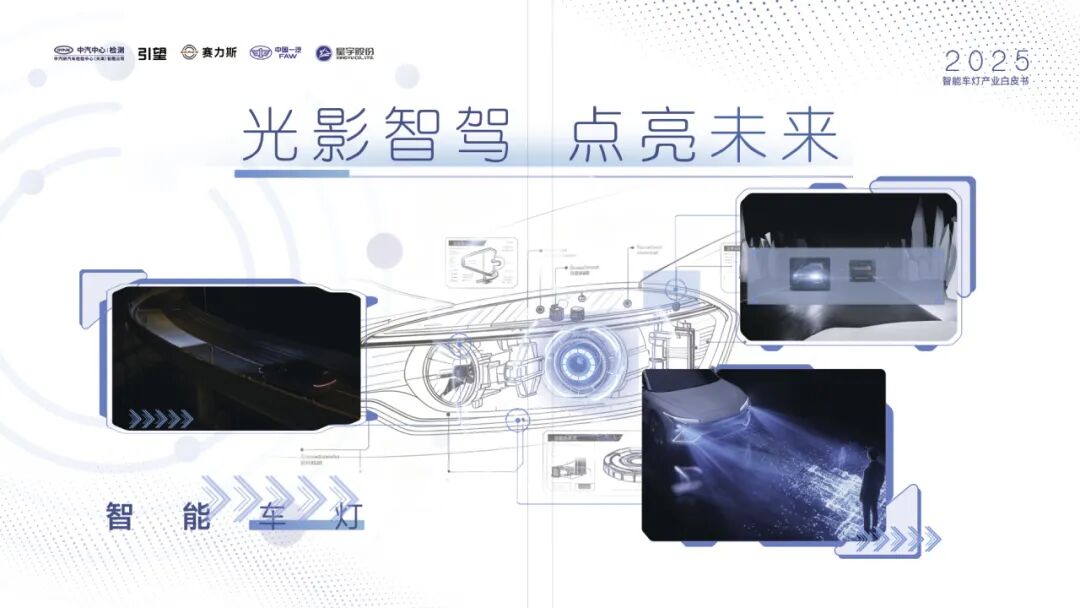
China Automobile Intelligent Technology (part of CATARC), in collaboration with industry-leading enterprises including Huawei, Seres, FAW, and Xingyu, have completed their 2025 Smart Automotive Lighting Industry White Paper.
What is really interesting is that this white paper has been written coöperatively by regulators, automakers, tier-1 and -2 suppliers, all working together. Here is my synthesis:
The white paper focuses on two core functions: high-precision ADB and intelligent light carpets.
In 2024, new-energy vehicles represented 47.6 per cent of China’s automotive market, with over 90 per cent equipped with advanced EE architectures. This created the hardware conditions for expanding intelligent lighting functions such as HD ADB. In addition, C-NCAP’s scoring system began including a dedicated scoring category for ADB in 2024.
Test results demonstrate that compared to standard ADB systems, HD ADB delivers significant performance enhancements in target masking accuracy, multiple-target recognition, and VRU protection.


With HD technology, through high-precision projection modules, specific light patterns are projected on the ground ahead of the vehicle to create a visual illumination effect resembling a ‘light carpet’. This provides predictive illumination of the equipped vehicle’s trajectory.

For an example: with light carpet and Huawei’s XPIXEL intelligent headlight unit, ground illumination ahead can be increased by 50 per cent, which is said to improve detection of potholes and ground obstacles by approximately 55 to 60 per cent.
From an industry perspective, more than 85 per cent of the new-energy vehicle manufacturers have positioned scenario-based lighting interaction as a core selling point (examples: Aito M9, Maextro S800, Audi E5 ‘Star diamond light curtain’, Zeekr 007 ‘Stargate’, etc), including welcome/farewell, personalization, and entertainment functions and features.

The white paper emphasizes the importance of smart lighting for the Chinese and global markets. Based on YH research and leading technology enterprises, the global headlamp market size will grow annually from 2025 to 2030 by 7.4 per cent to reach $27.3bn, while China will grow annually from 2025 to 2030 by 9.8 per cent to reach $10.7bn.

Focusing on the intelligent vehicle lighting market specifically,global market size will grow annually from 2025 to 2030 by 57.6 per cent to reach $8.3bn, while China will grow annually from 2025 to 2030 by 69.3 per cent to reach $3.6bn.

These HD ADB systems with projection capabilities are progressively evolving from optional extras in premium models to standard equipment across a broader range of vehicle segments.
From a 1-per-cent market prevalence in 2025 in China (premium vehicles priced above C¥300,000 / ~$43,200), the estimated evolution runs to 3 to 6 per cent market prevalence in 2027, expanding to mainstream vehicles priced above C¥200,000 (~$29,000). And by 2030, market share is expected to increase to 15 to 20 per cent, with adoption of this technology in vehicle priced above C¥150,000 (~$21,600).
The white paper mentions the remaining challenges to this rapid growth…

…and the possible action plan, including regulation evolution, industry collaboration, technological breakthrough, and market strategy:

I talked and listened with companies involved in crafting the white paper, to understand the background and learn additional details. Here’s what they shared:
Lan Lai, Policy Standard & Patent Dept, Shenzhen Yinwang Intelligent Technologies (Huawei):
“In recent years, the intelligent headlamp market has experienced rapid growth. As part of the industrial upgrading process, we had collaborated with CATARC to prepare this report, focusing on safety and user experience, customer value, technical solutions, supply chains and software-hardware division, regulatory requirements, and performance rating, to promote the sustainable growth of the intelligent automotive lighting industry.”
HongLiang Han, FAW:
“Regarding how to implement the intelligent lighting technology application you mentioned, in my opinion, the following key elements are required:
Standards first: Establish a standard system adapted to the development of intelligent vehicles, actively participate in the formulation of C-NCAP and GB standards, and seize the technical discourse power.
Technical collaboration: Break down the barriers of the traditional industrial chain, realize cross-domain technological integration (optics, electronics, software, AI), and create system-level solutions.
Risk sharing: Establish a coöperation mechanism of benefit sharing and risk sharing, and reduce innovation costs and compliance risks through joint research and development and joint certification.
User orientation: Focus on users’ needs for safety, comfort and personalization, balance technological innovation with regulatory compliance, and promote the transformation of intelligent car lights from luxury goods to safety necessities.”
Zhao Zhun, Regulation Expert at China Automobile Intelligent Technology:
“The white paper primarily focuses on the evolutionary background of automotive lighting transitioning from traditional illumination to intelligent interactive terminals. Under the influence of current trends in China – such as the penetration of new energy vehicles, the shift toward software-defined vehicles, and policies guiding the intelligent and autonomous driving industry – smart lighting technologies like microLED and DLP are projected to see widespread industrial adoption between 2026 and 2030. This advancement is expected to enhance driving safety and expand scenario-based value.
“In China, a collaborative model has emerged to accelerate the popularize of intelligent lighting from high-end optional features to vehicles across all price segments. This model involves:
- Institutional Standardization: Entities like the China Automotive Technology and Research Center (CATARC) establishing standards such as GB 4599-2024 and the C-NCAP evaluation system.
- OEM-Led Product Definition: Automakers, exemplified by the Aito M9 featuring million-pixel headlights, taking the lead in defining product specifications.
- Tier-1 Supplier Full-Stack Solutions: Companies like Xingyu and Yinwang providing comprehensive solutions and engaging deeply in collaborative R&D.
Together, these efforts form a closed loop of policy guidance, technological implementation, and mass-market promotion.”
Lin Shudong, Vice General Manager Changzhou Xingyu Automotive Lighting Systems:
“I. Background and Objectives
Against the backdrop of rapid automotive intelligence and electrification, vehicle lighting is evolving from traditional illumination components into intelligent systems that integrate perception, computing, and interactive capabilities. Currently, the industry still faces divergence in technical pathways, functional boundaries, and value perception. This white paper aims to establish a consensus foundation for industry by systematically outlining definitions, technological trends, market dynamics, and regulatory developments. It seeks to steer smart vehicle lighting from mere functional accumulation toward value innovation and orderly advancement.
II. Collaborative Model of China’s Smart Vehicle Lighting Industry
In China, the development of smart vehicle lighting demonstrates a highly collaborative industrial approach, primarily reflected in the following three aspects:
- First, forward guidance from industry institutions and standard systems.
Represented by authoritative bodies such as the China Automotive Technology and Research Center (CATARC), the establishment of national standards and testing evaluation frameworks provides clear direction for technological advancement. For instance, incorporating intelligent lighting functions like Adaptive Driving Beam (ADB) into the C-NCAP evaluation system, along with the continuous refinement of relevant national standards, has effectively fostered a positive mechanism where testing promotes research, and evaluation promotes application. This accelerates the maturity of technologies in terms of safety, reliability, and compliance.
- Second, the leading role of automakers in demand definition and system architecture.
In the context of software-defined vehicles, Chinese automakers no longer view lighting as an isolated functional component. Instead, driven by user experience, intelligent driving synergy, and brand differentiation, they proactively integrate smart lighting into the vehicle’s electronic and electrical architecture and software system for unified planning. Through scenario-based demand definition and support for OTA capabilities, smart lighting functions continue to evolve, becoming an integral part of the smart cockpit and intelligent driving systems.
- Third, the critical hub role of tier-1 suppliers in technology integration and industrial implementation.
Tier-1 suppliers are deeply involved in early-stage joint development, systematically integrating high-resolution light sources, control chips, algorithms, and vehicle requirements. By collaborating with upstream core component partners, they enable the engineering, scaling, and cost-effective implementation of technologies, accelerating the transition of innovations from prototype validation to mass production.
In summary, China’s collaborative model is a closed-loop characterized by standards guiding, demand driving, and technology supporting. This multi-party coöperation mechanism effectively accelerates the progression of smart lighting technologies from validation to large-scale application, offering a referential Chinese practice for the global industry. Xingyu Automotive Lighting will continue to increase investment in research and development, working alongside industry chain partners to advance the integrated synergy of light-sensing-intelligent driving and collectively illuminate the new era of smart mobility.”


