Saint-Gobain Sekurit, part of Saint-Gobain group, is a highly famous French company They were founded in 1665(!) and saw global revenue of €46.6bn in 2024 (2025 figures not yet released) with a global workforce of 170,000 persons. I visited them not in Versailles where I live (though I could, because they provided in 1678 the mirrors of the Galerie des Glaces in Versailles Castle!), but at the Shanghai autoshow last year where they were exhibited their Amplisky Roof innovation.

After the Shanghai autoshow, we continued the discussion and explained to the team how they could benefit by joining the DVN lighting community. And now here we are today: Saint-Gobain Sekurit became a DVN lighting member last November, and will exhibit at DVN Munich this week for the first time. They invited me to test the Imagine Lab Experience they have just launched, to explore, inspire, and help OEM designers in co-creation phases to design the interior cabin experience with glass and light.
Saint-Gobain Sekurit rely on eight cross-business R&D centres. Their 3,800 researchers filed 450 patents in 2024 alone.
The Mobility Business Unit is the group’s activity dedicated to automotive and public-transport glazing, as well as automotive glass replacement. Around 16,000 employees throughout the world are putting their expertise and passion for innovation to work for customers every day, paving the way for sustainable mobility.
In this business unit, Sekurit Automotive make glass solutions for the world’s vehicle manufacturers. Business is around €2,400bn with 14,000 employees, four R&D centres, and 34 plants (Mexico, Korea, China, Europe, India, USA) which represents around 20 per cent of the global market for glass windows.

Sekurit automotive focus on innovations in glazing systems.

The Sekurit Amplisky, with antiglare and privacy functions for roof glazing, has been introduced by many OEMs.
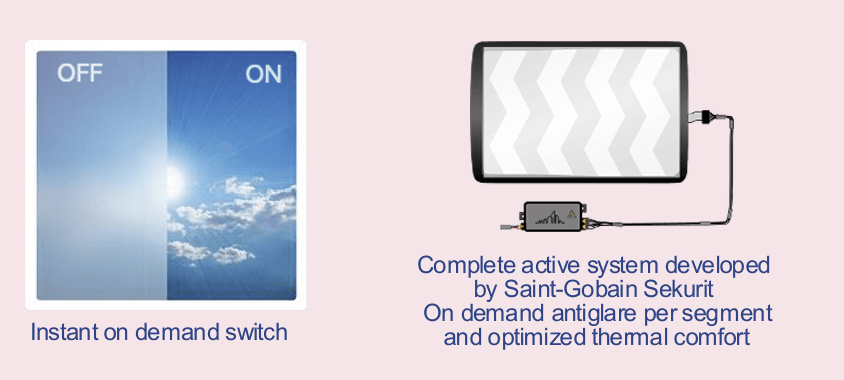
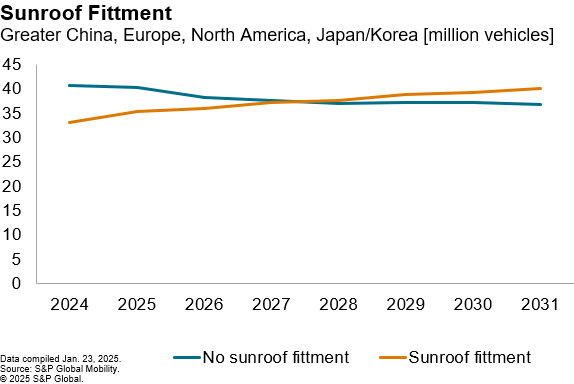
Indeed, these fixed glass window roofs are progressively replacing open roofs in most vehicles; advantages include smaller packaging space and lower cost, and also the fact that for EVs aerodynamic performance is super important (an open roof is aerodynamically ‘costly’), and also because after Tesla started to introduce this kind of roof, other automakers followed. The current take rate of glass roofs (of all kinds) is around 30 to 40 per cent.
Openable roofs are still predominant, though with a reduction year by year as panoramic roofs are increasing.
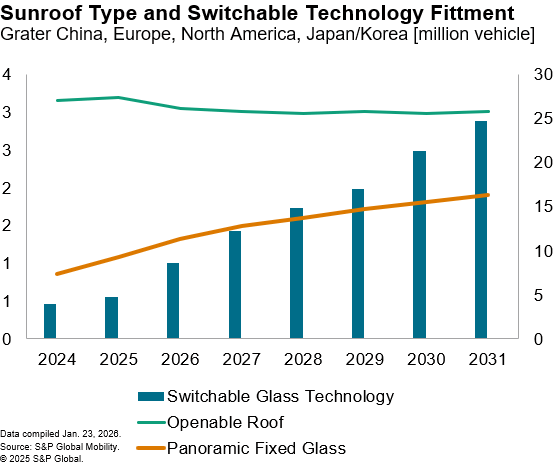
If we focus on switchable fixed glass roofs, the take rate is around 1 per cent today, but S&P Mobility forecast that could multiply by 3 by 2030.
The next evolution of the Amplisky product range is integrating ambient light into the roof, as applied in cars like the BMW i7, Mercedes GLC, and others. This is expected to expand in the coming years, especially because the extra cost is quite small, but the effect is super impressive.

The possibilities are really large, and Saint-Gobain have decided to create an Imagine Lab to gather OEM designers & engineers to imagine and co-create in-cabin experiences using glass roofs with various optical technologies. This is not limited to roof systems; it can be in side windows, the backglass, and even in the windshield!

Saint-Gobain can reach 10 cd intensity and overall luminance around 1000 cd/m2 with specific technology.
With my vehicle lighting expert eyes, I see three applications:
- Application like Mercedes GLC or BMW i7: LEDs on the side

With a PVB film between the 2 layers of glass, it is possible to include some patterns. This can be fully transparent (or not), which brings broad design flexibility. For this purpose, Saint-Gobain provide the glass roof and the complete system including films, PCBs, LEDs, and the optical system. Main interest of the concept is that you can replace the LED module in case of damage; main drawback is the LED position on the side. That means you cannot illuminate dots one by one, but the pattern is lighted by a cone of emission stemming from each LED.

This light can be visible from inside and/or outside the glass, depending on the film technology used.
- Application like Zeekr 001 shown below, with miniLEDs on a flexible transparent PCB. This solution creates full flexibility for designers, but has also drawbacks like cost. LED replacement is impossible; the full glass system must be replaced.

- Aside from design and wellbeing usage, this technology could also be used for legal signalling functions. If they succeed to reach a 4-candela intensity, with luminance around 1,000 cd/m2, it may be possible to incorporate a signalling function directly into the glass. Think of the Dacia Hipster design (lamp on glass), or why not an AD-S turquoise side light in side windows!

Saint-Gobain Sekurit will bring a piece of the Imagine Lab to DVN Munich, so come and try it out!


