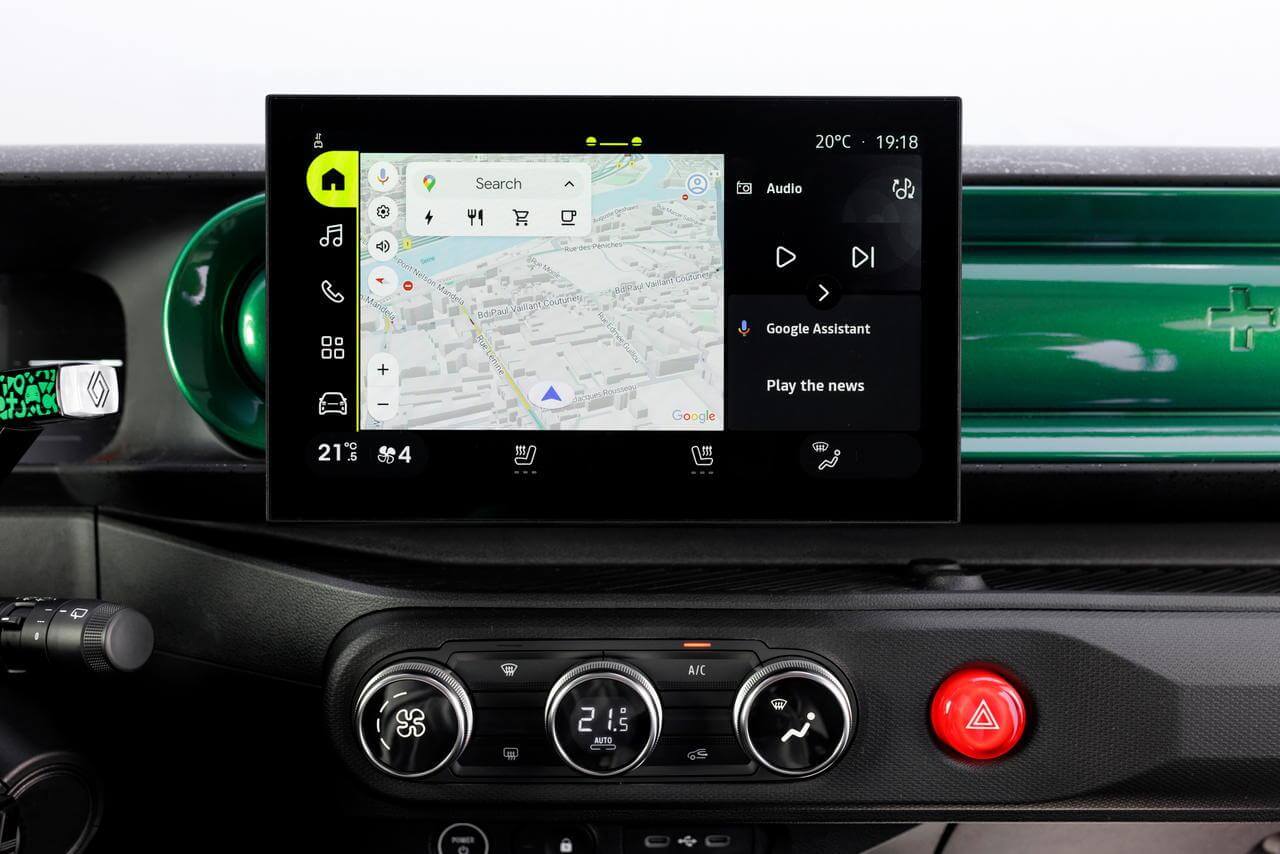
When you open the door of an original Twingo, then that of the new electric Twingo, it feels like going from a student flat in the 1990s to a fully connected urban micro-loft. Same size, same promise of compactness… but two design philosophies that reflect thirty years of evolution in car interiors.
The original: an ultra-modular bubble lounge

In the original Twingo, everything is organised around space. It’s a miniature hatchback, with wheels at the four corners and a very forward windshield, The interior forms a single bubble where the dashboard is just a large wave of grey plastic running from one pillar to the other. No tunnel, no intrusive center console, just the famous central digital display that served as a technological ‘totem’.
The message to young and old alike is simple: this is not a cockpit, but a small living space.
The rear seat slides back a long way, the backrest folds down, the front seats tilt: in just a few simple steps, you can go from four real seats to the loading space of a mini leisure activity vehicle, or even an almost flat ‘bed’. This freedom to reconfigure the vehicle, without any marketing hype, makes it a truly personal utility vehicle: express removals, weekend camping trips, getaways for two…anything goes.
The fabric interior contributes to this demystification of the car. Thick upholstery, fun and colorful confetti patterns, turquoise accents on the handles and controls: it’s closer to a 1990s sofa than a city car seat. The plastics are hard, yes, but generous in size, reassuring to the touch, with large storage volumes moulded into the sides and a full-width shelf at the foot of the windshield. The original Twingo doesn’t try to be ‘premium’; it tries to be welcoming and easy to understand.
The new model: same DNA, EV constraints
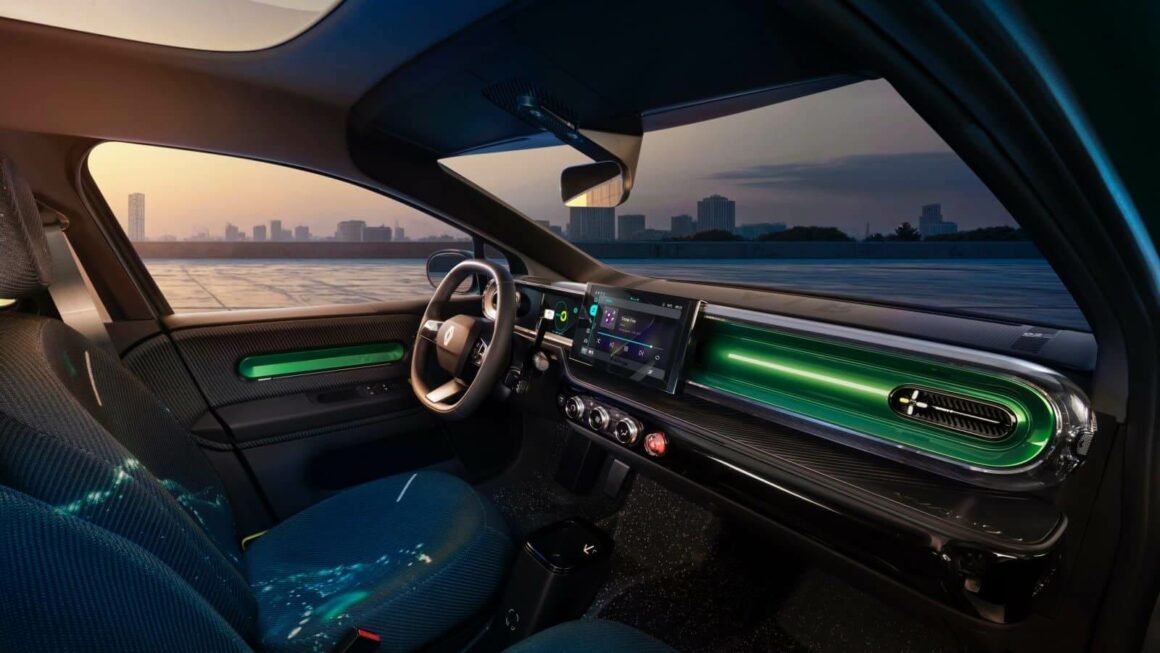
In the new Twingo, Renault has to deal with everything the first model didn’t have: a battery in the floor, more stringent crash tests, screens, ADAS, connectivity, etc. The miracle is managing to retain some of the original spirit without falling into the trap of creating a scaled-down clone of the Mégane E-Tech.
The suspended cylinder-shaped dashboard is the centerpiece of this new interior. It incorporates a 7″ instrument cluster and a 10.1″ central screen, yet remains compact. Above all, it frees up a continuous ‘shelf’ underneath, providing a usable horizontal surface – where many modern city cars have sacrificed storage space for the sake of dual screens. Instead of pushing the customer into a wall of interfaces, we have recreated a living space on board, in keeping with the Twingo philosophy.

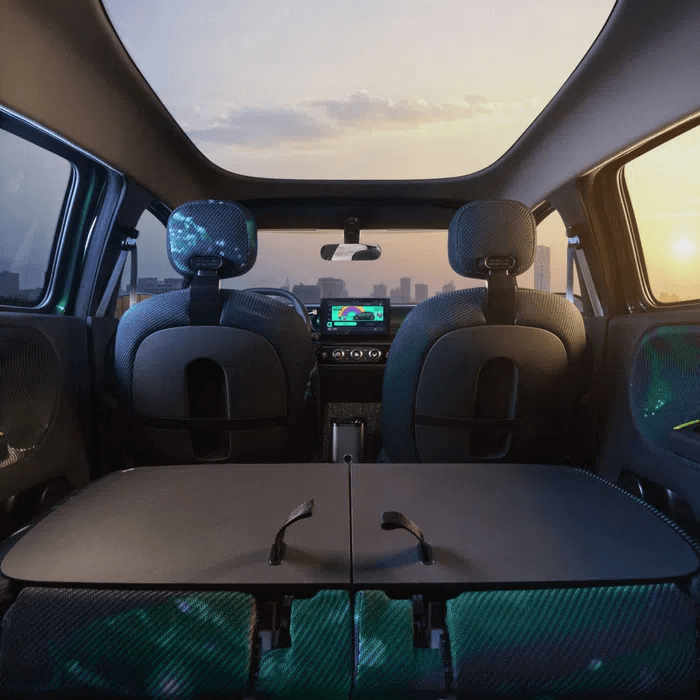
Modularity is still at the heart of the specifications, but it has been streamlined. We have moved from a single sliding bench seat to two independent rear seats mounted on rails, combined with a double-level boot floor and underfloor storage dedicated to cables. The usable volume has increased, with a loading length of almost 2 m with the passenger seat folded down, while still respecting the battery/chassis interfaces. It’s less ‘freestyle’ than in 1993, but much more tailored to urban electric use: cables here, luggage there, smartphones securely stowed in front of the teenagers in the back.
As to materials, the car has moved away from simple carpeting and thick fabric towards a mix of more technical textiles and innovations such as the stained cork flooring featured on the show car. This choice reflects both the growing importance of sustainability criteria and the search for acoustic comfort suited to a zero-emission city car. The graphic motifs of the original Twingo are referenced in subtle touches – stitching, inserts, door panels – without falling into pastiche. The DNA is recognisable, but in a more precise execution, calibrated to today’s quality expectations.
Finally, the ergonomics illustrate the desired generational gap. For analog users, there are real air conditioning dials, a well-sized physical control panel, a highly visible warning button and a high driving position with good visibility. For connected users, smartphone compatibility, onboard services and dedicated graphics provide the expected level of technology without invading every daily gesture. Where the original Twingo reassured with its simplicity, the new model reassures with its clarity.
Ultimately, the first Twingo remains the icon of total freedom: a simple body, highly modular seats and a textile interior that transformed the little Renault into a mini studio on wheels. The new Twingo takes up this idea of a ‘living space on wheels’, but with the constraints of electrification and regulations: the same basic logic – optimizing every inch of interior space for everyday life – but with a much more structured design, centered around digital interfaces and the battery pack.
For an expert reader, this is less a simple case of retro design than a textbook example of how to reintroduce the DNA of 1990s usage into a 2026 electric city car without compromising on technology, standards or industrial costs.


