By Wolfgang Huhn, DVN senior advisor
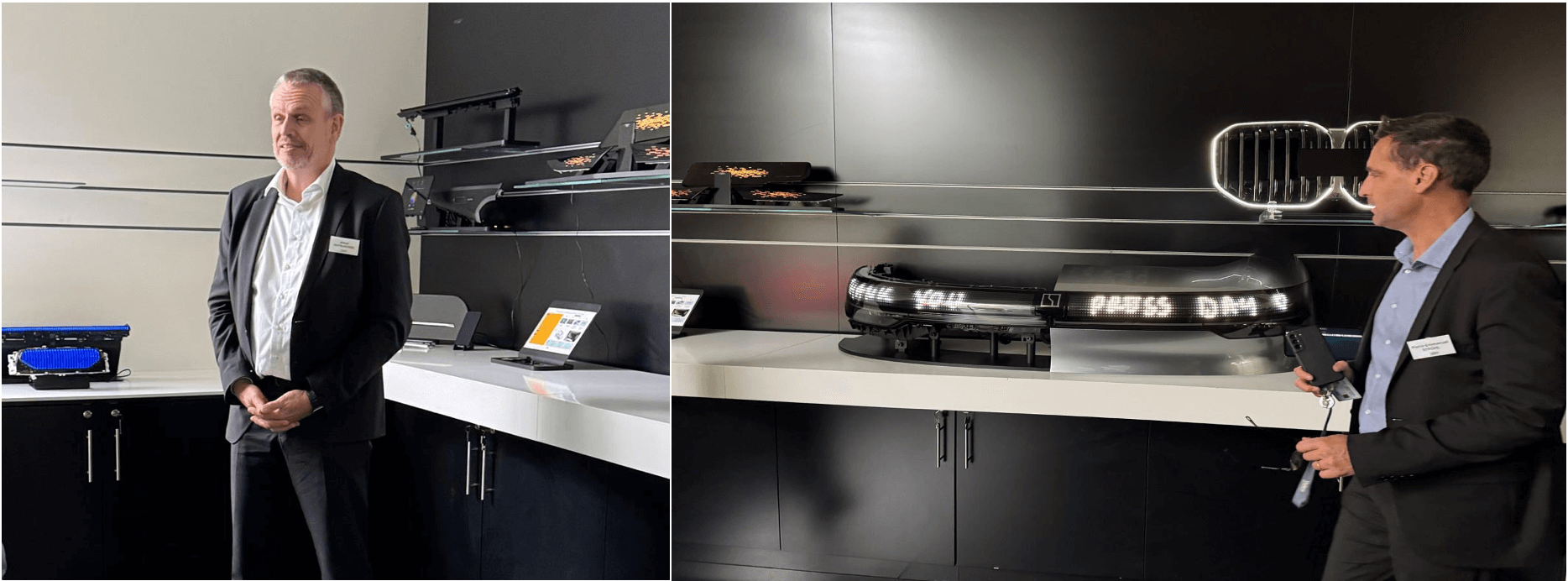
On October 15, Valeo invited German tech journalists from the automotive sector to a press event that included a night drive. Wolfgang Huhn was invited on behalf of DVN. The afternoon was dedicated to presentations of new technologies in meeting rooms and in the light tunnel in Bobigny. The evening was reserved for a night drive through the woods surrounding the Château de Chantilly. Leading Valeo managers, such as Klaus Matauschek (Lighting Systems R&D Director), Pierre-Emanuel Strohl (Light Division R&I and Strategy Director), and Olivia Da Silva (Lighting Systems Marketing Director) to name a few,gave interesting presentations and led a tour of indoor demonstrations of new technology. Progress in headlamp modules was demonstrated using the Audi A6 as an example.
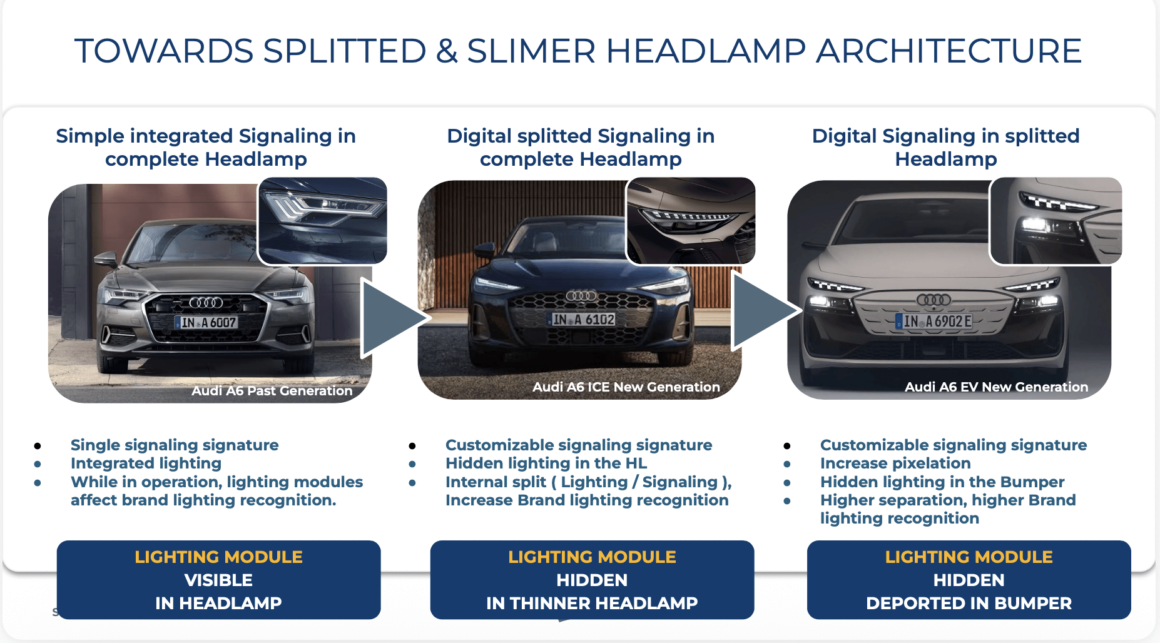
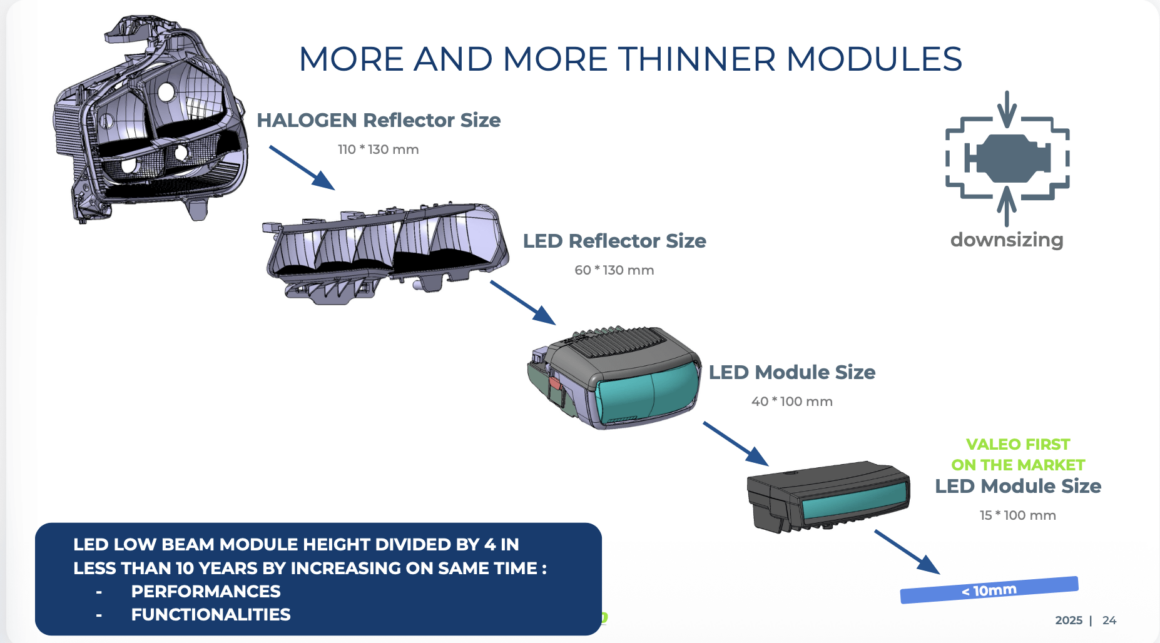
The general trend in headlamp design at OEM studios is toward slimmer headlamps. Valeo has adapted this trend by offering slim modules with high performance and acceptable efficiency. A few years ago, a height of less than 10 mm for high/low and ADB was unreachable.
In addition to the trend of slim headlamps, the HD headlamp trend is ongoing for the premium car segment, including road projection abilities. Matrix ADB with up to 100 segments is increasingly becoming standard equipment rather than an option (ADB goes mainstream, they said). In this area, Valeo presented a variety of complete module families, including the BiLED30 Matrix and the HD25K, which feature bending light technology. Surprisingly, Valeo also presented a vertical thin lens family with high-performance matrix technology.
During the marketing portion of the press days, an overview of this year’s international auto shows was given, focusing mainly on the IAA in Munich and Auto Shanghai. Of the 149 vehicles analysed in Munich, 97 cars on display came with Matrix or HD Matrix headlamps. In Shanghai, 166 out of 455 did. For “coast-to-coast” rear lamps, the ratio was 79/149 in Munich and 254/455 in Shanghai. Other interesting figures are: Eighteen percent of the analysed cars in Munich had an illuminated front logo, and the same percentage had an illuminated rear logo. In Shanghai, the figures were 22% for the illuminated front logo and 13% for the illuminated rear logo. Many more analyses were presented, providing valuable information for decision makers.
According to Valeo’s marketing, the market drivers are Electrification, Automation, SDV and Circular Economy.
The drivers in the lighting business are Safety, Style, Performance and Sustainability.
One dominant styling trend is minimalism, where slim, minimalist lighting systems are seamlessly integrated into the body. On the other hand, maximalism dominates styling in China, offering distinctive wow effects.
In the demo section of the event, we saw several projection units, such as a signal road projection for the turn signal and reverse light. Valeo hopes (like all others) that the GRE will soon be successful with the SRP (Signalling Road Projection) for turn indicator because there is high customer demand worldwide, and everyone in the industry is ready.

Illuminated logos were presented for VW, Zeekr, Volvo, and Geely. Other samples used translucent chrome, which was very interesting, for example, for the illuminated BMW kidney grille and the Zeekr front panel. Another application demonstrated was the flexible light guide, which is being used in an increasing number of exterior and interior applications. Compared with plastic injection molding, it saves huge tooling costs.
In the light tunnel, Klaus Matauschek presented the two cars for the nighttime driving. He explained all of the functions on the white wall in the lab, so the journalists were well-prepared for the road test later that day.
Valeo equipped an Audi Q4 car or a democar with the BiLED30 LB/MXB and a separate HD module with road projection driver assistance capabilities. The camera, HD driver ECU, and image processing software comprise a complete Valeo HD system.
The second car was equipped with a really interesting vertical system. It consists of two rows of seven identical lens modules. Together, they deliver a 28-segment MXB. The small modules are arranged vertically but can be placed according to the designers’ preferences without loss of performance. Also, in this car, the full system was developed and integrated by Valeo.

The night drive took place on country roads through the woods near the beautiful Château de Chantilly. Valeo chose a test route of about 15 km with long straightaways, some road undulations, several roundabouts, and a few corners. The test drive took place in real traffic, so oncoming and ahead traffic was present at times.
Before the night drive started, Valeo impressed the journalists with some nice Halloween video projections. The HD 25k system was integrated into another Audi.
While driving on the road, the vertical system in the Audi showed a surprisingly convenient cutoff line. When I saw the system during the day, I expected to see visible multi-cut off lines on the road, and I was also afraid of color fringes. But none of that was visible. I experienced a smooth, convenient cutoff line and homogeneous light distribution. The ADB function was as expected for a 28-segment system: slightly wider shadows around oncoming and proceeding traffic. Overall, this multi-lens system provides a comparable impression to one or two projection module headlamps.
The test car with the MXB+HD 25k pixels system was also used for the night drive. It projected legal warning symbols and driving support graphics, such as a guiding lane on the road, as well as other helpful projections. Another notable feature was the dynamic bending light in low- and high-beam conditions. The system demonstrated was state-of-the-art high end lighting technology.
The Valeo Press Day provided insight into Valeo’s lighting technology. The role of marketing in executive decision-making was clearly demonstrated. The combination of a meeting room, a demo sample room, a light tunnel, and a night drive experience was a significant undertaking for Valeo, but the outcome was worthwhile. Thank you, Valeo Bobigny, for this “bright” day!


