By Daniel Stern, DVN Chief Editor
For the lighting enthusiast – professional, geek, or both – the J.W. Speaker plant is a place where very good magic is made. That was my immediate impression 12 years ago, when I first visited to build our DVN profile of their company.
J.W. Speaker are regular participants at DVN events, always with an enticing display in their expo booth, and longtime Chief Technology Officer Dragan Popovic (“In 25 years here, I’ve never been bored!”) has often given presentations on innovations in lighting technique and design. We’ve reported on Speaker’s news over the years – their adaptive motorcycle headlamps which throw light into curves according to bank angle, their BlueTooth-enabled multifunction front lamps, their selections by OEMs as an exclusive supplier, and more. But even so, it was astonishing for me, on my recent visit, to see that not only is the magic still in motion, but it’s almost entirely all new since my last visit!
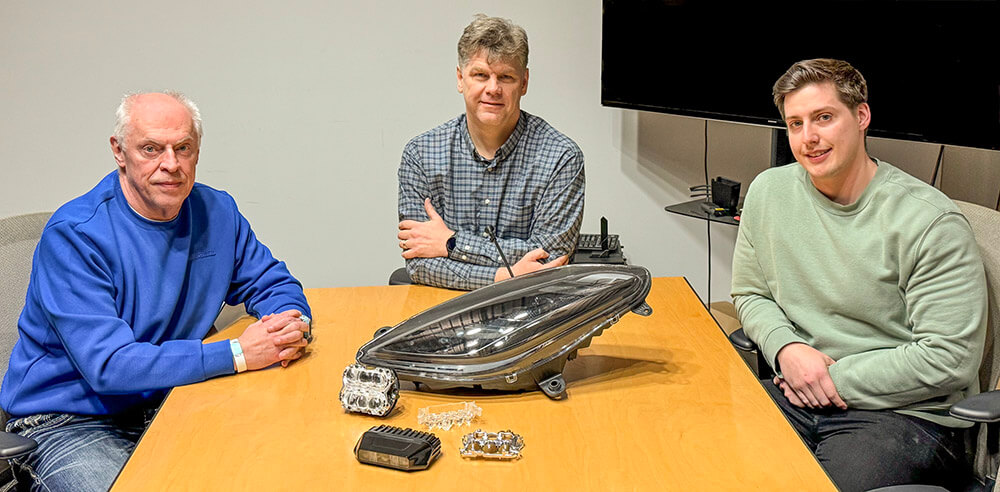
They aren’t a Forvia Hella, a Valeo Light, a Koito, or a Magna; they don’t turn out multimillion units of parts for high-volume mainstream cars. Rather, their thoughtfully-carved niche is more along the lines of Special OE and high-end upfitting and aftermarket. They furnish front and rear lights for some of the world’s most rarefied super- and hypercars and exclusive high-end EVs (McLaren, Faraday, Karma, Lotus, Ferrari). They’ve supplied a great many kinds of advanced headlamp as original and upgrade equipment for Harley-Davidson motorcycles (whose world HQ is just up the highway). Their high-spec LED front combination lamps are on New Flyer transit buses. They make LED locomotive headlamps to easily and radically upgrade the traditional glowing-filament ones. They’re several generations in on their miraculous adaptive motorcycle headlamps, with full motorcycle ADB under active, tractive development. They’re at the top of the list when Jeep owners and other off-roaders go fitting serious lighting systems, and their range of standard-size lamps and modules has just undergone a giant upgrade (more about that later in this article). Their products are evolving in technology and design before our eyes. A prime example: a hold-in-the-hand-sized clear optical element which generates a complete, legal, high-performance low beam pattern, including a well-defined cutoff and elbow. And this element is made on modular tooling, so variants (LHT, RHT, symmetrical motorcycle beam…) are easy and inexpensive to make. This is very, very far from the days, not long ago, when engineers were constrained by reflector size and cutoff shields.
J.W. Speaker’s production methods and techniques are evolving at a galloping pace, as well, in some surprising and delightful ways perfectly suited to the company’s position and focus. Example: short-order tooling made with 3D-printed steel. It’s a much faster and more cost-effective method than traditional CNC or EDM techniques, and it allows for significant improvements in the tools themselves. Finer-grained modularity, too, because key tool features that define the resultant beam are determined by small interchangeable inserts, rather than completely distinct sets of tools. This makes for faster iteration, lower cost, and greater flexibility – ideal for Speaker’s orientation.
The innovation also extends to electronics. J.W. Speaker aren’t buying off-the-shelf driver boards or farming them out. They build them in-house on their SMT lines with intelligent automated inspection and full traceability.
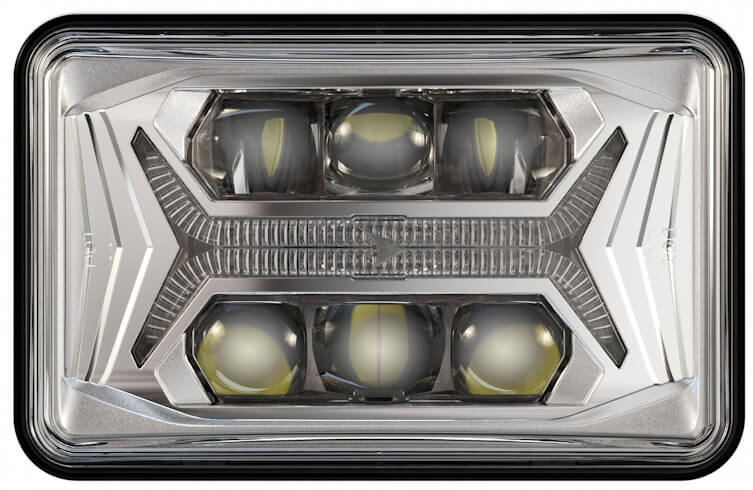
Their latest release, launched last week at NTEA Work Truck Week, is an all-new range of LED headlamps and multifunction lamps in all four of the traditional American sealed-beam formats: 7- and 5.75-inch round, and 200 × 142 and 165 × 100mm rectangular. These are a clean-sheet new generation of the top-of-class LED sealed beams they’ve been offering and improving for years. It might seem odd to get excited about lamps sized and shaped to go in mostly old vehicles, but there’s quite a bit worth seeing here. In their own right, they’re fascinating from the standpoints of technology and performance – and they serve as working billboards to demonstrate technology that can be built into lamps of any shape.
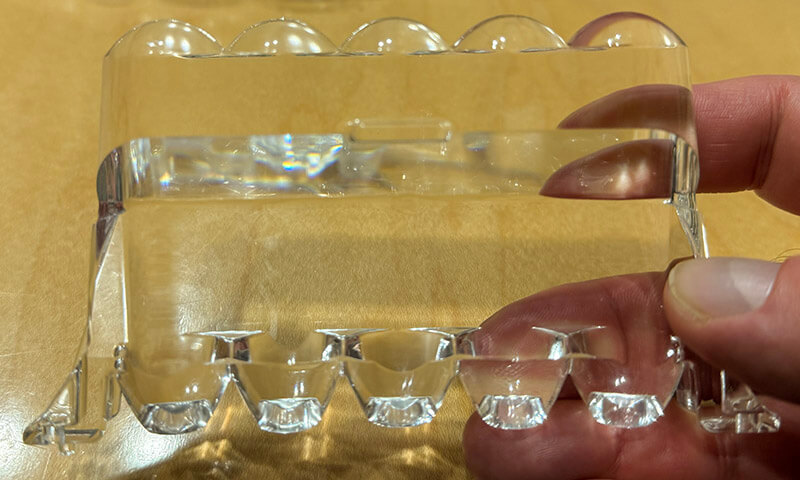
For one thing, they’re internally highly modular. That compact clear optical element I mentioned above comes into play here: it’s a TIR (total internal reflection) piece, serving as the complete optics for the beam. There’s no cutoff shield or shade, no reflector-segment losses, and no dead space between LEDs as with discrete individual optics. All of this means terrific optical efficiency.
The light stays inside the optic from incoupling to output. “Nothing escapes until we want it to”, says Popovic. “The elliptical reflector lets us concentrate the light wherever we want on the light screen, and then the projection optics shape it into the beam pattern. That combination gives us a lot of flexibility in a very compact space”.
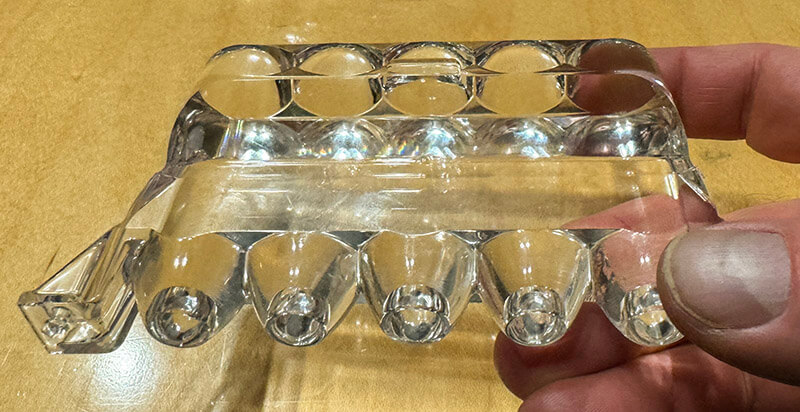
All their new standard-size lamps use this same optic – not just the same kind, but the same actual part – for the low beam. Likewise with a version of this part tuned to put out a high beam. This means the end of performance constraints imposed by the smaller size formats; the small lamps perform just as robustly as the big ones. And it makes the whole family of lamps less costly to make, and variants easy to produce. Example: “Super Low” and “Super High” versions of the smaller lamps, each containing two low beam optics or two high beam optics instead of one of each.
The compactness and efficiency of the headlamp optics leave ample room for additional functions; all these lamps can be had with integrated white position and daytime running lights, and with turn signals meeting the high intensity requirements for proximity to the low beam. The RHT beam pattern is a worldwide one, combining the best performance aspects of US/SAE and rest-of-world/UNECE photometric standards (the LHT pattern is the same, but horizontally flopped).

What’s the output like? In a word, excellent. These lamps put out a great deal of light, but they are deliberately not intended to break world records for low-beam peak intensity; Popovic commented on a competing LED sealed beam with a 54,000-candela low beam hot spot: “Some lamps push the hot spot intensity to 30-40-50 kcd, but the rest of the beam is almost empty. When you drive with that, you see this bright rectangle and nothing around it. It’s distracting. Our goal wasn’t necessarily to exceed the lumens of our previous generation (though we actually did); what mattered more was the uniformity. The old optics had interference patterns in the beam, and this one is completely smooth. When you drive with it, the pattern is just clean.”
As darkness fell, I had the opportunity to go for a ride in one of their test mules, a Jeep Wrangler fitted with the new Speaker lamps on a quick-change rack, and a competing major brand’s newest LED headlamps in the factory headlamp location. It was no versus; the Speaker lamps provided a broad, perfectly uniform lawn of light, with excellent width and reach, tightly-controlled glare, and no backscatter. The competing lamps – which aren’t cheap! – put out narrow streaks and spots of light (kind of like a poorly-made sealed beam, except blue), with distracting amounts of glare and significant backscatter. The Speaker beams were deep from top to bottom, while the competing beams were just a thin band of light.
Which is all fine and well for Jeepers, and for the large number of large vehicles still on the road with standard-sized headlamps (truck and bus drivers are going to love them), and for old-car and hot-rod enthusiasts. But beyond that, do these lamps matter? Oh, yes, they do. Because they serve as a demo showcase for the modularity of J.W. Speaker’s tooling production and optics. These same compact, high-efficiency optical elements can quickly and efficiently be integrated into headlamps and front combination lamps of virtually any imaginable design configuration. They can be stacked for vertical lamps, arrayed side-by-side for low-profile ones, clustered into geometric shapes, really anything. Again, perfect for Speaker’s market niches. Companies and people designing supercars, transit vehicles, next-generation truck tractors, new kinds of snowplow lights…all can have top-performing, eye-catching headlamps without busting the development budget.
That optical element is acrylic, by the way. Popovic says that because it sits so close to the LEDs (for incoupling efficiency), “the blue light starts breaking down [other materials]; they start to turn yellow, then eventually they begin to burn. With acrylic we tested 3,000 hours and saw none of that degradation”.
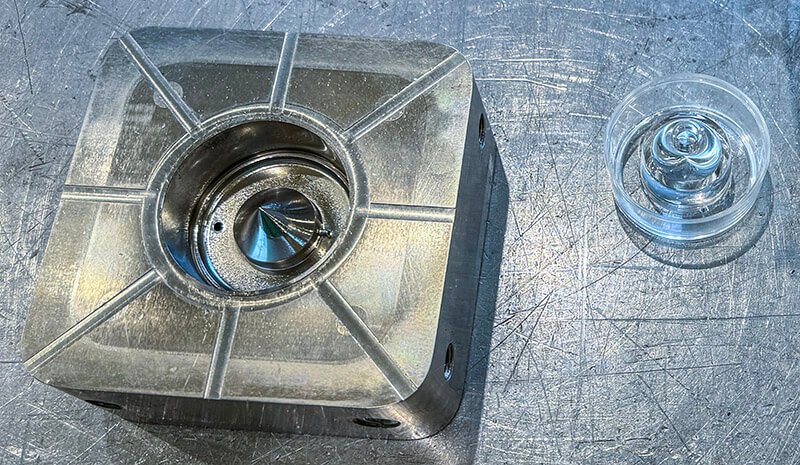
So all in all, these new lamps are emblematic of the Speaker product-magic. Now, let’s back up a step or two and take a closer look at their production-magic: additive toolmaking. They use equipment like Mantle P-200 metal 3D printers and F-200 sintering furnaces to create tools very fast, inexpensively, and with significant advantages over ordinary techniques. “This block started as layers of metal paste”, says Popovic, pointing to a metal brick with high-sheen optical tooling surfaces. “After printing, heat treating, and polishing, it becomes a mould insert. If I didn’t tell you it was printed, you wouldn’t know”. Yup, he’s right again. “With traditional machining you might schedule a CNC, a wire EDM, a sinker EDM, and polishing. With this system we load the paste, let it run for three or four days, and it builds the tool. Now we can build the tool once and make parts in seconds. The printing might take days, but it only has to happen once”. The advantages extend beyond the toolmaking, and into the qualities of the tool itself. Notably: conformal cooling geometry. Traditional mold cooling uses drilled straight channels in the mold steel. Printed tool steel allows for cooling channels that follow the exact contour of the optical surface, consistently about 5 mm from the optical surface in contour. This means more uniform cooling of optical surfaces, better dimensional stability, improved optical precision, fewer sink marks. That’s particularly crucial to the quality of TIR optics, light guides, and precision reflectors – exactly the kinds of optical elements Speaker are using in their latest lamps.
After the tour of J.W. Speaker’s expansive campus, Dragan Popovic talked with me about the company and their progress more generally:
DVN: Can you tell us about the niche JWS occupies in the vehicle lighting ecosystem?
Dragan Popovic: Lighting technology continues to evolve and integrate in helpful ways across many industries. As commoditized as some may think it is, lighting is mechanical, electrical, and optically regulated. It’s an essential safety system and of course highly cosmetic; a high-value marketing point on the vehicle. Custom-designed solutions as well as standard product offerings that are commercially appealing are in high demand. We specialize in offering these high performance, integrated products into low- and mid-volume market segments. Whether they are highly stylized or a common form factor is a decision made by our clients and customers. We are a high technology, high mix market/products company. We specialize in specialty automotive niche segments with high technology content.
DVN: How important to your business are aftermarket-oriented products like your LED sealed beams, versus your model-specific lights? What’s the sales mix of aftermarket/model-specific?
D.P.: They do quite well in certain market segments, particularly when capital is not planned for a project by our client. We also innovate here, this type of the products giving us chance to explore and apply new technologies, as a playground for advanced engineering. For instance, our global 90mm 5-function headlamp (low, high, DRL, position, turn) is unique on the market. Fitting five functions in such a small envelope and having relatively good performance is quite a challenge. JWS believe this is really a great product for new-vehicle development in the on-road, power sports, agricultural, or industrial market segments to minimize the number of lamps on the vehicle and simplify the control architecture and wiring harness without a need to invest heavily in a new custom design.
As far as the mix, JWS’s revenue is mostly from custom developments for our clients. Custom versus standard products, I would say 75/25 per cent.
DVN: So the aftermarket/universal products serve as a kind of ‘halo’, attracting the attention of customers for model-specific lights?
D.P.: They certainly are a brand identity for the J.W. Speaker name. Our lighting heritage goes back over 60 years, and our standard products from decades past can still be seen in applications globally today, although the brand wasn’t necessarily forward in the products’ design in those days. The injection-molded solid-optics process that we developed 20 years ago gave us a definitive look with our D-lenses and projectors. The look has become a staple in the aftermarket commoditized space with many imitators. Our patented SmartHeat lens heating technology also has a distinctive look. We pioneered that about a decade ago, and it has been remarkably successful with many trying to bring similar products to market. I suppose imitation is the sincerest form of flattery.
DVN: Do you expect to scale-up your 3D printing of production tools?
D.P.: 3D printing technologies are in general very new and interruptive. Development and usage of this kind of technology is growing every day. Beside technology, some cultural changes are required, new ways of thinking from engineering to production and testing. 3D metal printing tools are completely new technology, developed last year, allowing to print tools in very high tolerances, H13 or SS steel, in one week! As a new technology, some limitations are always present; size of steel inserts is limited to 18 × 18 × 13 cm, but we are working with the industry leader in this technology to double the size. So, I predict we will have 30 × 30 × 23 cm printing envelope perhaps this year.
DVN: Tell me some automakers who have come to JWS for interesting lights on interesting cars.
D.P.: McLaren, Lotus, Pagani, Karma Automotive, Nikola for their full-size Class 8 e-truck, BMW Motorrad, are good examples. All of what we have supplied to them has some form of intelligent lighting implemented inside of the head or rear lighting.
DVN: What’s your favourite JWS lighting product of the last year? The last five? All time?
D.P.: It is very hard to choose which one would be the favorite project/product. All products are like your child, each has specific meaning and grace. Some of the products were not technology challenged, but they enhanced and brought user safety on next level. We started development of the first LED head lamp prototype for one of the motorcycle industry leaders in 2001. The market was not ready for this technology yet, but we decided to start development using LED technology. I remember first night ride test together with the customer: it was special having a product implementing new technology and being one of the first in the world. It seems to me, the first product for an OEM which has some form or factor of new technology has a special place in our hearts. And personally, our adaptive motorcycle headlamps are one of my most favourite.
DVN: What challenges do you face in commercially keeping up with the cutting-edge of vehicle lighting technology?
D.P.: Considering that our specialty is niche specialty automotive market, commercial issues are always a challenge. Having ADB modules in different numbers of pixels helps, but every specialty automotive customer has different ideas about style, size, and performance. We constantly work to understand and define ingredients for ADB modules, so we can apply them to unique style requirements. Optical apertures going to be smaller and smaller, and performance requirements are rising at the same time. It is very difficult to standardize ADB module, stay on that one size, and satisfy customer needs. Core technologies like light sources (10-, 20-, 50-. and 100-kilopixels), system thermal performance, size of the base system, and communication to the source can be standardized to a point, but rest of the system should be a modular approach. 3D printing technologies will have significant impact to flexible approach, optical definitions, delivery time, and finally positive commercial impact.
DVN: What kinds of innovations are in the pipeline, in the short and longer terms?
D.P.: ADB systems for two-wheel vehicles, a motorcycle matrix system. All elements of the lamp are well defined and tested, integration with the vehicle and software development present challenges at the moment. We expect some motorcycle matrix systems to appear on the market by 2028. ADB systems based on µLED sources applied to different applications and markets. Any new technologies, after some period of implementation in the automotive industry, cascade down to different markets and applications. We’re not really making lights anymore; we’re making electronics that happen to light up! We tend to obsolete our own products in 18 to 36 months.
DVN: Thanks, Dragan. I’ll have to come back to see more magic soon!


