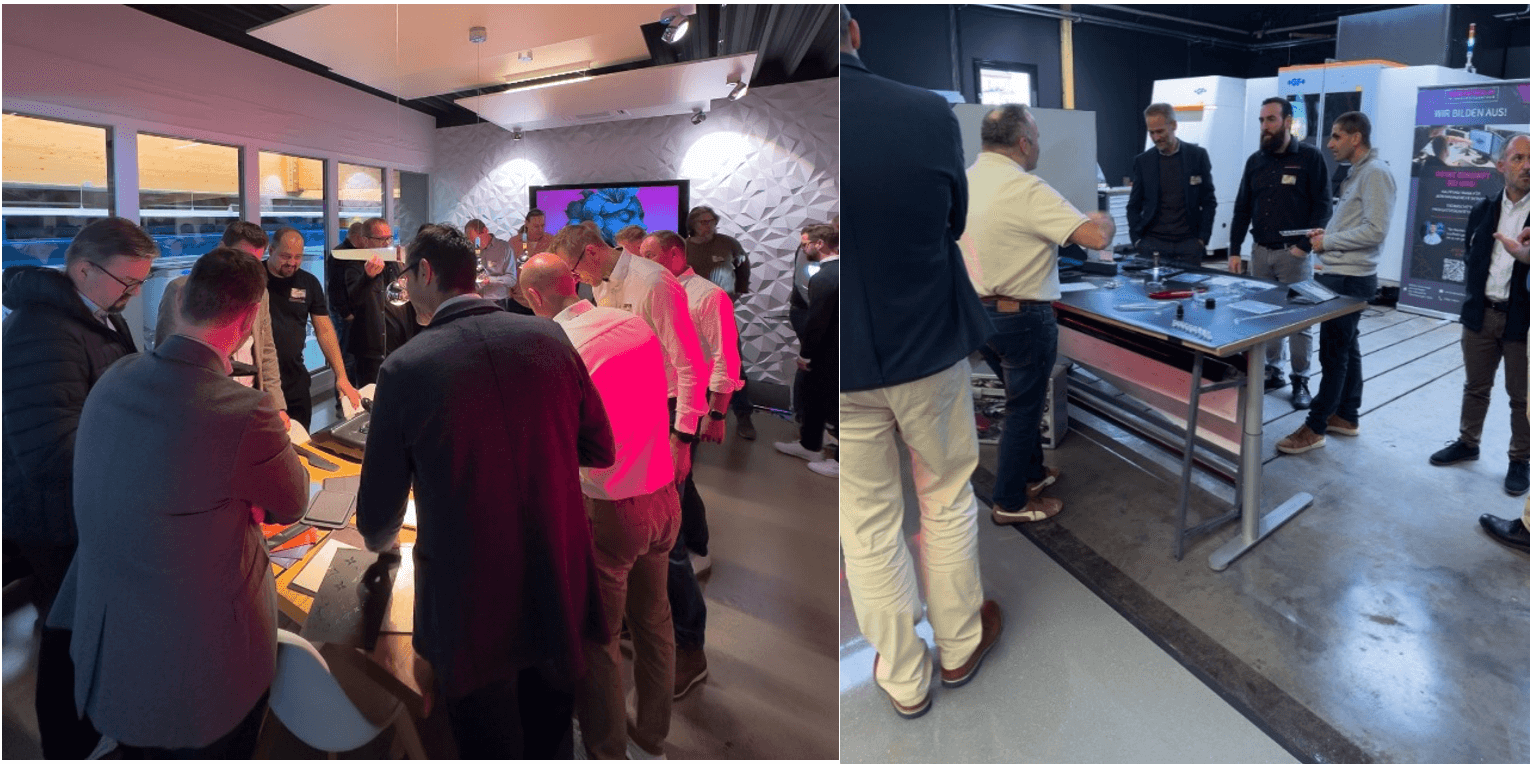
The Reichle-Votteler-Kurz TechDay showed a clear path forward: replacing paint with a tooling–film–PUR sequence capable of delivering surfaces directly from the mould, while paving the way for integrated visual and HMI functions. The key is twofold. Upstream, laser texturing of the tool ensures a topography that is reproducible to within a micron, which the PUR replicates faithfully. Downstream, the combination of IMD/foilmelt and in-mould PUR coatings provides the finish and, if necessary, optical transparency or RF permeability for ADAS. At the heart of the scale-up, the ENGEL duo platform, sized for large-format parts, offers a glimpse of complete ‘moulded’ roofs with integrated decoration, varnish and lighting functions.

Nano and femto laser texturing makes it possible to ‘compose’ matt, glossy, micro-patterns and depth effects, with a stability that is impossible to achieve using chemistry. The benefits go beyond aesthetics. In PUR, the mould surface is copied almost 100 per cent, which requires strictly controlled topography to guarantee gloss, haze and homogeneity across the bodywork. Controlled engraving eliminates the uncertainty of retouching and offers subtle luminous signatures: shy-tech logos, discreet optical conduits, sharp matt/gloss transitions. For exteriors, it is a credible alternative to textured paint with global repeatability controlled by the tool.
With Puriflow from Votteler (finishing becomes a moulding operation), the thermoplastic part receives a polyurethane coating in the mould that acts as a varnish, protective film and, if necessary, an optical layer. Glossy, deep matt, regular satin, pigmented or transparent textures: the range covers both premium interiors and exposed exteriors. The formulations address chemical and UV resistance, scratching and abrasion, with a ‘repair’ effect on micro-marks under moderate heat. Transparent and sensor-compatible grades enable backlit front panels, active logos and radar/lidar-permeable areas. The industrial challenge is clear: no more spraying, fewer layers, faster colour changes and quality linked to a closed process.

The Kurz demonstrator incorporates genuine Swarovski crystals as a touch interface, thanks to transparent PolyTC (PolyIC) conductive films and invisible wiring. Activation occurs upon approach and then contact, with LED backlighting and dedicated haptic feedback. The entire unit is protected by a scratch-resistant coating that is compatible with daily cleaning. For cockpit architecture, this means controls that are only present when needed, without breaking the surface, and a high-end aesthetic without visual overload. The technological building blocks are already in series production on.

Engel’s Duo platform combines injection moulding, film decoration and PUR overmoulding of the clearmelt/IMC type in combined cells. The high-clamping versions and standardised PUR peripherals, including multi-head dosing and online color management, position the machine for large-format exterior panels: bumpers, bonnets and roofs. The interest is not only dimensional. Eliminating the paint booth significantly reduces CO2 and VOC emissions, while stabilizing surface quality, as the ‘painting’ becomes a controlled polymerization in the mould cavity. The extension to a complete roof is based on the same building blocks, simply scaled up but the cost still limits the use to specific design curves.

The typical flow is established from the surface design stage. The tool receives laser texturing that will determine mattness, gloss and micro-patterns, including shy-tech light signatures. The support part is injection moulded onto a suitable thermoplastic (PC/ABS, PC/PP), with an IMD/foilmelt option if a decorative finish or adhesive layer is required. This is followed by PUR in-mould overmoulding and, depending on the formulation, transparency, colour or optical functionality. The integration of light guides and active logos is planned on the B-side. Appearance tolerances are controlled at the tooling level; qualification follows OEM scratch, chemical, UV, car wash and steam standards. The first iterations aim for a uniform textured surface capable of homogenizing the entire roof, with options for backlighting style lines.
An energy-intensive paint line is replaced by a repeatable, measurable and easily replicable tooling-film-PUR sequence between factories. This allows for greater design freedom, as texture is no longer an ‘accepted defect’ but a design parameter, including for guiding light. The HMI is brought closer to the decor, which simplifies the electrical architecture, reduces breaks and enhances the perception of quality. CO2 and VOC emissions are reduced, with a competitive overall cost and without compromising on the performance expected for outdoor use.
The Reichle–Votteler–Kurz cooperation defines the surface and its functions; Engel provides the capacity and scale. For fascias, pavilions and contact areas such as the steering wheel, the roadmap is clear: a high-quality appearance anchored in the tool, a polymerised finish in the mould and discreetly integrated lighting or touch functions.


