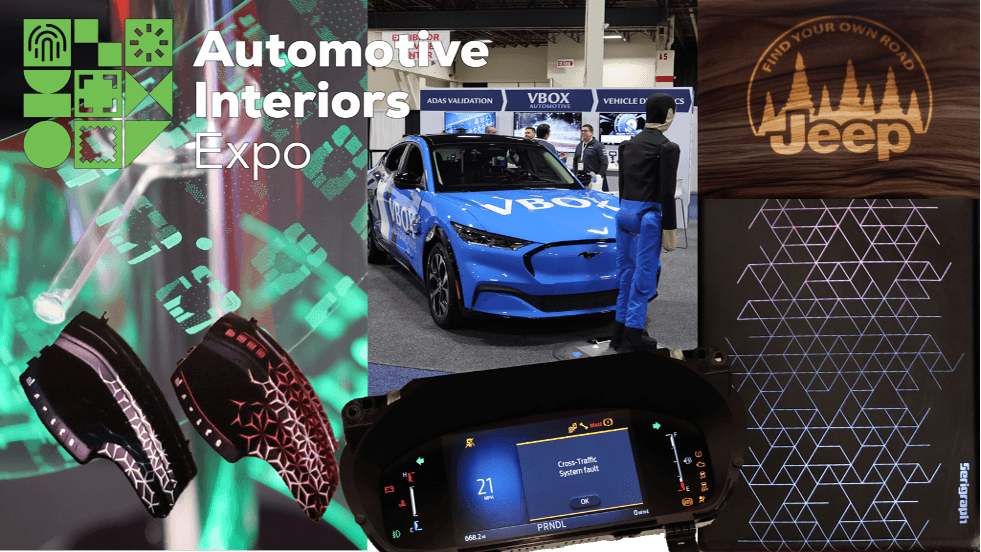
This year’s Automotive Interiors and Testing Expo North America in Novi, Michigan offered a great showcase of solutions and innovations for interior and testing, materials and digital validation and so much more.
The show brought together a broad type and range of suppliers shaping the future of user experience and comfort inside vehicles. From global leaders like Covestro and BASF to specialists in leather, fibers, films and interiors textiles, exhibitors presented how functionality and aesthetics are merging in the next generation of cabin design.
There were specialist suppliers of every part and aspect of vehicle interiors: acoustics and insulation, polymer compounds for flexible components, molded foams for structure and comfort applications, flocked soft-touch surface offerings. The expo also highlighted adhesives, films, and surface-protection solutions to facilitate seamless integration of texture, decorative elements, and lighting in complex interiors.
It was not a surprise to find supply chain partners like McCarthy Group and MEMA.

Suppliers like Apollo and PRD presented molded and partial assemblies components, while Bitron showcased their mechatronic controls and HMI solutions for interior cabin controls. Specialized suppliers like Proell showed their advanced screen-printing inks for polycarbonate films, which enable backlit interior panels with revolutionary design. Second-surface printing on polycarbonate enables deep, scratch-resistant finishes for dashboards, consoles, and HMI panels. Serigraph showcased screen-printed and molded films which merge decoration with function, integrating soft-touch coatings, backlit graphic and conductive layers for heating, sensing or other applications, supporting the evolution towards smart, illuminated surfaces.

Covestro stood out with their collaborative approach as a partner to develop new technology. The company showed their latest TPU and polycarbonate film technologies designed for printed electronics and illuminated interior surfaces, combining stretchability, abrasion resistance, and printability, supporting conductive inks and embedded LEDs for backlit HMI panels and trim. Covestro’s films, often overlaid with PMMA for scratch resistance, are compatible with screen-printing, thermoforming, and in-mold processes, enabling seamless decorative and functional integration. Strategic partners include ACI (conductive inks), SunRay Scientific (epoxy bonding), and Tapecon (conversion and assembly).
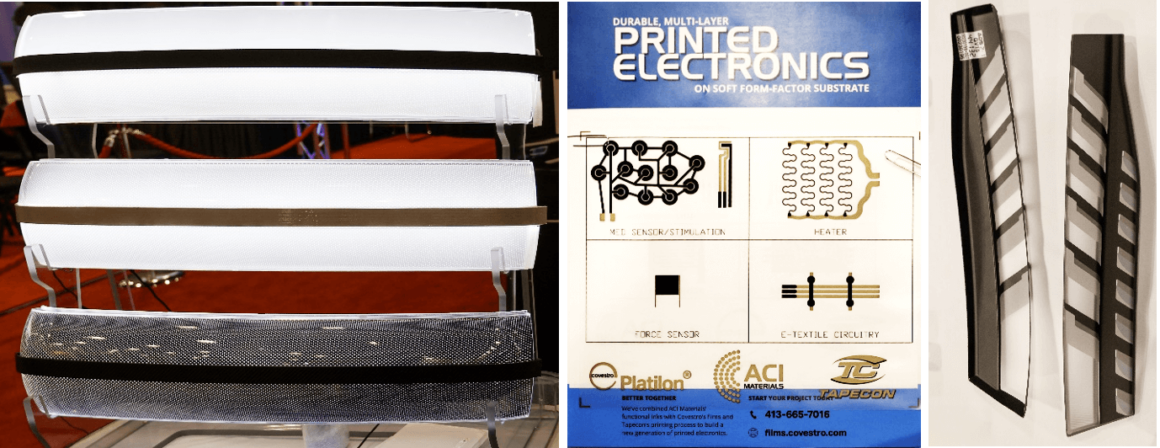
Other notable exhibitors included Global Lighting Technologies, who presented solutions for backlit illumination systems for interior and exterior application, including rearview mirror displays.

Elemantec, representing Mitsubishi Gas Chemical, and Asano presented solutions for interior and exterior applications as well, with PC/PMMA multilayer film offering strength, optical clarity, and surface durability. These materials support thermoforming and in mold process that can be combined with coatings for UV protection and anti-fingerprint solutions for the growing need in high touch, high visibility displays.

There were conferences throughou;the day. The conference program offered a deeper look into how design, data, and digitalization are reshaping the interior landscape. S&P Global Mobility’s Tanya Chantiri opened with a market forecast, mapping upcoming trends and volume forecasts for the interiors sector. Aurel François of Lawrence Technological University and Jesse Diephuis of GM Advanced Design described how AI and emotional design ecosystems are influencing the creative process, and a panel led by Lori Mavis, Derek Prentice, and Tony Sumcad examined the future of interior controls in a diversified post-EV market. Harsha Ravi addressed the ‘paradox of simplicity’, emphasizing ‘intentional friction’ in user experience design, and Brian Caiazza shared insights on Ford’s global sound strategy, highlighting the growing role of acoustics in brand identity.
Technical sessions from Abdul Salam Abdul Karim of Marelli and Robert Ciranna of True North Sustainable Growth closed the series with discussions on AI-assisted safety validation for cockpit ECUs and practical ESG integration for mid-size suppliers.

All in all, the expo emphasized how automotive interiors are evolving into an intelligent, sensor- and sensation-rich environment where material solutions need to be integrated with electronics, software and design. Innovation continues to drive differentiation for User Interface experience. Combined with conferences discussing how AI, safety, materials, process integration and sustainable design, the Novi event confirmed that auto interiors are not at all a static thing; they keep pushing onward and upward.


