By Paul-Henri Matha · DVN CEO and Lighting General Editor
Here is my eight-point list of main takeaway points from the excellent DVN U.S. Workshop ’25:
Safety
ADB now exists in the USA. We were able to test it during night drive with Rivian’s demo-car and a Tesla Y rental car. In my opinion, not a big difference between European ADB experience and US experience. Very smooth; seems like the 1-degree transition zone has been solved.
Rivian and OPmobility were explaining how they developed a 19-segment solution (with also a 16-segment kink for DBL function). High beam FoV is about ±17° width with 5-lux range 160m.


To pass the field test, a lot of loops were needed between the OPmobility and Rivian teams. Carlos mentioned that agile behaviour is important with 2-week loops (instead of classical 3 months loops) for software release.
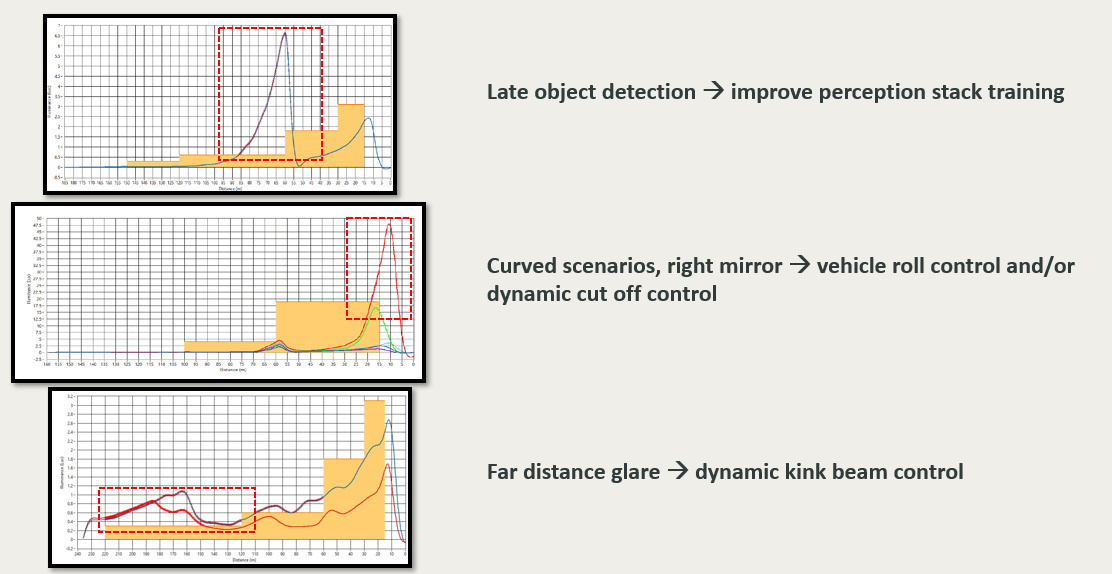
Rivian presented their action plan to fulfil ADB field test: perception stack improvement, vehicle roll and dynamic cutoff control, dynamic kink beam control.
Sapphire (STS) presented an update of their trailer test for US ADB, which already has six customers: Rivian, Toyota, Ford, GM, Dekra, and Volvo trucks. Marelli presented a really interesting lecture about how lighting can support US AEB. Two proposals were shown; one with additional visible light above the cutoff, still compatible with MVSS 108 (but with more glare), and one with 850-nm near infrared sources which may allow for front-camera performance without worsening glare.

Marelli also said we should not focus only on the requirements imposed by FMVSS 127, but also those imposed by US-NCAP starting in 2026.
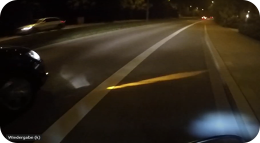
Valeo presented a field study about near-field projection done in Germany and the benefits of road-projected turn indicators. Results are really good (projection visibility > 80 per cent, better understanding of driver intent 87 per cent, preference for projection > 90 per cent, perceived safety 84 per cent).
Interior lighting
I saw a lot of different interesting proposals. Lighting behind knitted fabrics is clearly a new trend that is coming on a lot of cars. Forvia Hella presented an interesting COFI concept with simple light guide concept + reflector that can reach 100 nits luminance, large surface 500 × 150 mm for a 9-mm depth.

Valeo presented technologies with impressive projection systems, with an interesting software management strategy compatible with automakers’ SDV architecture and OTA updates.

Optical lenses
Sunex presented their roadmap to reduce lens size while increasing field of view from 24 to 48 degrees, and the need for hybrid plastic/glass solutions.

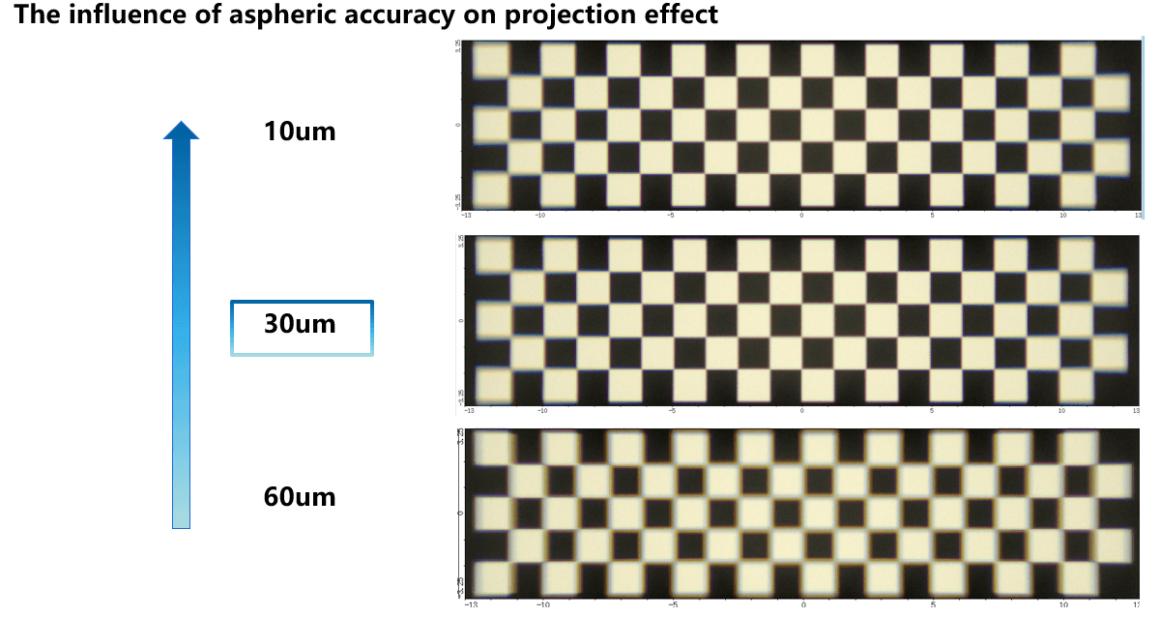
Huaju mentioned the need for accuracy for projection systems.
J.W.Speaker presented a study with super-slim HD module (25mm height) that may be interesting for designers.

Svarowski presented a low beam module with crystal lens that can differentiate the classical standard biLED module.

Materials
Interesting ultra-white Lexan LUX2289 resin from Sabic has good reflective property but low transmission property (to avoid light leakage even with very thin wall). This resin got an Edison award on a BYD lamp application that uses a unitized reflector and bracket system.

Covestro presented Makrolon polycarbonate grades TC, AL 2447, LED 2405 & 2245 EL, and DQ. They fielded an impressive demo with homogeneous lighting across an 83-mm long, 3-mm thick curved lens with no weld line and no optical distortion.

Magna showed an interesting dark-appearance lamp with 25-per-cent light transparency (compared to the 5 per cent existing today on Range Rover lamps). With miniLEDs and a collimator, it has uniform appearance across the lens area. Covestro presented a similar concept with 13 and 30 per cent transparency.

Modules
Valeo presented an interesting lamp for 2-wheelers, which could be an idea for passenger car lamps: superposition of an all-in-one module, similar to a foglamp concept. Would need additional bracket for lamp aiming on vehicle.

AD-S turquoise light
Interesting study from Mercedes with their S-Class in California: average distance is increased by 30 cm when AD-S is lit. Study shows also that other drivers are behaving in a similar way when AD-S is On or Off.


In an online survey (~1,800 participants in USA), 80 per cent think AD-S is not disturbing and 44 per cent think it clearly improves safety.
Electrics & Electronics
There were lots of presentation about different protocols (LIN, UART over CAN, Ethernet, OSP) to talk about future with automakers’ EE architecture for SDVs or smart RGB applications (all-in-one LED + LED driver). The conclusion of the panel discussion was the need for deeper discussions and alignment between automakers and tier-1 and -2 suppliers to converge on standard solutions.
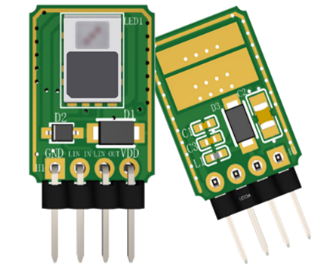
Brightek presented an interesting LIN-Lite all-in-one RGB LED + LIN transceiver as a world first. It may reduce packaging, BOM and cost.
Light Sources
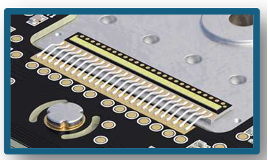
ams Osram showed their Oslon PX24 which combines from 5 to 100 addressable pixels.
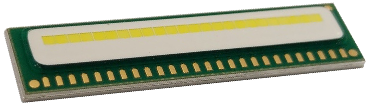
Lumileds presented a similar concept, already in production on the Volvo XC90 and ES90 (NeoExact 1.0 mm2 with 24 pixels, 1-row array)
Films
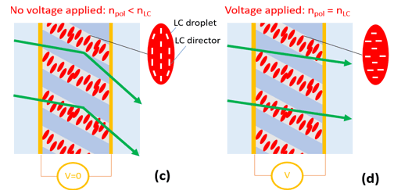
Luminit presented a promising SGB (switchable Bragg grating) technology, with electrically-controlled holographic film which diffracts or transmits light on demand. This enables compact, tuneable optical functions for digital lighting applications such as lit grilles and grilleboards.
SL Corporation presented a first: with laser welding with infrared ink through galvano film, to replace chrome. They say it brings a 45-per-cent CO2 reduction versus standard chrome plating.


