By Paul-Henri Matha
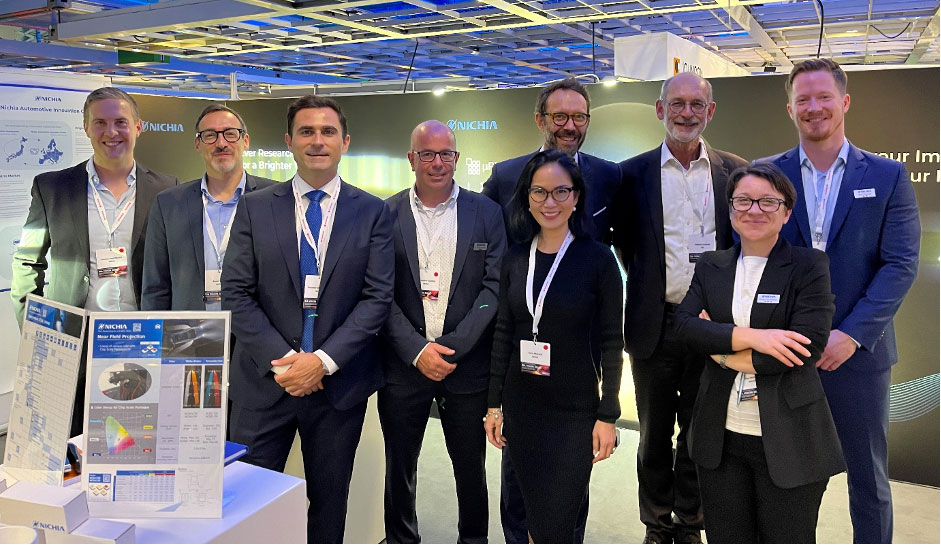
At SIA VISION, I discussed evolution of automotive LEDs with Xavier Denis, Technical Head at Nichia Europe. During the event, Nichia showcased four technologies:
µPLS: Micropixelated Light Source
Nichia’s µPLS is a pioneering light engine integrating pixelated microLEDs. It is ideal for high-definition ADB applications. The µPLS delivers exceptional brightness, high pixel density with individual pixel control, and flexible connectivity, seamlessly integrating into modern electrical/electronic car architectures. The integrated driver IC, co-developed with Infineon, independently controls over 16,000 microLEDs using PWM.

Chip Scale Package (Colour): Optimized for Near-Field Projection
The Chip Scale Package (Colour) projects clear, bright images directly onto the road, helping drivers navigate safely in adverse conditions.
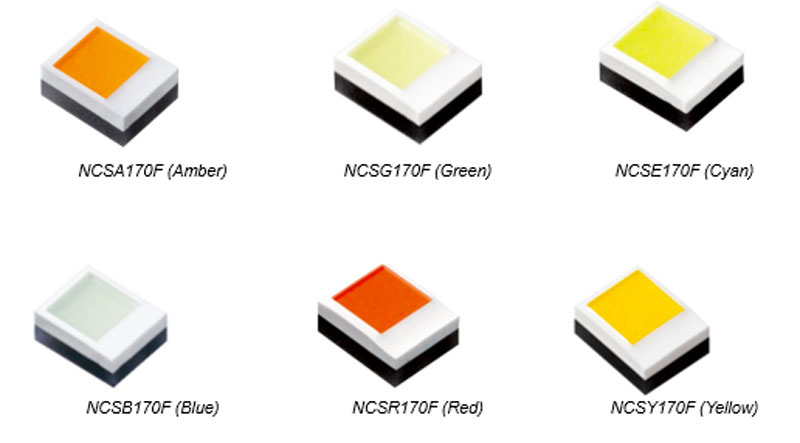
Chip Scale Packages (White): For Thin-Design Headlamps
Nichia’s latest Chip Scale Package (White) enables the development of ultra-compact, slim and sleek headlamps, enhancing vehicle aesthetics and safety without compromising performance or efficiency.
Interior Lighting: High-CRI Light Simulates Natural Sunlight
Nichia’s high-CRI products demonstrate the impact of mimicking natural sunlight, providing exceptional colour rendering to improve visibility and minimize eyestrain.
All these great products are ideal for enhancing both vehicle interiors and exteriors, contributing to safety and comfort with clear, precise lighting.
DVN: Will you please introduce yourself?
Xavier Denis: I’m Xavier Denis, the Head of Technical Marketing and Technical Support at Nichia Europe. With over 20 years of experience in lighting and optics, I have held various management roles at Nichia, GE Lighting, and Optis. My academic background includes a Bachelor of Science in Applied Physics from the Georgia Institute of Technology and an Executive MBA from Corvinus University. I am passionate about advancing next-generation light source technologies, ranging from human-centric solutions to microLEDs, and I look forward to sharing valuable insights with you today.
DVN: As a light source manufacturer, and a presenter and exhibitor, what stood out to you at VISION?
X.D.: We had the opportunity to do a lecture as well as exhibiting at the show. This dual presence made the congress a great platform to showcase our expertise and innovations with direct engagement with vehicle lighting professionals. The event allowed us to maximize both our visibility and networking opportunities within the industry.
As for main takeaways, the congress highlighted the transformative impact of LED technology on the automotive industry. Automakers continue to adopt dynamic and adaptive lighting systems, leveraging technologies like chip scale package LEDs, matrix LEDs, and microLEDs to improve safety. Sustainability was another key theme, with LED manufacturers focusing on delivering of energy-efficient solutions.
Automakers and tier-1 suppliers are clearly striving for stronger supply chain partnerships, encouraging LED makers to provide integrated solutions and engage early in vehicle development to deliver innovations that meet global standards and align with the evolving needs of the automotive industry.
DVN: What do you think of blue diodes versus RGB?


X.D.: RGB LEDs are primarily focused on interior lighting rather than exterior applications. This is largely due to regulatory restrictions that currently do not permit multicolour lamps for exterior use, except for specific scenarios such as parking mode. Additionally, there is the strong demand for more reliable light sources with higher power output to ensure visibility during the day, as current RGB solutions are limited to 0.5W, which is insufficient for many exterior needs.
Another challenge lies in the lack of standardization for communication protocols between LEDs through LED IC. While protocols exist, such as ISELED, and LED manufacturers like Osram or Nichia have also introduced their own open protocols. However, a unified solution that the industry can adopt universally has yet to emerge.
An alternative to RGB light sources is the use of discrete colour LEDs, all based on blue diodes with different phosphor conversion for each colour. The main advantage of this approach is to simplify the colour shift management by delivering consistent performance even at high temperatures, eliminating the need for individual PWM adjustments for each LED. Discrete colour LEDs also overcome power limitations, making them more suitable for exterior applications. Additionally, there is no need to add a fourth LED to obtain a real white colour (RGB-W solution) as this can be easily handled with broader colour gamut management. This combination of benefits makes discrete colour LEDs an attractive option for exterior lighting in automotive applications.
P.H.M: How about lasers; do you see similar trend to go to multicolour solutions?
X.D: Nichia is at the forefront of automotive RGB laser diode innovation, combining high luminance and reliability. Our QuaLas platform is the world’s first SMD RGB laser to meet automotive standards. With QuaLas and TO-CAN packages paired with advanced technologies like MEMS mirrors and digital micromirror devices, these diodes enable high-efficiency and high-performance solutions for exterior and interior projections, as well as head-up displays. The diodes offer a wide colour gamut for vivid visuals, a long lifespan to reduce maintenance costs, and compact design for flexible integration across various systems.
P.H.M: Speaking of Head-Up Displays, including Augmented Reality HUDs, what technology do you think will dominate?
X.D: There are currently three solutions involving the integration of RGB LED, RGB lasers, and white LEDs, each undergoing significant innovation. For an AR HUD, higher brightness and larger sizes are required, necessitating a significantly brighter light source. Tier-1 suppliers are requesting a luminance of 10,000 cd/mm2 – 10 times that of an ADB matrix light source. The good news is that this level of brightness is achievable with LEDs as well.
P.H.M: Do you see emerging trends in classical lighting and signalling functions?
X.D: We observe two distinct major trends. The first is safety, with a focus on enhanced performance. For example, signalling projection is gaining traction, and to ensure visibility during the day, laser technology proves to be an excellent solution. The second trend is power consumption, as car makers aim to reduce power use, or expand lighting and signalling capabilities without increasing energy demands.
To address these needs, Nichia are developing chips without any saturation while maintaining high performance, and improving packages with better thermal dissipation and advanced electronic integration—such as smart LEDs and microLEDs.
P.H.M: How do you see the market developing in the coming years?
X.D: I would like to highlight six main points for a light source maker:
- Advances in miniaturization at the chip and package levels
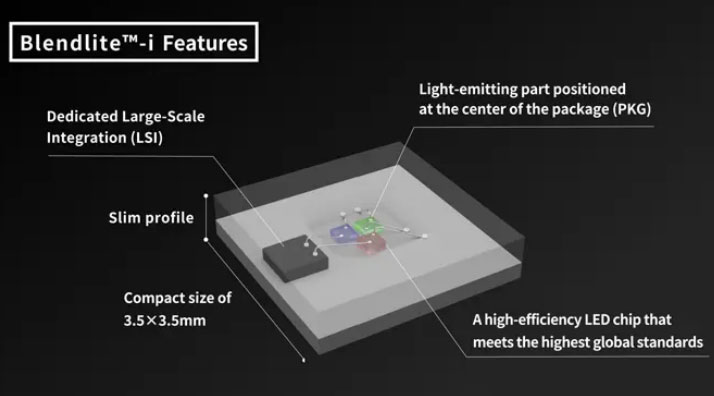
- Electronic integration in package, including smart driver and even more. Our Blendlite-i RGB light source is a good example.
- Human-centric lighting continues to be a focus for interior lighting with high CRI (colour rendering index) and designs that support the human circadian rhythm, enhancing comfort and wellbeing for car occupants.
- LED deployment in cars will continue to grow, with manufacturers focusing on achieving this within the same price and same power consumption.
- Signalization extension, such as enabling bright, visible signal projection by day to improve safety and communication on the road.
- Product lifecycle assessment analysis will grow in importance and impact the way we address development and production processes, especially in terms of addressing designing light sources for re-use and repair.


