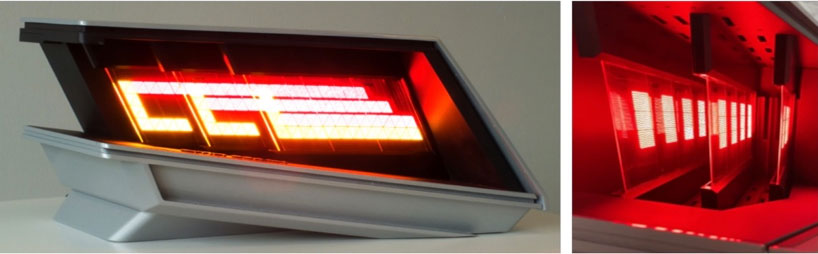
At ISAL last week, ams OSRAM introduced their new Aliyos™ technology: a thin, transparent, 2.5D-bendable foil for creating customized, multi-segment, adaptive, 3-dimensional lights and invisible-when-unlit lights on curved panels.

MiniLEDs are assembled onto a thin transparent substrate (the ‘foil’). Thin metal traces on top of the substrate are used for current-spreading within the segments, and as contact pads for the miniLEDs. Typically, several miniLEDs are connected in series within one string and several such strings, in turn, are connected in parallel to fill the segment area. The number and position of the LEDs and the corresponding wiring has a large degree of freedom, and so can be used to form individually-addressable segments of any shape. The flexible LED foils can be part of a transparent stack, or applied behind translucent materials.

This enables revolutionary designs and on-demand features. Connected by almost invisible metal traces, the mini-LEDs can be arranged with a large degree of freedom to form individually addressable segments of any shape. They can be positioned to perform standard lighting functions such as a stop light or turn indicator, but with unique, custom shapes and animation effects. The mini-LEDs can also be used to display symbols, words, images or abstract patterns for decoration, information, or warning. Multiple foil assemblies can be placed one behind the other to create dramatic new 3D lighting and animation effects.
For the ISAL presentation, ams OSRAM built two rear combination lamp prototypes: an ultra-thin 2.5D curved one, and a transparent one with 3-dimensional design. Both prototypes feature customizeable tail and stop light functions as well as turn signals with 256 and 384 addressable segments, respectively. The prototypes more than meet the UN R148 requirements for the luminous intensity of the stop, tail, and turn signal functions.

You can use it like a film, you can bend it, it can be homogeneous with an additional diffusive element, it can be pixelated, it can have a display appearance. A lot of new possibilities and for sure a lot of interest for designers and stylists! Industrialization of the technology has begun. The aim is to enable the first cars to be equipped with Aliyos lights by the end of 2025.
This new concept was one of the major innovations released during ISAL, and the DVN team took time to discuss it with Manuel Walch, ams OSRAM automotive signalling product marketing manager:
DVN: You mentioned 2025 for SOP. Will you start first with red colour, or both red and yellow? And what about white color for DRL, front position, and reversing lights?
Manuel Walch: In the first generation we will have red and yellow available. White will follow shortly thereafter with the second-generation Aliyos.
DVN: What about optical performance, what luminance can you reach? What’s the power consumption and efficacy like?
M.W.: The achievable luminance depends on the colour and the forward integration of the Aliyos foil in the customer’s solution. Brightness levels greater than 10,000 cd/m2 are possible. Power consumption depends on the customized design, including number and shape of segments, and on the segments’ brightness level. To get an idea: in our own demonstrator, we would be able to fulfil the stop light function with ~10W power consumption for the array of three Aliyos LED foils mounted one behind the other.
DVN: How about integration, how will you connect this film to the lamp harness? What can you say about qualifications like AECQ-102?
M.W.: The forward integration is something we are discussing with the tier-1s and OEMs. Our target is to qualify the Aliyos LED-on-foil technology for automotive exterior. I ask for your understanding that we don’t share details at this time.
DVN: Have you also considered how your Aliyos technology will work in terms of the EPLLA (effective projected luminous lens area) requirements in the USA? Will it go by pixel surface or film surface?
M.W.: For sure we will consider together with our customers the legal requirements and have to pass legal values and tests.
DVN: Thank you, Manuel, for the interview. This is amazing technology!
At ISAL last week, ams OSRAM introduced their new Aliyos™ technology: a thin, transparent, 2.5D-bendable foil for creating customized, multi-segment, adaptive, 3-dimensional lights and invisible-when-unlit lights on curved panels.
MiniLEDs are assembled onto a thin transparent substrate (the ‘foil’). Thin metal traces on top of the substrate are used for current-spreading within the segments, and as contact pads for the miniLEDs. Typically, several miniLEDs are connected in series within one string and several such strings, in turn, are connected in parallel to fill the segment area. The number and position of the LEDs and the corresponding wiring has a large degree of freedom, and so can be used to form individually-addressable segments of any shape. The flexible LED foils can be part of a transparent stack, or applied behind translucent materials.
To read more, you need to be DVN Gold Lighting or log in


