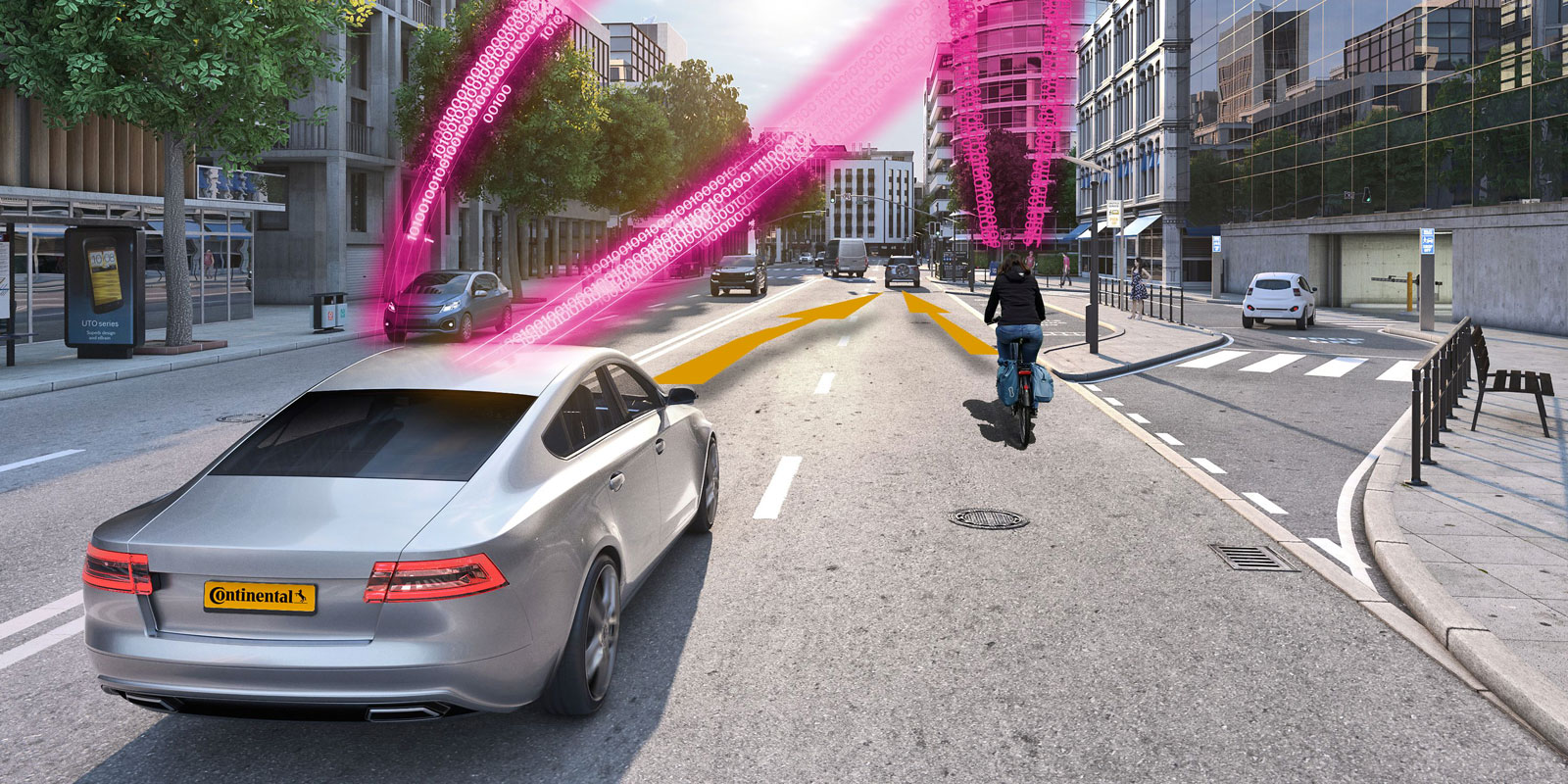
Continental and T-Systems, a division of Deutsche Telekom, are developing a system that warns of accidents between connected vehicles and VRUs (vulnerable road users) including cyclists, scooter riders, and pedestrians. The solution calculates the paths taken by cars and bicycles. If they are likely to cross at the same time, the system warns both road users via mobile communications in real time. Initial road tests have been successful.
Continentals Head of Research and Advanced Development Karsten Michels says “Vulnerable Road users in particular are often overlooked in road traffic. What’s more, according to the European Road Safety Council, more than 80 per cent of accidents between pedestrians or cyclists and motorised vehicles end fatally for the vulnerable road users. Thanks to real-time networking and collision warning, we therefore give cyclists or pedestrians more visibility. In this way, we reduce serious accidents, injuries, and traffic fatalities”.
And Oliver Bahns, responsible for connected mobility at T-Systems, says “With collision warning, we are equipping cyclists, pedelec and scooter riders with a digital guardian angel. The key to this is the high level of connectivity: around 85 per cent of the population in Europe uses a smartphone. And more and more cars are connected, too. With our computers in the mobile network, we also ensure extremely short response times”.
The collision warning system is based on GPS, acceleration sensors, mobile communications, and cloud computing. The car transmits its position and acceleration values to the cloud via mobile communications. The cyclist also sends this information to the cloud via smartphone. It calculates the paths for the next 5 seconds and sends a warning to the car and the cyclist’s device if a collision is imminent. To ensure that this information reaches both road users as quickly as possible, the nearest cloud computer in the mobile network to the location of the possible collision is always used.


