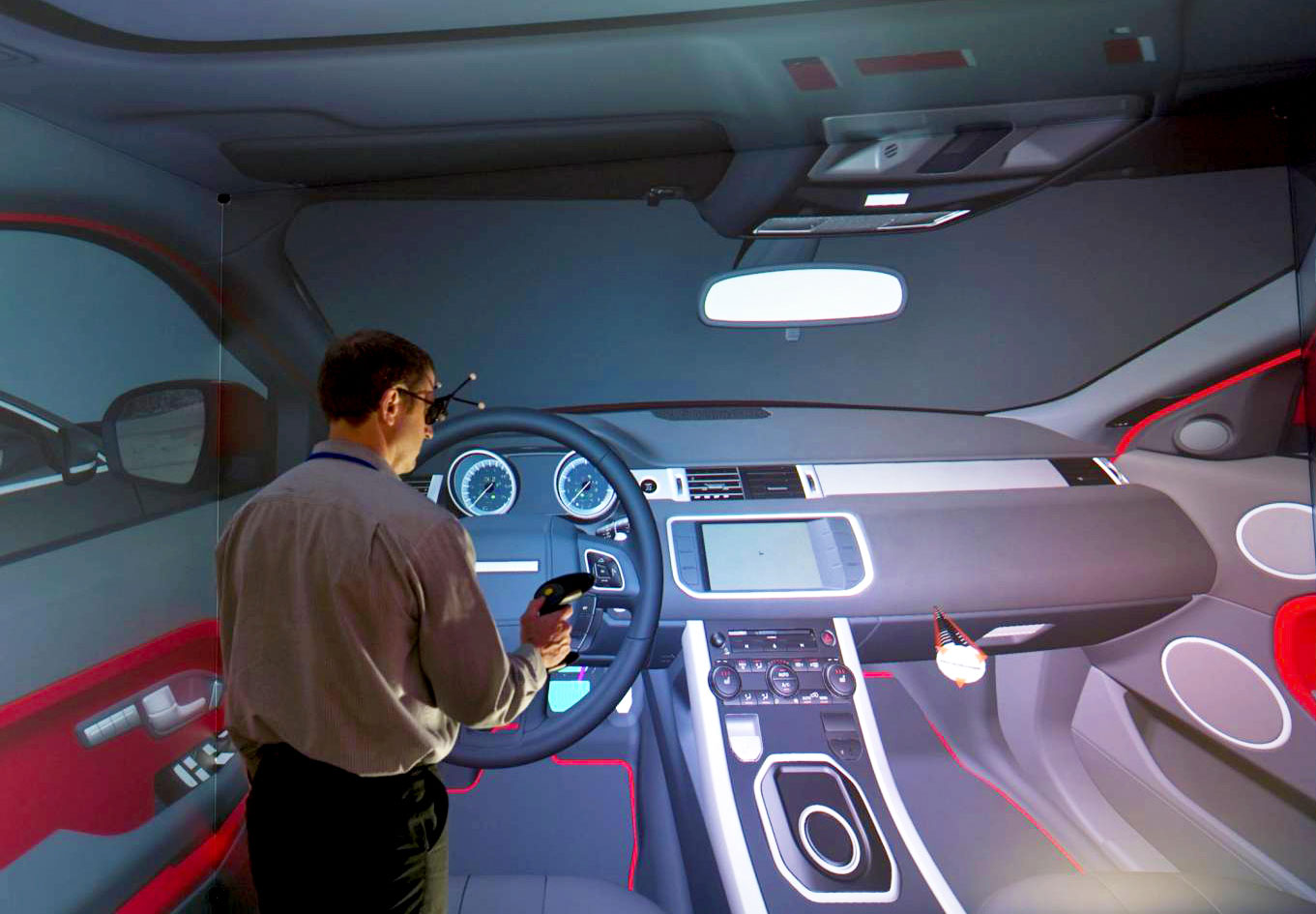
25. VR as a design tool_
Often in car design, Virtual Reality is part of the design process. This kind of practice has come a long way. With the intention to illustrate an aspect of everyday life, the 50-second silent film showing a steam locomotive entering the train station as a continuous real time shot, eternalized the Lumiere brothers in the accounts of filmmaking. The story goes that when the film was first screened, the audience was so overwhelmed by the moving image of a life-sized train coming directly to them, that people screamed and ran to the back of the room. Whether or not it actually happened, the film undoubtedly astonished people, unaccustomed to the illusion created by moving images. That was in 1896.
Since, the ability to change perceptions and create a sense of presence, trained us continuously. By looking many hours, a day to any unnatural, rectangular frame/screen we passed from representation to simulation, from a framed moving image to a 360-degree view embodiment. We have always created worlds through ‘windows’ and now with VR we can step into them and participate to the making of. Unlike all other media, VR does not have a format. Entering virtual utopia is about tricking the senses by limiting any physical surrounding. The lack of critical distance suspends any disbelief. While toaster-size goggles are strapped on our face and an awkward feeling of isolation occurs, we each create our own environment. Unlike in UX, language is not the only form of interaction. Gesture, face expression and body posture, can play an equivalent role. We can practice anything, from surgery to public speaking, from spacewalk to being lifted out of our bodies into someone else’s posture, from driver to passenger or to a pedestrian looking at the car we are in. Thus, it provides a way to create a different understanding from someone else’s point of view, adjusting a sense of self according to the viewpoint. However, car interiors are environments, not objects and the amount of information needed is multiple.
Building interiors in virtual terms is a bit like world building. Orthographic views such as plans, elevations, front and rear views don’t matter anymore since they all merge into one holographic universe, up to their most realistic value. Unlike VR exteriors, in interiors there is never enough distance to see pure elevations and more than ever we don’t ‘see’, but we ‘experience’. In the interior world, the most complex of all 3D perceptions, representations and creative process require particular artistic genius, comparable to cinematographic environment art. In any other kind of representation, like paintings, our consciousness interprets the medium, while here VR becomes the medium.
VR can be a performing design tool. What is furthermore stunning in this creative and creating process is that ‘materiality’ is gone. This is the main characteristic of interiors and their reason to be, as the molds of our body-envelops, and so car interiors become visual environments in the purest sense, often loosing scale to the benefit of any important detail. No bumping anymore on bolsters or on central consoles allows a better observation and perception of its systemic aspect. Visually, it often feels like flying through a district of tall and short buildings or deep diving through passages, corridors and cavities, twisting space and time. It is only our physical memory that holds everything in place. The fact of being able to immaterialize interiors while designing them, provides a higher degree of sophistication. It is like making theater sets during rehearsals.
Obviously a ¾ flip-up of a driver’s seat doesn’t have the same value of a ¾ tip-up view of the entire interior and if the same views are applied respectively to the overhead, they acquire an important R&D value. With the VR, we are fleeing the human perspective, looking into aspects and angles we have never though they existed, learning a lot more about our limits.
VR is a representation medium in a way we have never seen before. It is a picture about the use of a picture, representing reality not as it is but as needed to be and often works like an empathy machine. Trying to explain what VR stands for, is as irrelevant as undetermined and wavering. We progress faster towards the result in a world that even instant gratification is too slow. Frames within frames, images within images, dimensions and perspectives mixed with unreal immaterial proportions, are maybe not the alternative to morphine but a chance to capture feelings of reality, way beforehand. By stepping out of ourselves into VR, our brain is adapting, providing enough of a perspective shift that enables different instant views and options of the future. Virtual reality is the short-cut to the future. The question is who is going to design a different future.
‘Life is not a problem to be solved, but a reality to be experienced’
Søren Kierkegaard
_to be continued…
__________________________________INDUSTRIOUS__


