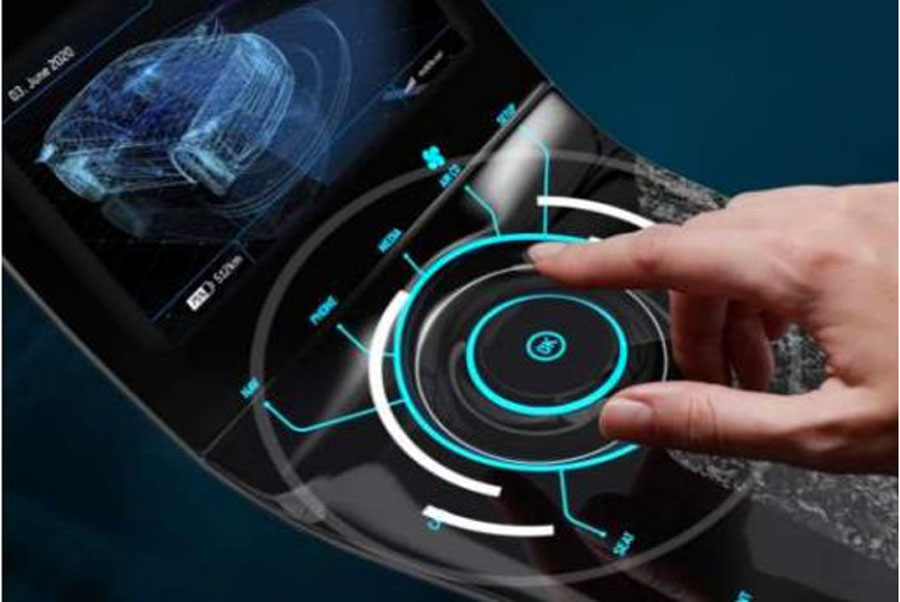
DVN Interior reported lecture by Dr. Wolfgang Clemens, Director Product Management & Business Development from PolyIC, a Kurz company, at the 2021 DVN Shanghai international Workshop about “Smart HMI Surfaces with Touch Sensors in April 29 edition. We’re going here deeper in the Touch sensor technology.

User interfaces are progressing in car interiors, and in the whole consumer technology world, smart phones to home appliances. Touch screens and capacitive keys are replacing simple displays and electromechanical keys. The user experience, combined with exceptional design, is gaining significance with increasing digitization.
The PolyTC® capacitive touch sensors are based on transparent and conductive films. Typical for PolyTC® sensors is a conductive coating with a metal mesh in high optical resolution, which is applied to a transparent polyester substrate (PET). The lattice-like silver microstructures provide maximum electrical conductivity and at the same time high mechanical flexibility. Even designs with real 3D shapes can be furnished with this sensor technology.
PolyIC delivers sensor foils as a single, ready-made sensor label including supply line and connector, the appropriate adhesive or process-specific primer, and foils to protect against scratches. The sensor foils are adapted to the specific integration process and to the needed material consistency and can be directly processed. The integration into the plastic parts is aligned to the geometry and size of the part and sensor. It is performed by stamping or rolling with pressure and heat, is fully automatic, highly precise and durable. This Functional Foil Bonding (FFB) can be linked directly to the injection molding process for high quality functional surfaces. In comparison to conventional processes, you have advantages in the stability when specification requirements are high.

PolyTC® touch sensors can also be applied with lamination. It covers a wide spectrum of application scenarios on glass and plastic surfaces – even in small runs. But with an eye to the future of touch-sensitive surfaces, this proven standard method has its limits, such as when used on outgassing plastics or curved surfaces. In contrast, the injection of labels in In-Mold Labeling (IML) processes is fully automatic, and combines simultaneous decoration using In-Mold Decoration (IMD) or insert foils.

Lamination: To achieve high transparency, the display industry in particular employs laminating with cost-intensive OCA (Optical Clear Adhesives) as a standard integration process for touchscreen sensors. If only transparent or visually noncritical surfaces are requested, PSA (Pressure Sensitive Adhesive) is usually used. PolyTC® offers sensors with both OCA and PSA coatings.
Inmold Labeling (IML) is a time saving injection molding procedure.A combination of IML with IMD increases the efficiency and quality of the processes in the production of 3D touch surfaces. Simultaneously the transparent, conductive PolyTC® sensors should be applied to the parts during the injection-molding process. A combination with insert decoration foils is possible, as well as sensor integration without decoration. Advantages are a high visual quality for injectable plastics and the linking of decoration and function in one step.


