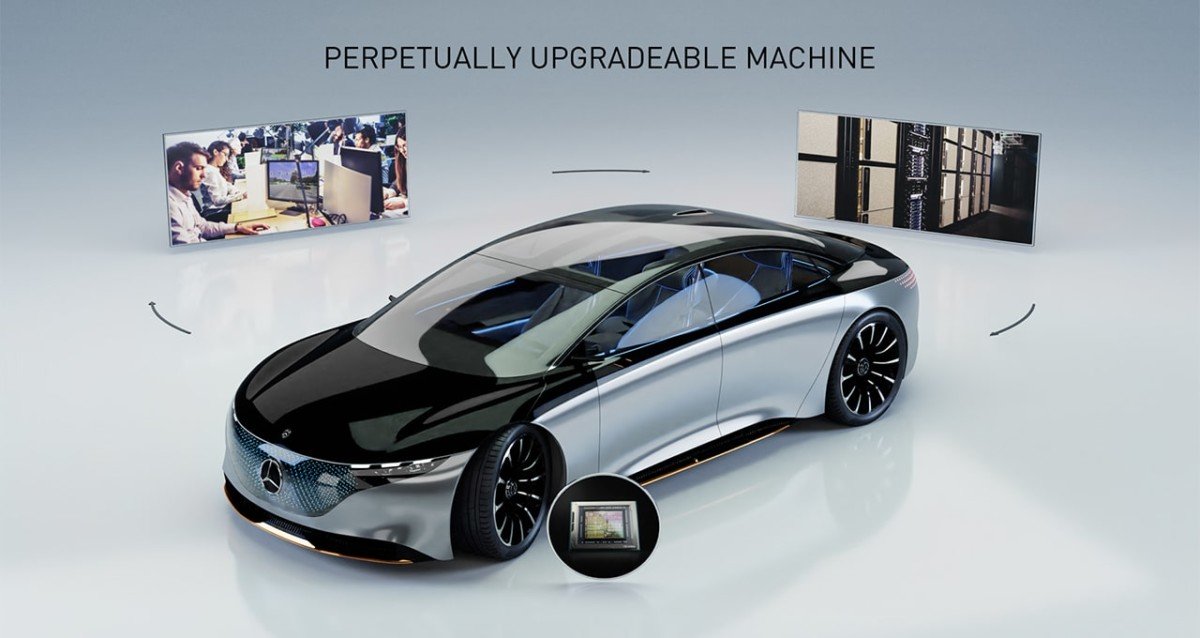
A week after BMW and Mercedes canceled their tie-up for autonomous car development, Mercedes announced they will use a full Nvidia software and hardware system for to power self-driving cars set to first roll in 2024.
The system will be based on Nvidia’s Orin chip, which they claim outperforms Tesla’s FSD computer by ~38%.
Nvidia’s system will be available progressively on all Mercedes vehicles. All cars will come with the hardware built in, regardless of whether or not they are ordered with self-driving options installed. This sounds similar to Tesla’s current model of including Autopilot hardware on all cars, then selling full self-driving as a software option.
The companies emphasized that next-gen vehicles will be “software-defined” with continuous upgradeability—also similar to Tesla.
Another aspect of the software-defined car will be the presence of apps, much like those on a smartphone. Some apps may be free and some may be paid, but this will be a way for owners to customize their driving experience and for cars to lengthen their usable life by getting new features (OTA?) after release. No information at this stage, if it could be open to third-party developers.
While Nvidia claims their Orin is capable of up to L5, Mercedes only plans to take the system up to L2 or L3, with L4 parking capability as a geofenced fully autonomous operation, with human override available.


