
Textiles for A surfaces in the car interior are becoming ever smarter and increasingly multifunctional. Textiles can contain light, heating, switching, electronics and sensor technologies, realized in laminated composites with a thickness of about 1 mm. Companies like FLT (Future Lighting Technologies) deal very intensively with this topic.
Lighting:
Optical fibers are woven into the textiles and laterally connected with LEDs, to couple light into the light guiding optical fibers. To create a homogeneous illuminated area or a light pattern on demand, the optical fibers have to be activated by implementing light scattering centers on the surface or in the volume of the light guiding materials. Another technical solution for luminous textiles is the processing of current-carrying threads with soldered Micro-LEDs, collected and connected to smart electronics with an electric power supply, separated or also integrated in the textile.
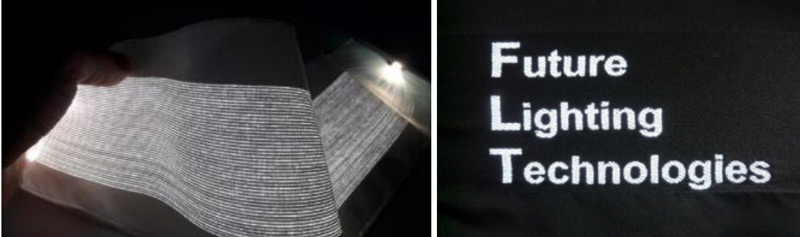
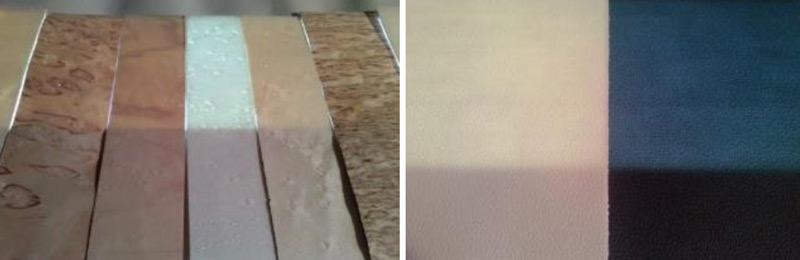
Light patterns on demand with sharp contours and hidden-until-lit structures can also be made by screen printing of electroluminescent paste.

The advantages of lighted textiles compared to rigid plastic light guides:
- light emissions out of very thin light guiding materials over the whole textile surface
- large area backlighting of translucent materials
- 2D and 2.5D geometries by using special weaving structures or elastic yarns
- low or no tooling costs
Heating:
Electrically conductive threads can be woven or knitted into textiles. Connected with an electrical power supply, the filaments can be heated up to 65 °C for an automotive seat heating and up to 100 °C for other technical applications—to eradicate viruses, perhaps?
Another material for homogeneous heated surfaces is nonwoven fleeces with pressed and fixed conductive metallic or carbon particles. A laminated composite of a heated and a lighted fleece has a thickness of about 0.5 mm and allows—directly below the A surface—a very fast heating of the surface material.

Advantages of heated textiles and fleeces compared to conventional heating systems:
- Power of heating can be adjusted by:
– electrical power input
– definition and composition of raw materials
– number of processed heating fibers
– perforation of heated fleece
- 2D deformable, thin, breathable, robust, laminable, light weight
- uniform heating output
- very low tooling costs
Contactless switching in textiles:
For a switching operation in textiles, e.g. for a seat or door heater, during the lamination process nearly invisible electronic contact foils can be incorporated for a touchless capacitive switching below the surface material. The contacts are connected to an electronic control unit with thin contact wires or FPC-foils. For haptic feedback of the switching operation, vibration micro-motors can also be incorporated into the composite.


