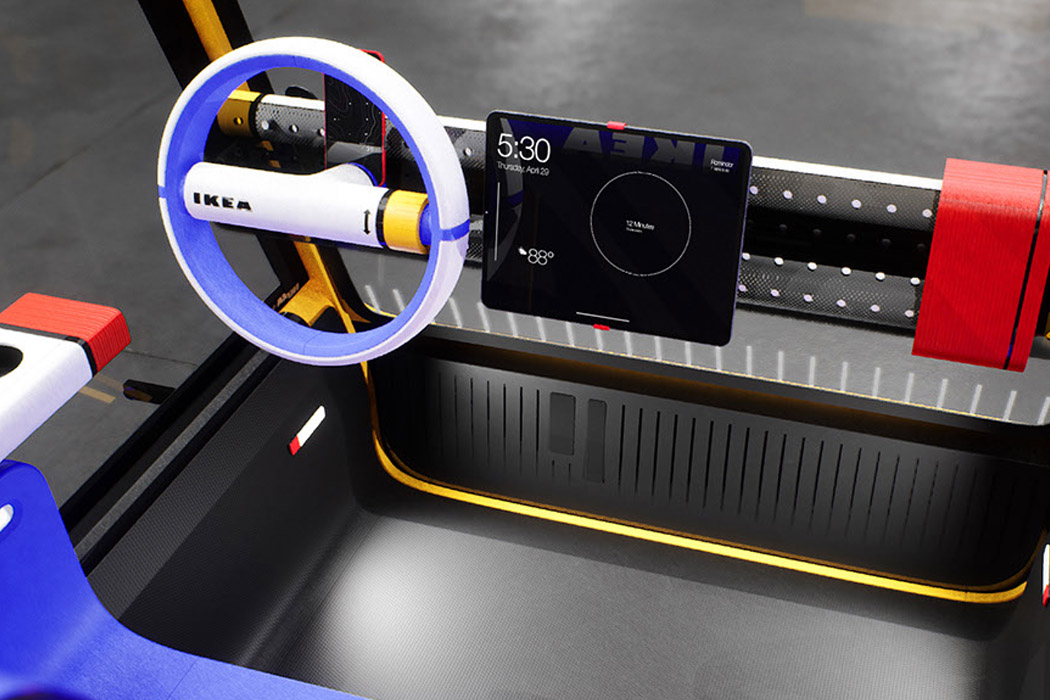
Ikea is teaming up with Renault for the Höga project, an electric car, accessible and to be assembled yourself. Still at the project stage, the car is a small city car 2.3 m long and 1.80 m high (the Smart Fortwo is 2.5 × 1.51 m); despite these dimensions, it’s spacious on the inside. Originally, it was transportation design student Ryan Schlotthauer’s bachelor thesis.

Designed as the ultimate kit car, this tiny vehicle is inspired by Ikea design philosophy and is made to integrate within Renault’s EV mobility program. It aims to be “clever, low cost and sustainable,” without any compromise to passenger safety, usable interior space, or ease of use.
The car itself ships in a box, like Ikea furniture. There’s the upcycled skateboard that ships in one piece and an assortment of parts that you will have to assemble yourself. The A-frame design of the body includes an integrated roll cage, and the two parts click together like Lego. The Höga has 374 total parts and 114 individual parts, and as any DIY product, probably more you will never know what they’re for! Color coding is used in the interior to enable the smoothest operation without the need to employ an instruction manual.
The Höga is modular. The cabin has a steering wheel, a large display, and the possibility to use your own device for entertainment. The entire dash clips onto the windscreen, so access and egress are through the front and rear. Ikea would offer a range of options, depending on your needs. You could have two seats in the front, or just the driver seat and more cargo space, or tandem seats with a child’s seat in the back.
The Höga is sustainable: the platform is upcycled, and most parts are recyclable, so it won’t create waste even after the end of its useful life. Even the box it ships in is reusable: you can send your old furniture back to Ikea as part of its recycling program. Because of the smart use of materials, the Höga would also be cheap, retailing at around €5,300.
Will the project go to market? Probably yes, if it passes quality and cost hurdles, and homologation.


