(A designer’s look at our mobility-centric culture)
2. Disruptive city planning
This is the second in DVN-I’s series of articles on trajectories as æsthetic depictions of our mobile self, in which we continue with the typology of displacements that reflect new economic, social and spatial organizations.
With speed being the third reading dimension of every trajectory, all aspects of the journey are distinguished. Long fast sweep segments, straight constant speed lines, or slow curvy arcs—and combinations of all these. Technical progress on tires, suspensions, brakes and steering brought better control of the carriage and drew smoother trails. By 1740, the outspread network is a mosaic of all sorts of drawn trajectories. This choreographic pluralism boosted by the cross section of different means of transportation gives rise, late in the 18th century, to the first sidewalks separating mobile paths and categorizing pedestrian pathways.
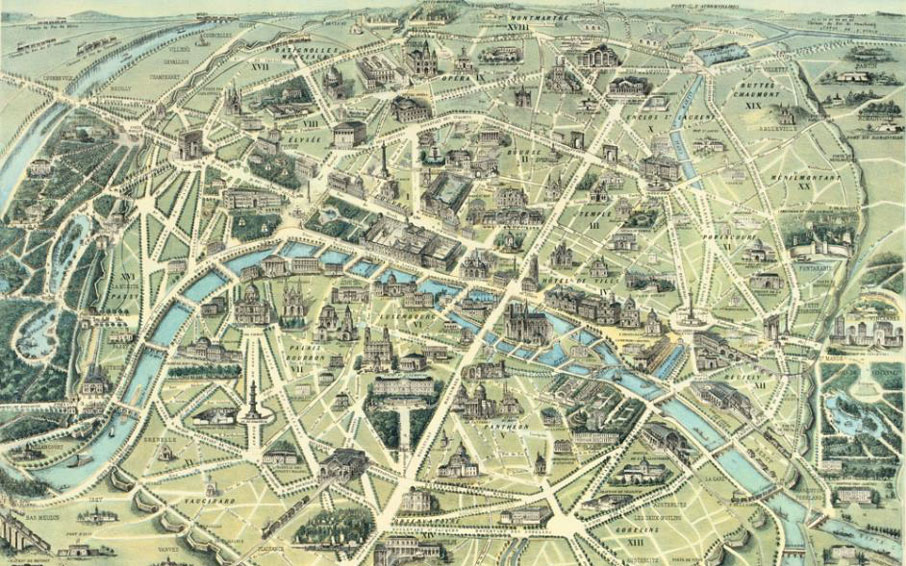
Baron Haussmann, the first celebrity urban planner, wished during the reconstruction of Paris to institute a policy facilitating the flow of people, goods, air, and water; he was convinced by the hygienist theories inherited from the Enlightenment and which had spread following the cholera epidemic from 1832. This campaign was entitled “Paris embellished, Paris enlarged, Paris sanitized”. («L’urbanisme hier et aujourd’hui. Et demain…?», Jean-Claude Poutissou, in Les Publications de l’AUEG) . Haussmann’s obsession with the straight line, called the “cult of the axis” in the 19th century generated vast spatial constructions intersecting staging monuments in vast perspectives in the form of avenues or large squares. The resurrection of Paris included sidewalks for the first time—Parisians could now dress up and wear nice shoes. Hence, city streets were transformed into places to see and be seen among the fashionable elite, redefining the experience of urban life in the process. After the railway track, a second mobility segregation took place with space dedicated to pedestrians. A category on its own with slow, extremely fluid and flexible trajectories that can crack rules and infiltrate any vehicle paths, even coexist within, like in the subway that has been described as a moving sidewalk.
In the last decades of the 19th century, population growth in Paris caused a considerable densification of the central districts and the operations carried out by Haussmann influenced the urban planning of several cities bringing about major demographic and social changes.
INDUSTRIOUS_


