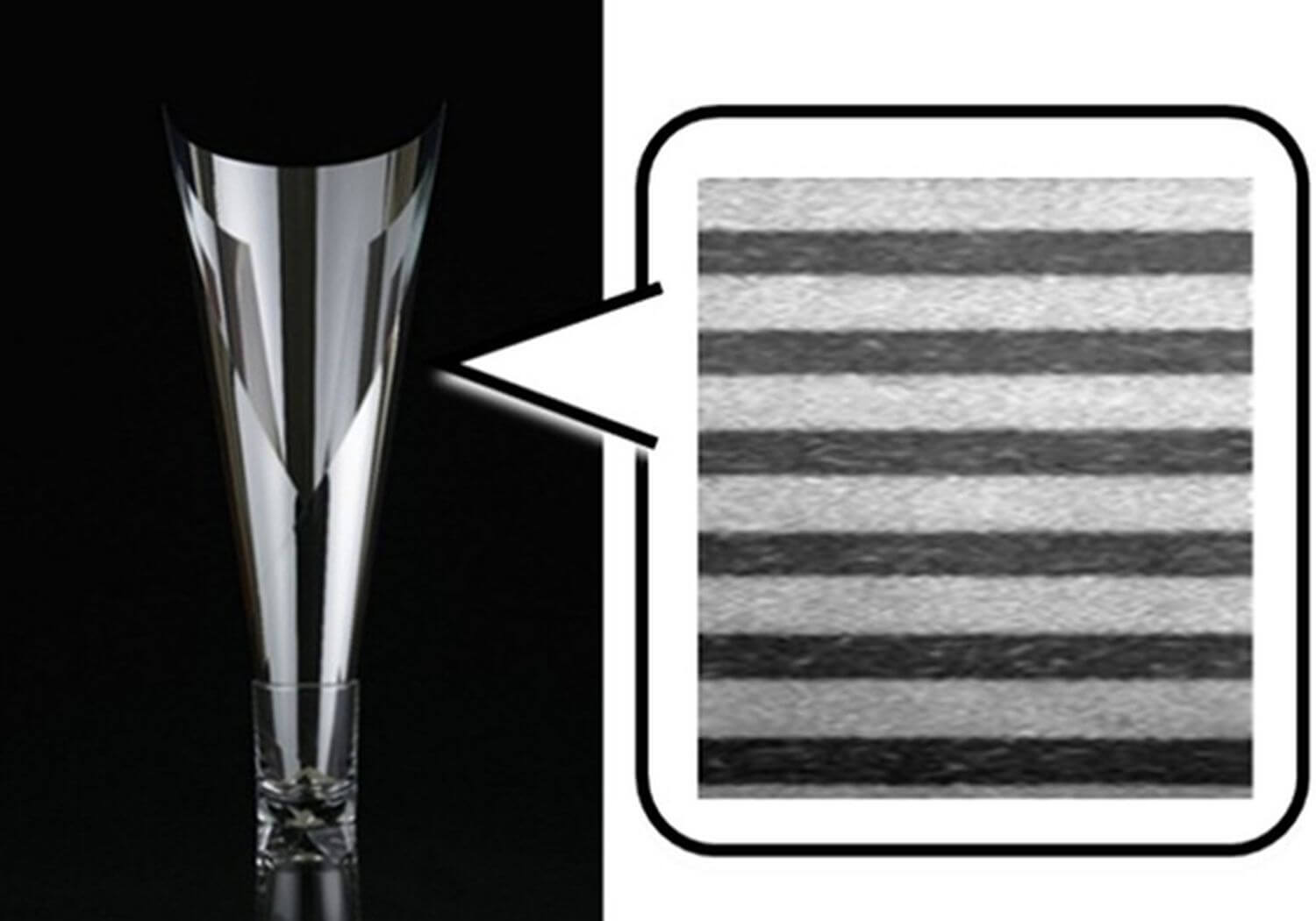
Toray has established its high-precision nano-laminated film technology by combining and deepening its core technologies of polymer molecule design, film optical design, high-precision equipment manufacturing, and stretching film manufacturing process technology. Furthermore, based on this technology, it has developed and industrialized PICASUS®, a nano-laminated film with optical interference reflection capabilities, and has been promoting its social implementation in a wide range of fields. These series of technological developments and efforts toward practical application have been recognized as outstanding achievements, and Toray has now received the “74th (2025) Chemical Technology Award” from the Chemical Society of Japan.
To achieve optical reflection properties through nanolayer structures, it is necessary to laminate polymer layers with different refractive indices with ultra-high precision at the 1nm level, spanning hundreds to thousands of layers. However, conventional industrial manufacturing methods have faced challenges in ensuring sufficient reproducibility of the laminated layer thickness, which is essential for realizing optical functions, and uniformity of lamination over large areas.
Toray has established a high-precision nanolayer film technology that was difficult to achieve with conventional industrial methods by integrating and advancing elemental technologies: polymer molecule design considering fluidity and optical properties; film optical design based on optical theory and simulation calculations; high-precision equipment manufacturing through polymer flow analysis and precision metal processing; and stretch film manufacturing process technology.
Furthermore, based on this technology, Toray has created PICASUS®, a nano-laminated film utilizing multilayer optical interference. PICASUS® possesses light control technology that selectively reflects specific wavelength bands from the ultraviolet to the visible and near-infrared regions, and also boasts excellent moldability due to its all-polymer composition. As a result, it is being put into practical use in a wide range of fields, including design and display applications.
The mobility sector has seen increased demand for improved comfort in the vehicle interior and for highly visible and advanced information displays. To meet these needs, Toray has further refined our nano-lamination technology and developed world-first polymer materials with optical functions, such as the highly transparent and heat-shielding film PICASUS®IR and the front-transmitting and oblique-reflective film PICASUS®VT, for HUD applications.
By applying “PICASUS®VT,” a wide nano-laminated film with the property of reflecting only light from oblique directions, to HUD (Head-Up Display) technology, it is possible to achieve a highly clear display without double images across a wide area of the windshield, and the display can also be clearly seen even when wearing polarized sunglasses.
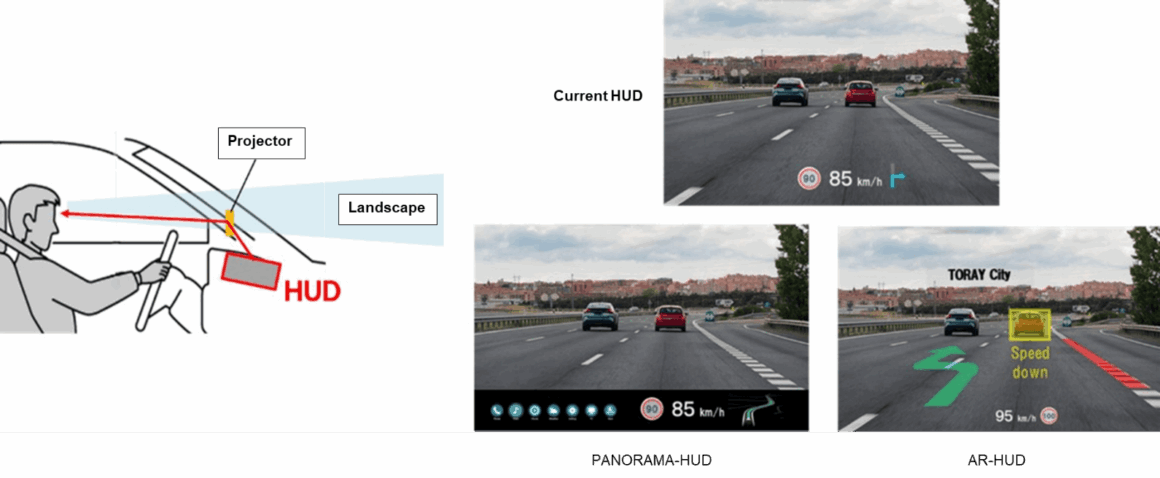
Current HUD technology displays information by projecting S-polarized (S-polarized) images, which are easily reflected by glass surfaces, onto the windshield. However, with typical windshields, the image is reflected from both the front and back surfaces, resulting in a double image. Therefore, special glass that prevents double images is used to achieve partially clear displays. Furthermore, polarized sunglasses, which absorb S-polarized light, are widely used in Europe and the US, but they present the challenge of obscuring the image when worn.
Toray’s PICASUS®VT offers glass-like transparency when viewed from the front and selectively controls reflectivity for oblique light. By combining this with a light source that emits P-polarized (P-polarized) images, which are not reflected by glass surfaces, the above challenges are solved, resulting in the following characteristics as a projection material for HUDs.
By reflecting images only on the film surface, high-definition information display is possible over a large area.
Toray has deepened its material design, manufacturing equipment, and process technology for this film, and has established a system to supply 1600mm wide film rolls applicable to almost all automobile windshields.
If a high-definition, double-image-free information display that is also compatible with polarized sunglasses can be achieved, driving assistance information can be conveyed to the driver with minimal eye movement, and visibility can be ensured even in bright sunlight, thus improving driving safety.


