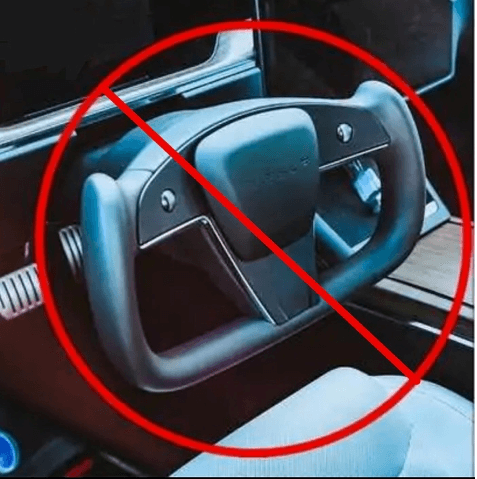
China’s MIIT (Ministry of Industry and Information Technology) has published the preliminaries of a safety standard intended to prevent injuries caused by steering mechanisms. The standard includes updated test procedures requiring impact testing at specific points around the steering wheel rim – points not present on yokes and half-wheels.
The preliminary text asserts that steering yokes – widely disliked by consumers and safety experts ever since Elon Musk declared round wheels “boring” – can permit a driver to move past the rim in a collision, and toward the dashboard. The document also says 46 per cent of driver injuries are linked to steering mechanisms, and that airbags in steering non-wheels can be less predictable in deployment compared to those in actual steering wheels, and that whole wheels provide a larger surface area to cushion a driver making contact.
The new steering wheel safety standard will take effect on 1 January 2027, the same date as the ban on Tesla-style pure-electric door handles (Tesla has reportedly been linked to at least 15 deaths in crashes where doors became unopenable following a crash or in a fire): mechanical door releases will have to be accessible inside and outside the car. Semi-hidden handles are allowed, but must provide a recessed area not smaller than 60 × 20 mm, and there must be signage at least 10 × 7 mm in the cabin, indicating how the door can be opened.
There will be a 13-month transition period for vehicle models already homologated with steering nonwheels when the rule takes effect, while the doorhandle transition period will run to January 2029.
China is the world’s largest car market, so bans there on steering nonwheels and imaginary doorhandles stand to influence the design of cars worldwide. This, like China’s regulation-in-development on wide-angle seats, signals China’s emergence from followship to leadership on vehicle safety regulation.


