By YH Research
Against the backdrop of the accelerated evolution of the global intelligent connected vehicle industry and increasingly stringent automotive safety regulations, the Driver Monitoring System (DMS), as a core intelligent configuration ensuring driving safety, is becoming a standard system in automotive intelligence upgrades thanks to its technological advantages of real-time perception, proactive warning, and precise intervention, with the market showing explosive growth. According to research by Hengzhou Chengsi, the global revenue of automotive DMS systems is estimated to be approximately C¥49.42bn in 2024 and is expected to reach nearly C¥174.83bn by 2031, with a CAGR of 22.8 per cent from 2025 to 2031. By integrating multimodal sensors and AI algorithms, DMS transitions from passive safety to active safety, not only filling the monitoring gaps of traditional safety configurations but also driving the automotive safety system toward a ‘human-vehicle-environment’ collaborative protection upgrade, providing critical safety support for the large-scale adoption of intelligent connected vehicles.
The vehicle DMS (driver monitoring system) is an intelligent safety solution based on visual and sensor technologies. Its core goal is to monitor the driver’s physiological and behavioral states in real time, proactively identify safety risks, and trigger warnings to prevent accidents. Its technical architecture revolves around the core link of perception-analysis-decision-warning, integrating various sensors such as infrared cameras and millimeter-wave radars with AI algorithms to build a comprehensive driver state perception network, achieving a shift from single-feature monitoring to multidimensional state assessment.
From a technical perspective, the core of the DMS lies in multimodal sensor fusion and AI intelligent analysis: the perception layer captures the driver’s facial features (such as eye movements, blink frequency, and facial expressions), head posture, and body movements through infrared cameras. Millimeter-wave radar assists in monitoring subtle body movements and posture changes, and some high-end systems even integrate biosensors to collect physiological signals like heart rate and respiration, achieving multidimensional data acquisition through vision, radar, and biosensing. The algorithm layer uses deep learning models to fuse and analyze multisource data, accurately identifying risk states such as drowsy driving (e.g., frequent blinking, nodding off), distracted driving (e.g., looking down at a phone, eyes off the road), and dangerous behaviors (e.g., not wearing a seatbelt, driving while holding objects). It also has adaptive learning capability, dynamically optimizing the recognition model based on different driver habits. The application layer issues warnings to the driver through audio-visual alerts, steering wheel vibrations, or seat reminders. Some systems can even interface with the vehicle’s control system to implement interventions such as deceleration and lane keeping, forming a closed-loop safety protection of monitoring-warning-intervention.
From a technological advantage perspective, modern in-vehicle DMS have three major breakthroughs: First, non-contact monitoring, which does not require the driver to wear any device; monitoring can be achieved through in-vehicle sensors, ensuring driving comfort and operational convenience. Second, high-precision recognition, where the iteration of AI algorithms has significantly improved the accuracy of risk behavior identification, allowing the system to distinguish different levels of fatigue and types of distraction, avoiding false positives and missed detections. Third, real-time response, with sensor data collection and algorithm analysis latency controlled at the millisecond level, ensuring timely risk warnings and giving drivers sufficient reaction time.
The DMS forms a comprehensive safety protection functional system by monitoring the driver’s status across multiple dimensions, covering all driving scenarios. From fatigue and distraction to dangerous behaviors, it identifies potential risks in an all-around manner, providing customized safety protection for different types of vehicles.
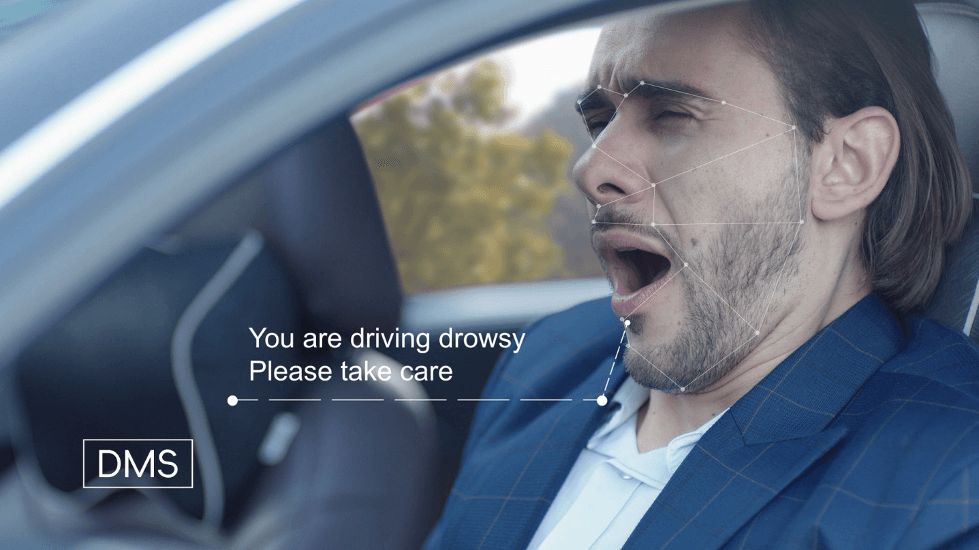
Fatigued-driving warnings are one of the core functions of the DMS, which assesses the driver’s fatigue state by monitoring eye and head features. The system analyzes metrics in real time, such as blink frequency (e.g., reduced blinking, increased eye closure duration), pupil changes, head tilt angle, and nodding frequency. When moderate fatigue is detected, a level-1 warning is triggered (audio-visual alert), and in cases of severe fatigue, it escalates to a level-2 warning (seat vibration, active deceleration), effectively preventing delayed reactions or loss of control caused by drowsiness. This function is particularly important in long-distance and night driving scenarios, making it a key safety feature for both commercial and passenger vehicles.
The distracted driving alert monitors drivers’ attention deviation from the driving task, covering both visual and behavioral distractions. Visual distraction monitoring tracks eye movements to determine whether the driver’s gaze is off the road ahead (such as frequently checking the rearview mirror or looking down at the center console), while behavioral distraction monitoring identifies actions that affect driving, such as using a handheld phone, smoking, or drinking. When distracted behavior is detected, the system promptly issues an alert to guide the driver’s attention back to driving, reducing the risk of accidents caused by distraction and meeting the safety needs in the complex traffic environment of urban roads.
Hazardous behavior recognition and intervention further expand the scope of safety protection, including monitoring dangerous situations such as not wearing a seatbelt, opening the car door while the vehicle is in motion, or the driver leaving the seat. Some advanced DMS also feature driver identity recognition, verifying the driver’s identity through facial features to prevent unlicensed driving or vehicle theft. At the same time, by combining the vehicle’s driving status (such as high speed or emergency lane changes), the system dynamically adjusts monitoring sensitivity, achieving precise protection under various driving conditions.
The application of in-vehicle DMS has gradually expanded from commercial vehicles to passenger cars, special vehicles, and other vehicle types. Different vehicle models, based on usage scenarios and safety requirements, are driving the DMS towards standardization and high-end development, forming a multi-tiered market demand structure.
The commercial vehicle sector was the early application scenario for DMS, with demand focusing on long-distance transportation safety. Commercial drivers have long driving hours and high labor intensity, leading to a high risk of fatigue driving. Regulations in many countries generally require DMS on large commercial vehicles. Commercial vehicle DMS emphasize interlinked warnings for fatigued driving, speeding, and lane departure, with some systems capable of uploading driver status data to fleet management platforms, helping operators regulate driver behavior and reduce fleet operational risks and accident costs.
The passenger car sector is the core engine of market growth, with demand rapidly expanding alongside smart upgrades. As consumers pay more attention to vehicle safety and the race for intelligent car features accelerates, DMS have penetrated from high-end models to mid- and low-end models, becoming an important selling point for new cars. Passenger car DMS focus more on user experience, integrating personalized features (such as adjusting the interior environment based on driver mood, memory for seat and mirror positions) in addition to basic safety warnings. They also interact with autonomous driving systems, playing a key role in driver takeover alerts for L2 and high autonomous driving levels, ensuring safety in human-machine co-driving scenarios.
Applications in the field of special vehicles emphasize scenario customization. For instance, for school buses and hazardous material transport vehicles, DMS need to enhance specific functions based on their operational characteristics. DMS for school buses adds monitoring of driver and passenger interaction status, while for hazardous material transport vehicles, the focus is on ensuring drivers comply with safety operation standards. Custom solutions meet the safety needs of these special scenarios.
The explosive growth of the global automotive DMS market is the result of the combined effects of mandatory safety regulations, the upgrade of vehicle intelligence, declining technology costs, and rising consumer demand. Multiple driving factors together create a strong growth momentum.
Major countries and regions worldwide have introduced automotive safety regulations that include DMS as mandatory equipment. Some countries have explicitly required newly manufactured commercial vehicles to be equipped with DMS, and the compulsory adoption of DMS in passenger vehicles is also gradually being promoted. Under regulatory pressure, automakers must accelerate the development and installation of DMS to meet access requirements, creating rigid market demand and serving as the core driver of market growth.
Intelligent connected vehicles have become the mainstream in the industry, with the penetration rate of L2 and higher autonomous driving models rising rapidly. As a critical part of autonomous driving safety, the DMS is responsible for monitoring the driver’s status and providing takeover alerts, making it an essential configuration for achieving advanced autonomous driving. At the same time, with the development of intelligent cockpits, the integration of DMS with smart cockpits is deepening, creating more personalized application scenarios, further enhancing product added value and market demand.
The costs of sensors such as infrared cameras and millimeter-wave radars continue to decrease. The open-source nature of AI algorithms and improvements in chip computing power have significantly lowered the hardware costs and development barriers for DMS. Meanwhile, the continuous maturation of industry solutions is driving the DMS from customized development toward standardized products, enabling rapid integration across different vehicle models and accelerating the large-scale market application process.
Consumer attention to vehicle safety has shifted from passive safety (such as airbags and vehicle structure) to active safety, with more users increasingly considering DMS as an important factor when purchasing a car. The richness of active safety configurations has become a key differentiator for automakers, driving the rapid increase of DMS penetration in the passenger vehicle market, gradually becoming standard in mid-to-high-end models.


