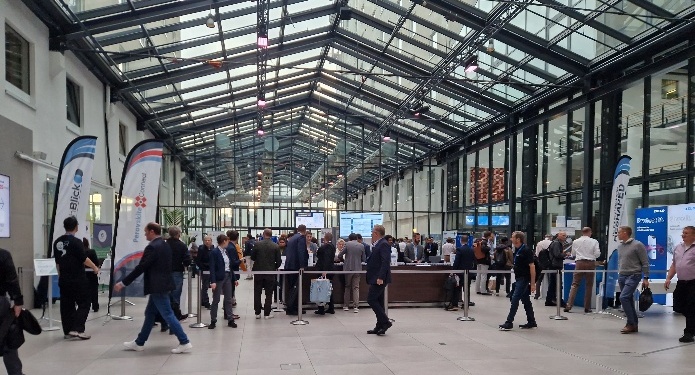
The TechBlick show in Berlin this past month sparkled with innovations relevant to vehicle interiors – and not just those on roads! Here are some of my highlights, favorites, and takeaways:
Alqio printed electronics for functional surfaces
Within the Armor Group, Alqio specializes in transforming materials into functional surfaces — turning thin films or textiles into components that sense, react, or communicateIts work sits at the intersection of advanced coatings, printed electronics, and electroactive polymers, bridging R&D and industrial-scale manufacturing.
Alqio leverages ink-based electronic printing techniques — such as screen printing, gravure, or inkjet — to create conductive, resistive, or piezoelectric layers directly on flexible substrates. Unlike traditional PCBs, these printed circuits are additive: material is deposited only where needed, reducing waste and enabling integration on curved or soft surfaces.
Recent advances in functional inks (silver, carbon, or graphene-based) and dielectric formulations allow the design of multilayer devices that remain lightweight, flexible, and scalable. This approach supports a new generation of components (smart sensors, flexible heaters, and electroactive transducers) embedded directly into films or textiles and new substrates like steel, glass, and wood maybe soon? We will have to watch and see!
A capacitive sensor glove and a piezoelectric film loudspeaker
At the show, I saw a prototype capacitive sensing glove built on a thin flexible film printed with a network of conductive traces and electrode patterns. Each printed capacitor detects variations in electric field caused by proximity, touch, or pressure. The electrodes and dielectric layers are deposited by printing on a polymer or textile substrate, maintaining functionality.
This prototype shows promising response, in term of gesture recognition, haptic interfaces, and human–machine interaction compatible with lifetime of the vehicle
Another fascinating prototype was a printed loudspeaker based on a piezoelectric polymer film, developed in collaboration with Arkema’s Piezotech division. The film consists of a poled copolymer layer, sandwiched between two printed electrodes. When excited by an alternating voltage, the electroactive film vibrates and generates audible sound without any moving coil or rigid diaphragm.
The result is a thin, flexible, and transparent acoustic transducer suitable for integration into textiles, packaging, or curved structures. This technology also opens possibilities for haptics.
Alqio – Arkema Collaboration

The Alqio – Arkema collaboration focuses on leveraging the unique properties of the P(VDF-TrFE) polymer family. These materials combine high piezoelectric coefficients, thermal stability, and processability in roll-to-roll environments.
Together, Arkema and Alqio are exploring scalable fabrication routes for printed electroactive films that can serve both as sensors and actuators. Arkema (as Piezotech) contributes expertise in polymer chemistry and film processing, while Alqio brings industrial know-how in coating, printing, and prototyping.
Epoxy to replace printed electronics with thermoplastic terminations? Heraeus says yes!

The shift advocated by Heraeus at TechBlick is the adoption of high-temperature thermoplastic terminations instead of ‘flex’ epoxies. In practical terms, this absorbs card flexing (tests up to 10 mm and drift < 3%) and reduces ceramic micro-cracks that undermine the stability of HMI/lighting functions, especially on thin, rigid-flex and IME/IMSE cards integrated into doors, dashboards, headliners or seats.
For interior design and integration this would mean greater freedom for large curved screens, continuous lightbars, backlit surfaces and haptic actuators — fewer stiffeners around cut-outs and better margins for door-slam/NVH-type impacts.


