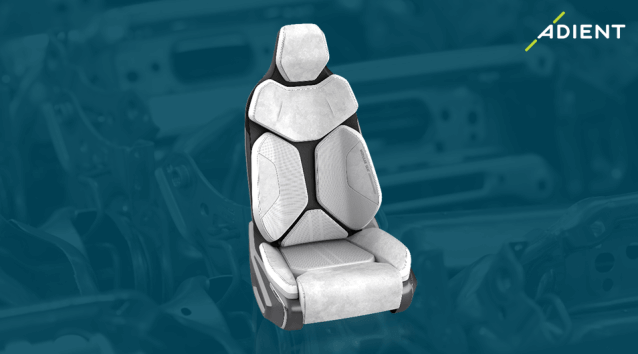
Adient has announced their latest breakthrough, the ModuGo seat. They say it redefines how car seats are designed, manufactured and experienced.
Inspired by the flexibility of building blocks, ModuGo lets automakers achieve higher efficiency at lower cost to deliver a highly customizable, adaptive and comfortable in-car experience, by dint of modular design for highly agile product development and manufacture.
Traditional seatmaking relies on complex and integrated structures that are labor-intensive. ModuGo shifts this approach with a modular design which:
• Enhances assembly efficiency by 36.3 per cent compared to conventional JIT models
• Simplifies production workflows, reducing total processes by 34 per cent
• Increases output from 50 JPH (Job Per Hour) to 78 JPH using the same workforce
• Shortens production line length by 72 per cent, delivering significant savings in floor space
The central thing is Adient’s ‘one base, multi-use’ platform philosophy. By swapping baseplates and modules, Adient and its customers can rapidly configure seat designs and functionalities tailored to different vehicle models, reducing development time and cost while maximizing flexibility.
This lets automakers create unique seats that reflect their brand images and meets the needs of their target users. Built on Adient’s Ultrathin base and lightweight frame technology, the ModuGo system supports full customization across structural zoning and styling, material and color selection, and smart features including heating, ventilation and massage.
The Ultrathin base enhances cabin space and aesthetics with fully recyclable materials.

ModuGo’s adaptive support mechanism is engineered for dynamic comfort. Its modular layout aligns with the body’s muscular structure, especially in the lumbar and back zones, allowing real-time adjustments that respond to driver and passenger movement.
The seat also features an open-zoned spinal support area that enhances lateral muscle support while relieving pressure along the spine. This design not only improves long-distance comfort but also reflects a deeper commitment to occupant well-being.


