By Daniel Stern, DVN Chief Editor
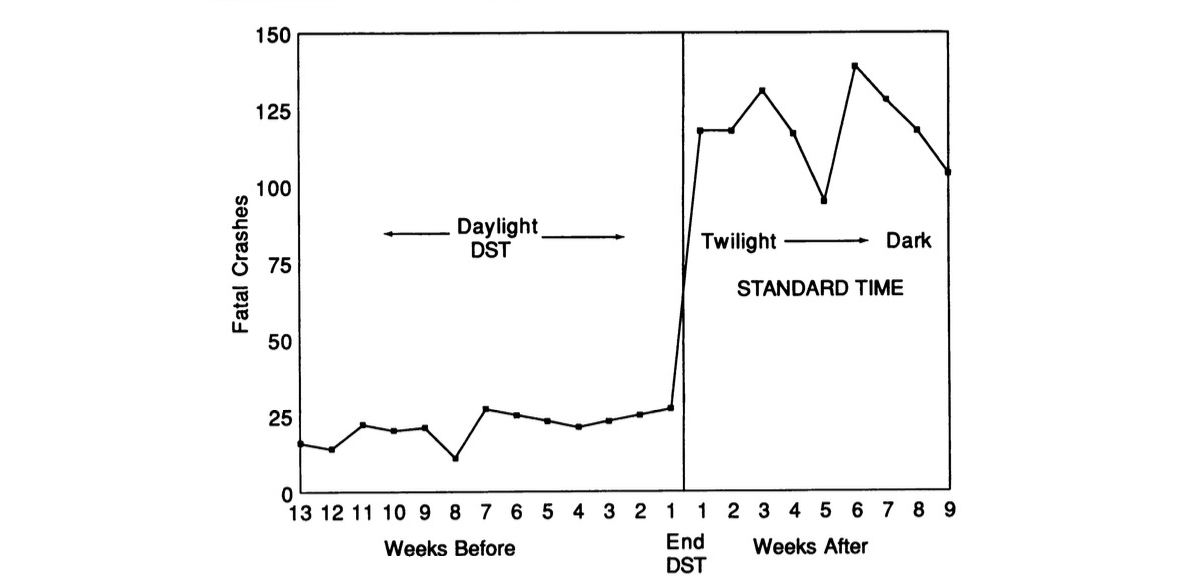
For quite a while, we’ve been reporting on the sharp increase in nighttime pedestrian fatalities which accompanies the annual clock-shift to standard/winter time, and persists until the clocks are put ahead an hour to daylight/summer time.
Now, the Canadian province of British Columbia have gone ahead with a shift to permanent daylight/summer time. In BC, last weekend’s spring-forward adjustment of the clocks was the last one; when (some) other provinces and countries make the shift back to standard/winter time next fall, BC will not. The change was planned in 2019, but put on hold pending similar moves in the US states of Washington, Oregon, and California – the idea being to avoid incongruence in the Pacific time zone. But as the linked BC press release makes clear, things have changed with regard to how the United States is functioning (or isn’t), and so the plan was put into effect.
The cardiologists say changing the clocks causes a spike in heart attacks and strokes because of physiological stress – and they’re probably right. The sleep specialists talk about sleep disruption – and they’re probably right. The psychologists talk about brain fog and cognitive dysfunction; they’re probably right, too. Pretty much everyone agrees the clocks ought to be left alone so we can stop giving ourselves two cases a year of artificial jetlag, with all its physiological and psychological bad effects. So far, so good.
But there’s no shortage of people talking about circadian rhythmic disruption, as though we all live in caves in the forest and our lives are illuminated only by the sun, the moon, and whatever fires we might be able to make – they’re loud, and they’re squawking that the province has got it wrong, that they should have legislated for permanent standard/winter time. Problem is, they’re claiming to wield “the science”.
Perhaps there’s some validity to some of what they say, but to overinflate it into the totality of the science is just plain wrong. As with anything about our world, there are many causes and many effects. The hard part is figuring out what the net overall effect is, and how to optimize it. Making that even more difficult in this case is that when a bunch of people say “we should get rid of daylight saving time”, some of them might mean it literally (adopt permanent standard time), some of them mean the opposite (adopt permanent daylight time), and many of them just mean stop messing with the clocks twice a year, and they don’t care which way is permanent.
BC has chosen to go to permanent daylight time. As a result, drivers will hit fewer pedestrians. And, as Scientific American has just pointed out, they’ll hit fewer big animals, too. Surely, more ambient light during high-road-activity hours will be at least as effective as Finland’s experiment with retroreflective reindeer!


