By now everyone probably knows the sequential turn indicator activation story: the UNECE regulation change was initiated after an Audi proposal at GTB in Copenhagen in May 2012, 14 years ago. Indeed, regulation was not clear enough about bulb activation time (small delay with filament bulb technology) while it has become possible to activate LEDs in microseconds instead of milliseconds.

After long discussion in GTB and GRE, UNECE regulations were clarified, including R48 (vehicle lamp installation) and component regulations.
Extract of UNECE R48 (vehicle lamp installation) edited for clarity here:
2.7.6.5. “Sequential activation” means an electrical connection where the individual light sources of a lamp are wired such that they are switched ON in a predetermined sequence according to the relevant UN Regulations.
5.9.3. The photometric characteristics of a [front or rear] direction indicator lamp may be varied during a flash by sequential activation of light sources as specified in paragraph 5.6. of Regulation No. 6 or paragraph 5.6.11. of UN Regulation № 148.
Extract of UNECE R148 (lamp component regulation) edited for clarity here:
5.6.5. Additional specific requirements:
The flash may be produced by sequential activation of their light sources if the following conditions are met:
(a) Each light source, after its activation, shall remain lit until the end of the ON cycle;
(b) The sequence of activation of the light sources shall produce a signal which proceeds in a uniform progressive manner from inboard towards the outboard edge of the light emitting surface;
(c) It shall be one signal with no interruption and no vertical oscillations (e.g. not more than one change of direction along the vertical axis). The distance between two adjacent/tangential distinct parts of the light emitting surface of the sequential direction indicator shall not exceed 50mm, when measured perpendicularly to the reference axis, instead of the values defined in paragraph 5.7.2. of UN Regulation № 48 or paragraph 5.7.2. of UN Regulation № 86 or paragraph 5.6.2. of UN Regulation № 53. These interruptions of the signal shall not create any overlap in the vertical axis between the different parts, from inboard towards the outboard of the vehicle, and shall not be used for any other lighting or light signalling functions;
(d) The variation shall finish no more than 200 ms after the beginning of the ON cycle;
(e) The orthogonal projection of the light emitting surfaces of the direction indicator in the direction of the axis of reference shall be circumscribed by a rectangle on a plane normal to the axis of reference and having its longer sides parallel to the H-plane. The ratio of the horizontal to the vertical sides shall not be less than 1.7.
Text is clearly defined for sequential activation. And additional discussions have been raised about this sequential activation.
The USA does not recognize UNECE regulations, and there are market-specific requirements and constraints on sequential turn signals requirements. Chief among these is that the EPLLA (minimum lit area) requirement must be fulfilled immediately at the start of the ON (lit) phase of each turn signal flash. On the other hand, sequential de-activation is allowed – which is not provided for in the UNECE specifications.
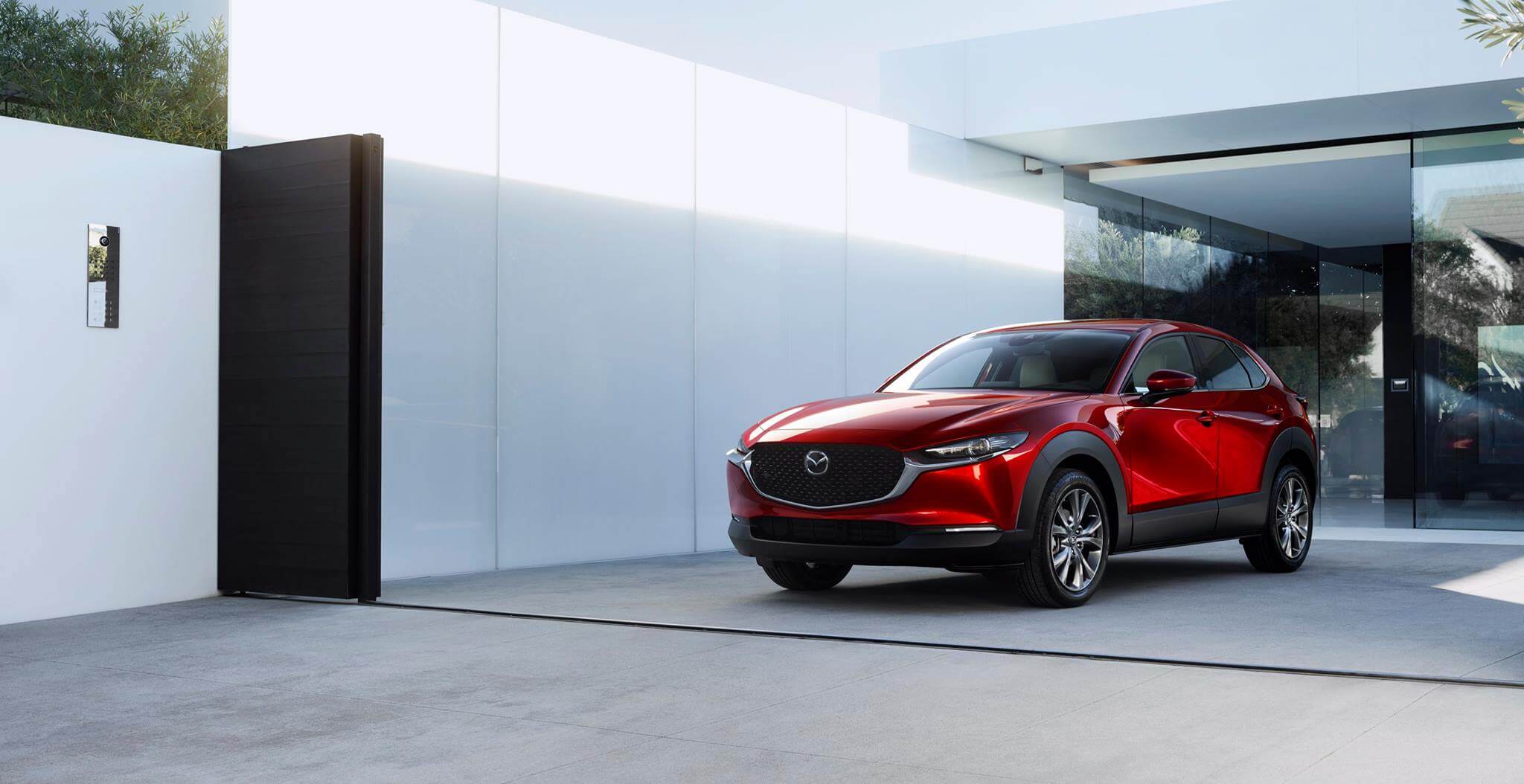
However, sequential operation is no longer the only deviation from the traditional on/off. We see on the road more and more different kinds of turn indicators. First, as I remember, was the Mazda CX-30 in 2019 with a high intensity pulse followed by a flux reduction.
This Mazda innovation, developed with Stanley Electric, is said to replicate the human heartbeat; Lamp Development Leader Atsushi Yoshida said, “I wanted to infuse a sense of life into the turn signal lamp—a feeling that would manifest the concept of ‘car as art'”. The Stanley team explained differences between bulb and LED activation and explained what they wanted to do with the new pulse:


By gradually dimming the light after reaching its peak instantly when turned on, dimming turn signals have a light waveform that combines the characteristics of both a bulb and an LED. As a result, it emits light instantly when turned on, so that the conspicuity of an LED turn signals retains, and it gradually turns off.
At least in USA, BMW have equipped recent models with LED turn signals that do the opposite of the Mazda effect: they gradually rise to full intensity, then instantly drop off to zero. I have seen that BMW is also proposing a ‘personal turn indicator’ activation with a double flash. Something different to Mazda that gives another impression, a bit more aggressive
So, are the regulations clear enough? UNECE R48 just defines the turn indicator frequency. OEMs are free to pick a frequency between 60 and 120 flashes per minute
Extract of UNECE R48:
6.5.9. Other requirements
The light shall be a flashing light flashing 90 ± 30 times per minute.
Operation of the light‑signal control shall be followed within not more than one second by the emission of light and within not more than one and one‑half seconds by its first extinction.
The duration of the ON and OFF times are defined in R148. But only in the test method as an alternative.
Extract of UNECE R148:
1.2.2. Operation of direction indicator lamps shall be done in flashing mode (f = 1.5 Hz, duty factor 50 per cent). (requirement for testing)
5.6.4. Measurement (requirement for light intensity measurement)
In general, the intensities shall be measured with the light source(s) continuously alight.
However, depending on the construction of the lamp, for example, the use of light-emitting diodes (LED), or the need to take precautions to avoid overheating, it is allowed to measure the lamps in flashing mode.
(a) This shall be achieved by switching with a frequency of f = 1.5 ± 0.5 Hz with the pulse width greater than 0.3 s, measured at 95 per cent peak light intensity. In all other cases the voltage as required in paragraph 4.8. shall be switched with a rise time and fall time shorter than 0.01 s; no overshoot is allowed;
(b) In the case of measurements taken in flashing mode the reported luminous intensity shall be represented by the maximum intensity.
As a consequence,
- Can we have a turn indicator with a period 90 per cent ON and 10 per cent OFF? it seems to be possible because it would fulfil R148, ¶ 5.6.4a. (pulse width greater than 0.3 second).
- Can we have a turn indicator with 10 per cent ON and 90 per cent OFF? I’m not sure because it risks not fulfilling R148 ¶ 5.6.4.a.
- Can we have a double intensity peak during the ON phase? Not clearly defined.
MVSS 108 contains nominally similar specifications (90 ± 30 flashes per minute) but how it gets there is a bit different; OEMs have to fulfil the table that indicates the frequency and on-time percentage:
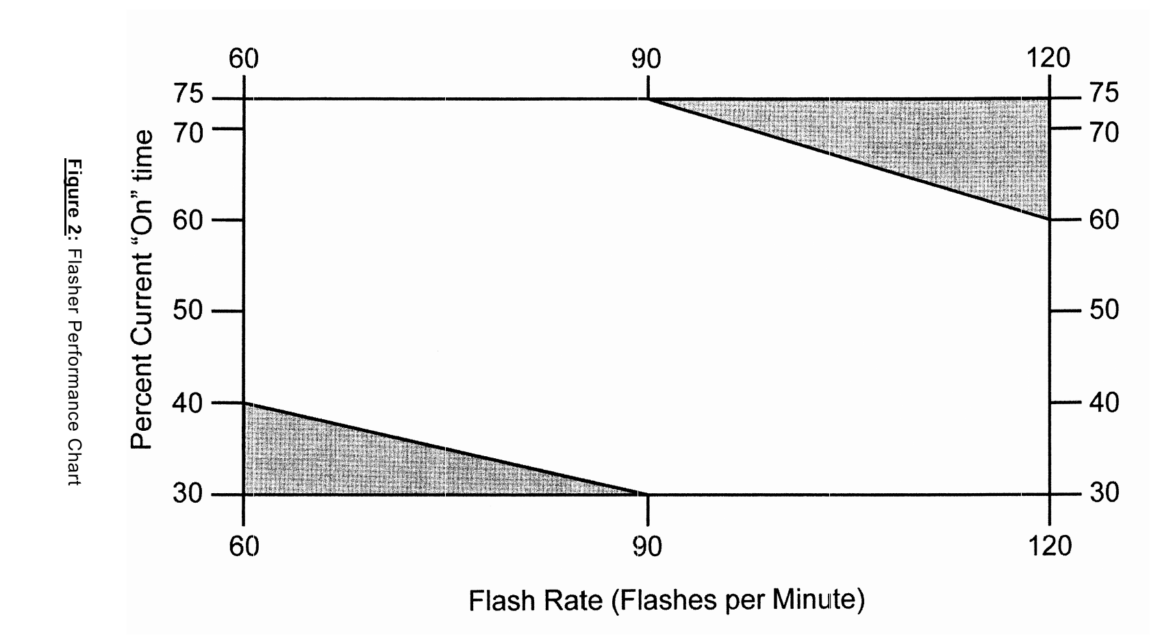
On-time light intensity is not defined in MVSS 108, but in SAE standard J588 (Turn Signal Lamps) and J1690 (Flashers). Like UNECE, SAE standards are defined for testing. Do they apply for vehicle installation requirements?
To go further:
Design Without Compromise: Signals from the Heart | Mazda Stories


