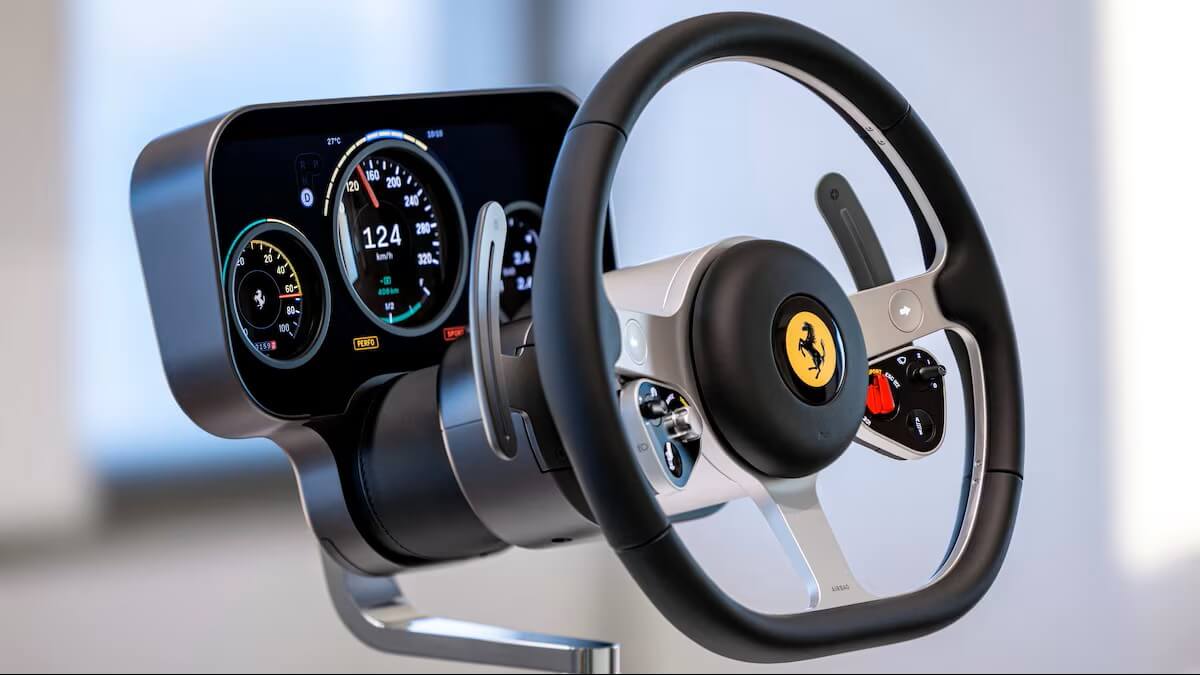
The full reveal is planned for this coming May, but Ferrari has introduced their first EV by dint of what DVN-I readers actually care about: the cabin; specifically, the cockpit! Instead of leading with range figures or motor specs, Ferrari released teaser images and a carefully-staged narrative around the Luce cockpit, positioning it as a statement on what luxury should feel like in an electric Ferrari.

It’s a signal that Ferrari wants the Luce interior to evince the kind of design quality and discipline typical of high-end consumer electronics: minimal visual clutter, high perceived quality, ‘honest’ materials, and – above all – intuitive interaction and operation. They engaged top talent to get there, too: Sir Jony Ive, who was Apple’s Senior VP of Industrial Design from the late 1990s until he was promoted to Chief Design Officer in 2015. In 2019, he left Apple and founded LoveFrom, the creative design collective hired by Ferrari for the Luce cockpit (video). Ferrari Chief Design Officer Flavio Manzoni told design journal Wallpaper, “It was a very intense collaboration – our chairman wished to make a clear statement in terms of innovation; the first electric Ferrari had to be something special (…) the idea was to avoid the conventions and codes of car design”.

From an HMI architecture standpoint, the Luce pushes a hybrid interaction stack: physical controls are not decorative, they’re core to the UX philosophy. Ferrari is clearly betting on a premium interpretation of eyes-on-road ergonomics, using dedicated buttons and rotary elements, operable by feel, and cutting back on complex menus and everything-by-touchscreen.
This positions hardware controls as a premium differentiator, rather than a cost item to be deleted. At the same time, though, Ferrari isn’t going retro here; the controls and displays are designed and configured as precision instruments, with thoughtfully restrained digital layers adding depth.
The display concept bears scrutiny: Ferrari describes three primary displays – cluster, central screen, rear control panel – but the standout is the steering-wheel-synchronized instrument cluster, reported as a first for Ferrari, using overlapping OLED layers that blend digital and analog cues. The Samsung OLEDs power an approach that feels like high-end watchmaking applied to the automotive realm. The convex lenses produce a parallax effect over circular OLED elements; again, a very luxury-forward approach to digital information.
The central screen is mounted on a ball-and-socket mechanism and can rotate toward the driver or passenger, and there’s a thoughtful bit of ergonomic luxury: the screen includes a palmrest to stabilize interaction. That’s a pragmatic, realistic answer to the real gritchments of trying to accurately use a touchscreen in a moving vehicle. Rather than expecting the UI alone to solve the problem, Ferrari is engineering the human hand into the HMI.
In parallel, the cabin introduces a motorized ‘multigraph module’ which can act as a clock, chronograph, compass, or a launch-control indicator, reinforcing the idea that information display can be emotional and tactile, not just functional.

Materials are treated as part of the interface, not just as decoration: anodized aluminum and strengthened glass are the dominant signature materials. The steering wheel is made from 100-per-cent recycled aluminum, and it is lighter than Ferrari’s standard wheel. The cabin reportedly uses more than forty Corning Gorilla Glass elements, some with laser-drilled microholes to enable graphics.
The design experience extends beyond the cabin itself. Ferrari’s key fob is described as incorporating an E-ink display and triggering a distinct wake-up sequence when inserted, turning access into a controlled ritual. This is a reminder that UX is no longer confined to the center screen; it’s the full chain from approach to ingress, from the first interaction to the final one.
There are two open threads worth tracking as more details are released. Ferrari has not confirmed CarPlay Ultra adoption, which will be a key strategic indicator: does Ferrari embrace Apple’s deeper integration, or keep a brand-owned HMI stack to preserve differentiation? And Ferrari previously discussed EV sound design that amplifies real vibrations rather than simulating ICE noises; will they pursue that on the Luce?
More broadly, dare we hope that elegant, intuitive, physically-present controls and displays could gain traction as a trend…and become available to people who don’t have Ferrari money, too?


