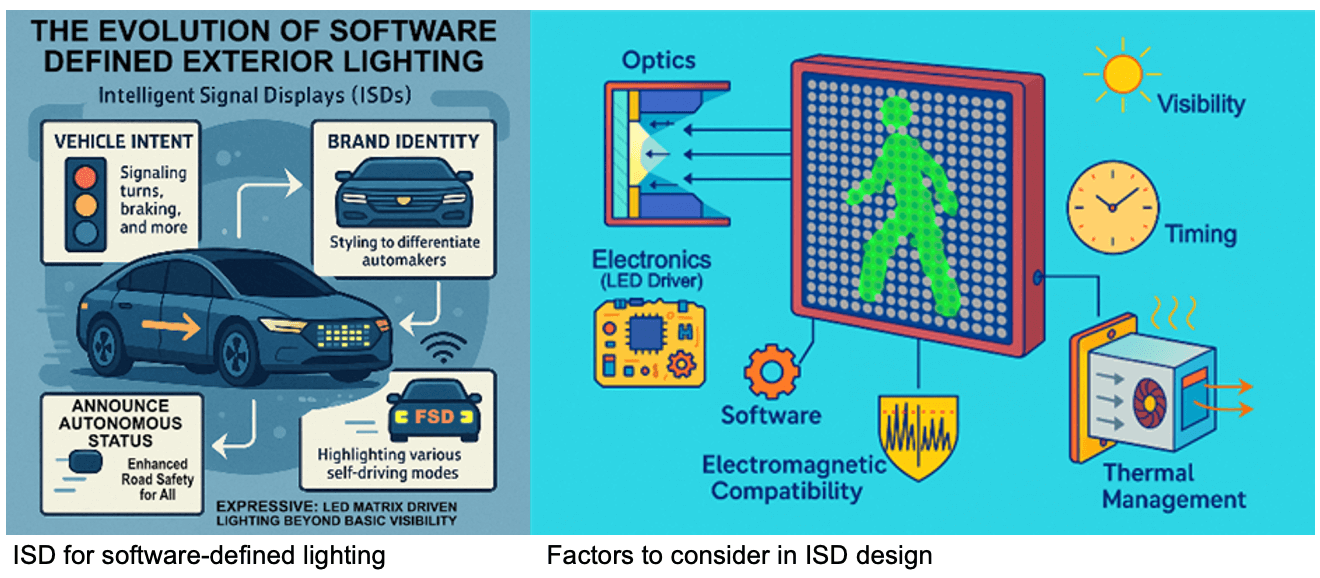
ISDs (intelligent/interactive signal/social displays) are software-defined exterior lighting functions that go beyond basic illumination to deliver short, clear cues for vehicle intent, safety, and brand expression. Typical implementations include segmented or matrix LED modules in front, rear, and side lamps synchronized over CAN, LIN, or Ethernet. Each module uses LED drivers for PWM dimming, diagnostics, and protection, while software selects patterns based on vehicle state. The result is synchronized, adaptive lighting that communicates what the vehicle is doing in real time.
ISD adoption is being driven by vehicle autonomy and need for human-readable cues, not only for inter-connected vehicles but also for pedestrians and cyclists who remain non-connected. Standardized signals for yielding, waiting, or low-speed remote-park can reduce hesitation and increase trust in mixed traffic. Vehicles provide intent data to the automated driving system (ADS) core, which then drives an ISD pattern engine; ADS indicator lamps form the safety-critical baseline and align with emerging SAE and UNECE concepts for system-engaged indication.
Lighting is primarily for safety, so legibility and brevity beat novelty. Keep cues (arrows, pulses, expanding bands) intuitive, stay within regional colour and flash envelopes (ECE, MVSS), and validate with user studies that measure recognition time, error rate, and glance behaviour in daylight and night conditions. Regulators are opening doors for new functions – for example, ADB is now permitted in the United States, and GTB planning indicates additional near-term work on projections and ADS status indicators. Enable expressive features by region and fall back to a legal baseline where required.
For flicker-free visuals and camera friendliness, keep the PWM carrier above 20–32 kHz. Increase effective dimming depth with frame-level dithering. Use phase-inversion, spread-spectrum, and staggered starts to flatten EMI peaks and meet CISPR-25 limits. Build in per-channel current monitoring and fault protection to detect open/short LEDs and apply LED ghost-removal techniques for matrices. Thermal budgets must reflect worst-case ambient, enclosure heating, and animation duty cycles with appropriate derating.
Common pitfalls include ambiguous icons or color choices, too many modes that conflict with rules, PWM set too low causing camera banding or flicker, non-deterministic timing between modules that produces visible beating or EMI spikes, weak daytime contrast, and thermal corners that shorten operating life.
Demonstrators and series programs show the concept is real. One example uses cyan lighting to indicate automated-mode, magenta with a warning symbol when a pedestrian is detected, and a green walk indication at a stop. DVN’s recent ISD study indicates that China is scaling production of ADS lamps, with significant penetration among leading EV brands. These snapshots illustrate that software-defined exterior signalling is moving from concept to measurable deployment.
ISD modules rely on LED drivers that support high-frequency PWM, selectable dithering, phase control, robust diagnostics, and familiar interfaces (I²C, SPI, UART, CAN, or serial-shift).
As a supplier of LED ICs, Lumissil offer AEC-Q100 and ASIL-capable devices for these needs. For example, the IS32FL3776 integrates the main ISD building blocks into a single automotive-qualified matrix controller. With 36 constant-current channels configurable as a 36×6 matrix, it renders dense, individually addressable pixels for icons, flowing turn signals, proximity bands, and ADS/ISD status indicators while keeping BOM complexity down. High-bit PWM with selectable dithering ensures smooth fades and precise low-level LED control; de-ghosting, low-headroom operation, and 8-bit dot correction keep signatures uniform and clean; and high-speed UART or SPI with device addressing simplifies multi-module sync in a lamp.
For EMC, the device supports phase-delayed switching, spread-spectrum PWM clocking, and staged channel activation to reduce ripple and emissions during complex animations. For thermal efficiency, it uses a two-pronged strategy: an internal 10-bit ADC measures LED forward voltages and computes the minimum rail voltage; then adjusts the external DC-DC supply to reduce thermal dissipation. In addition, it drives six external PMOS FETs so high-side conduction losses shift from the IC to external devices and copper, lowering junction temperature in high-pixel-density lamps. The part adds cycle-by-cycle LED open/short detection, ADC monitoring, OCP, UVLO, and thermal shutdown, and is AEC-Q100 Grade 1.

If light is becoming the language of vehicles, ISDs are the grammar that carries intent, identity, and trust. By integrating optics, LED drivers, software, and human factors, engineering teams can create expressive yet safe signatures that redefine how vehicles communicate. Lumissil’s automotive-grade LED drivers provide the high-frequency dithered PWM, thermal management, diagnostics, and scalability needed to implement these ISD concepts across front, rear, and side lighting.


