
Next-Gen Automotive Interiors: Where Design, CMF, and Sustainability converge
The second day of our conference in Turin.
First on stage was Charles Trelogan from Zeekr, who gave us a good overview of Zeekr Design in Gothenburg, then a thorough workup of the Zeekr 9X interior design (he was one of the main designers) – as covered by DVN-Interior here.

Then Jimena Martinez from Lemonlab delivered a very interesting and thoughtful speech titled: “Back in the Driver’s Seat: Decision-Making in Uncertain Times”. She artfully linked to what Andreas Wlasak told us the day before “When nothing is certain, everything is possible”.
With her background in architecture and human behavioral science (with a Master’s in Psychology), Martinez gave an overview of some of the main processes behind decision making in our brain. In her daily work she uses neuroscience and design thinking together. . See more on her website here, as well as here.

She explained, to exemplify for the audience, that the fox behavior is typical female and maybe south American, while the dog behavior was more male and perhaps German.
Spontaneous versus rational – autopilot versus pilot. Of course a great simplification, but still a good example.

Related to our automotive context, it’s important to understand what triggers our customers and what gives them benefits that are obvious to relate to. We came back to what triggers a person’s ‘inner fox’ quite a few times for the rest of the day.
Then, Guang Yang’s presentation, covered here: “Culture made visible: CMF, Lighting and UX between China and Europe”.
We rounded up this first session of the day with a Q&A where we concluded that it’s important to redefine the emotional bond and that we designers have a very important role in that happening. One quote we discussed was “Designers are not putting the outer skin on the structure, they are redefining the structure”.
CMF: How important it is for Carmaker DNA
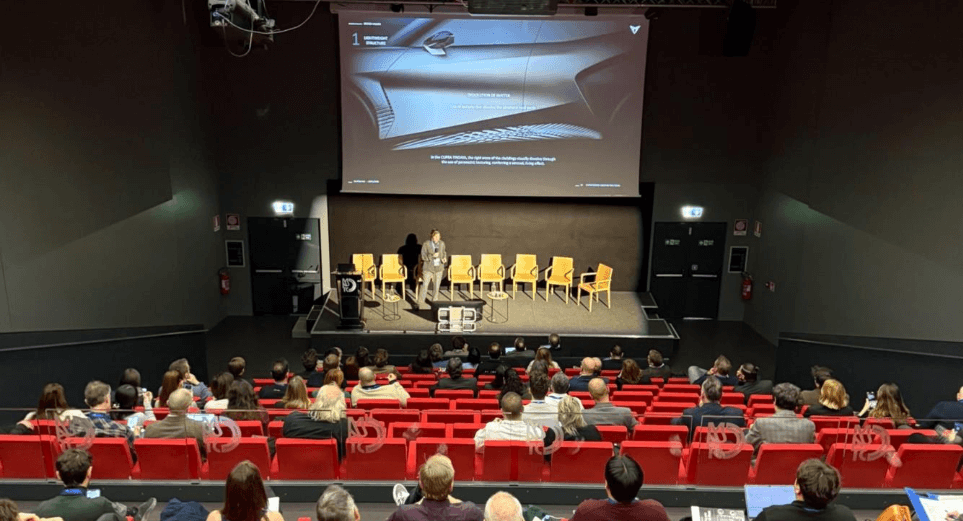
This was the day’s second session. First up was Cupra’s Francesca Sangalli, on “How materials shape brands and create the next aesthetic frontier.”
This was an inspirational presentation of the thinking behind the form language of Cupra and how CMF is playing a vital role in conveying that language, from the products itself all the way to brand activations at events and more.
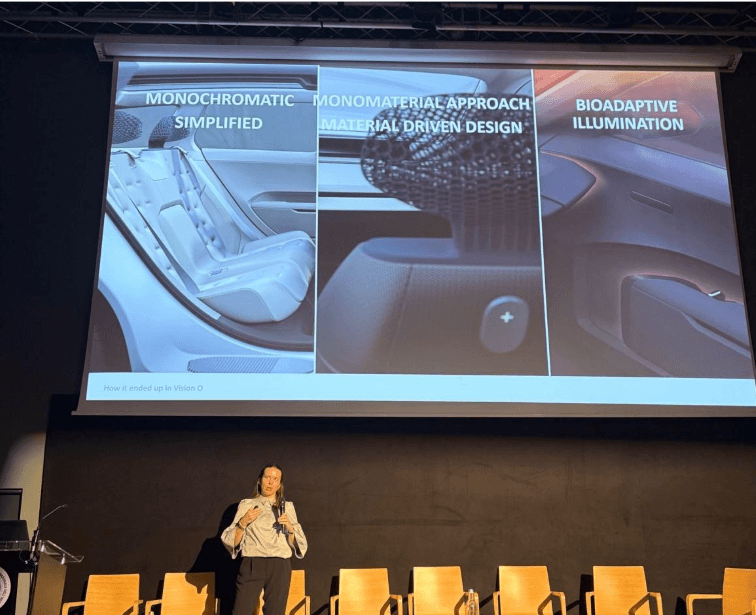
Then Kateřina Vránová took us through how the Škoda CMF team go from vision to mission. She used their latest Vision O concept car as a reference (see video).
It was quite intriguing to hear more about their approach to CMF and sustainability, where one of their tracks is to look into monomaterials for the sake of circularity. In the Vision O, they have also used ‘bioadaptive ambient Illumination’, following a Circadian rhythm and a color concept across the whole physical + digital environment. This is something the ESA (European Space Agency) has been exploring as well, together with Danish lighting specialists to support long term space travelers to improve their wellbeing and sleep (read about the SAGA lamp here).
Our final CMF speaker was Gwenaëlle Poulet, from Alpine Cars.
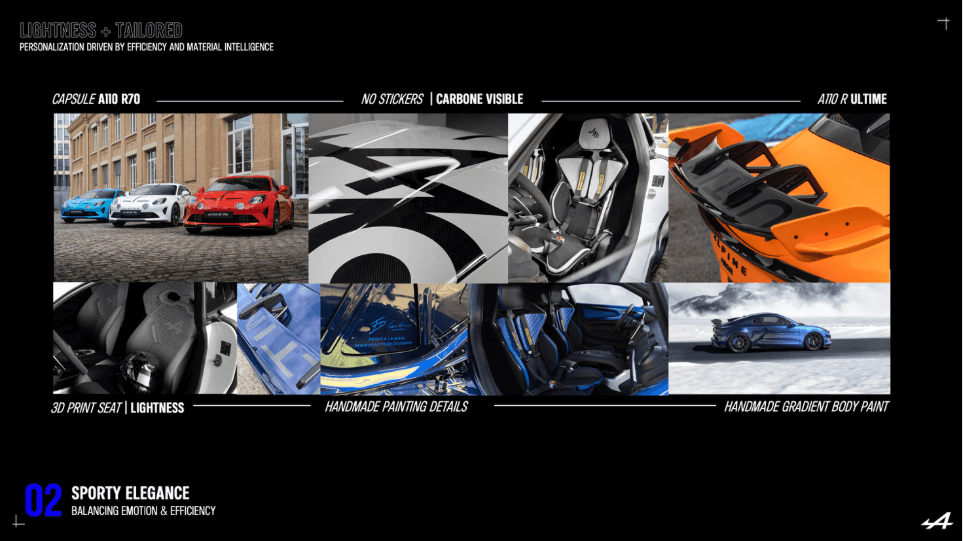
She took us through how Alpine focuses on sporty lightness in their cars and how they work with their personalization program, Atelier, wherein customers can customize their car’s build and configuration.
It’s not a no-holds-barred, customer-is-always-right arrangement, though; Poulet explained it remains impossible to get, say, a pink exterior or go totally bananas: “At Alpine, personalization is not endless choices, but an intelligent selection aligned with brand DNA. Personalisation is about refinement, not excess”.
So, while respecting the integrity of their brand DNA, they offer a curated selection of customization options.
Then it was time for the lunch break and mingling, after which the next session was: “Sustainable materials & CMF, the perfect match”
First on stage was Gabriele Ciaccio from Stellantis, talking about the recycling challenge: “To succeed it will be important to increase the efficiencies of the processes, to be cost competitive with the virgin materials, improving the sorting systems and decreasing the multi-materials applications (design for circularity).”
Then we had Ciro Piermatteo from Covestro presenting, “Pixel to Reality: Digital design freedom meets sustainable interior innovation”
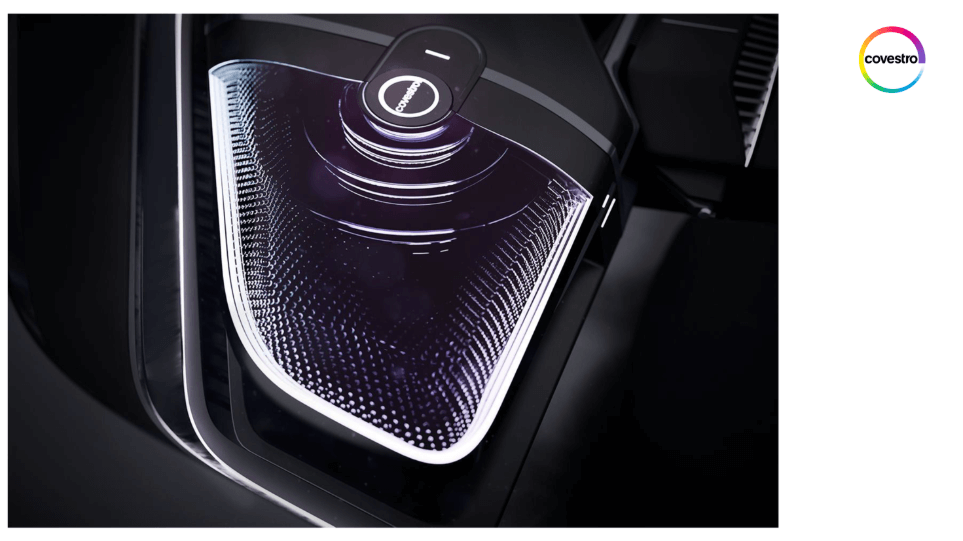
Covestro has used some of their materials to create a dashboard end detail that would appear with a piano-black finish in unlit state, and sparkle with a fantastic light pattern in the lit state. By using all the latest available technology, these kind of parts are now possible.
Piermatteo also told us that they worked on getting the development time down for such a complex part. The customer benefit of such a part is that it’s monomaterial, it takes up to 30 per cent off of mass (weight, it’s space-optimized since it’s very slim, and it’s developmentally efficient due to the use of simulation.
Then we had Gabriele Grezzana on stage from BComp.
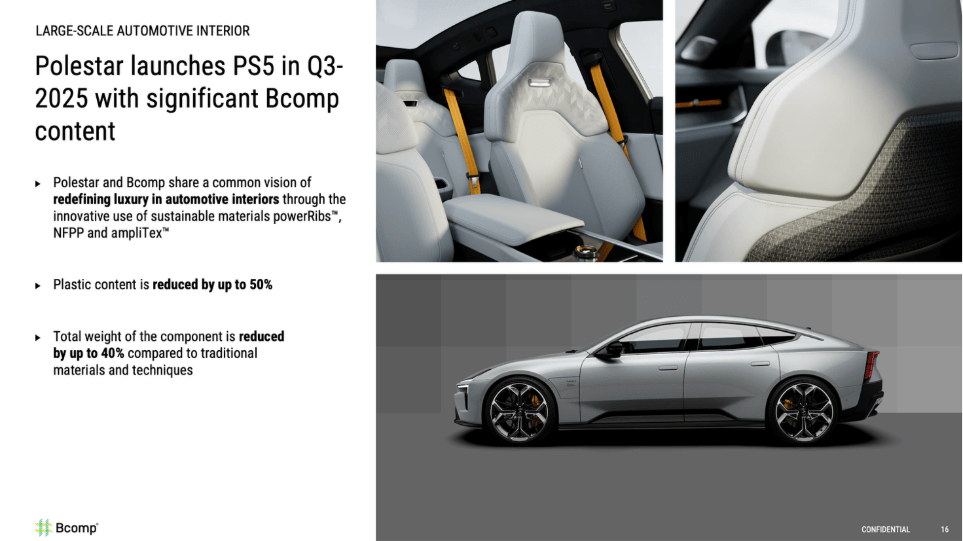
BComp, covered here, I have followed since 2018 – and it was good to see how much is reaching production now.
Then we had Dow MobilityScience on stage, with Dr. Esther Quintanilla Lujan talking about: “How to design interiors with innovative circular and low carbon solutions”.
A very engaged and factually-intense presentation where we got to hear a bit about the company and then dived into the topic. She took us through different advancements in both mechanical recycling for circularity but also chemical. How to extract PU from waste without disassembly was one example.
Next on stage was Beond , whose presentation showed us what they are good at.
At the end of this session, creative consultant Laetitia Lopez talked about luxury and sustainability. An interesting topic that sometimes can be contradictionary. She explained the classic three ingredients of luxury: rarity, craft, and exclusivity. She proposed that the sustainability aspects of transparency, responsibility, and traceability could live alongside the other three…but how?
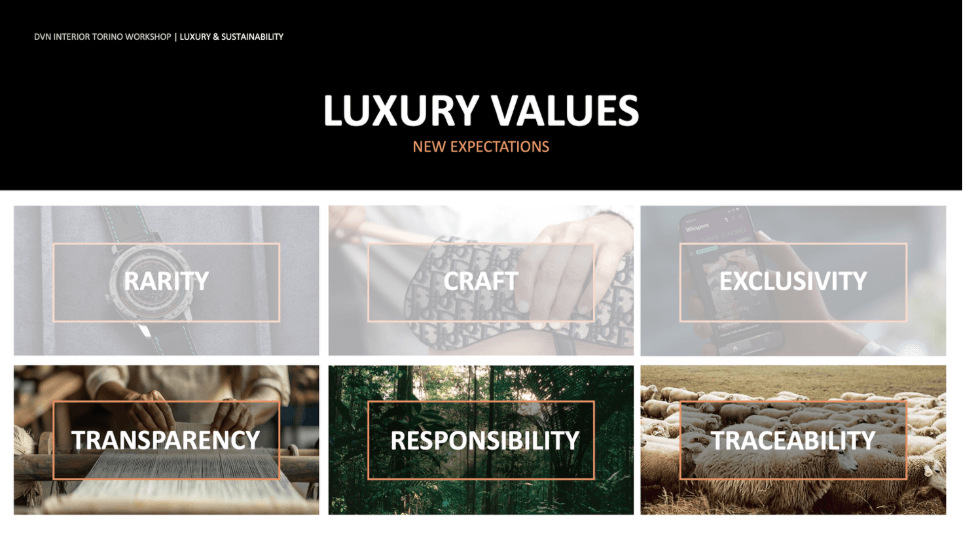
She ran us through the ‘seven R’s of circularity’, shown below, and gave concrete examples from other luxury related business of how they have done it. Very inspiring.

Then we had a break, after which came the final session. First on stage was Salvatore Grande from Marelli, and you can find coverage of that speech here.
Then we had Martin Walker from DesignLED taking us through their latest advancements. I have followed them since probably 2018 and the whole journey from startup to now being part of Forvia/Hella.
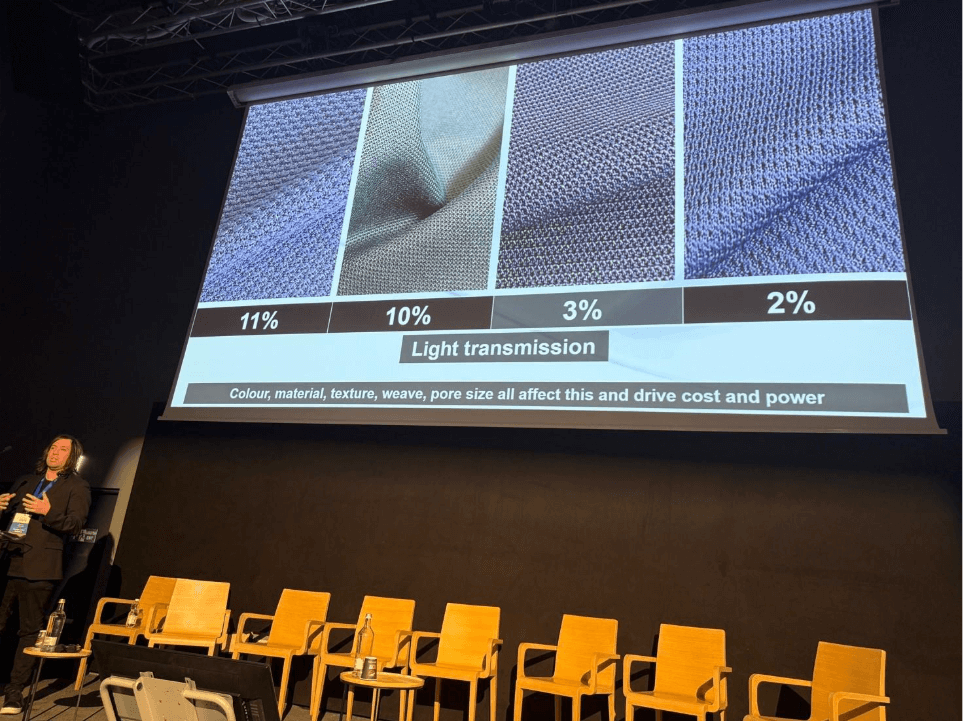
He showed their latest development, called Airtile” a thin space between two layers defining the optics, filled with air where previously a molded flexible transparent material added weight.
Then we had Ana Bravo form Martur Fompak on stage talking about “How CMF is evolving in the Era of digital interiors: Tactile + Digital”. Ana gave us a good overview of all the bells and whistles available from a supplier perspective, and weighed in on what the future of CMF could look like: “The future automotive interior will not be defined by screens alone. It will be defined by how surfaces feel, respond, and communicate. CMF is becoming the emotional and sensory bridge between humans and digital technology.”
Then we had Italdesign on stage again, with Fabrizio Ribet and Marco Pietropaolo taking us through their speech titled: “New Concept Lab: The Ultimate Hub Setting The Benchmark For The Definition Of Next-Generation Interiors” where we got to hear about their solution for physical testing of digital design models.

Part of Italdesign’s exhibit was their”New Concept Lab Buck”, and it was most impressive. The speed in development time you can achieve by using these new tools is substantial, and a gamechanger in our industry.
And we had Danny Tierney from Autodesk on stage talking about “Gaining Digital trust”. In exhibition they showed some of their enabling tools for achieving this new speed of development, namely digital evaluation using Apple Vision Pro (or other) gogglestogether with VRED to be able to view digital models in full scale with superior quality in a mixed reality environment: you see the real world behind the digital model since the goggles have cameras on the front.
To have trust in the digital tools is then important so you know what you look at to evaluate is on par with the real world. Tierney showed us how far the advancements in showing materials and colors in a digital world has come. Very impressive.

All in all, it was two great days in Turin with the spirit of DVN community well presented – a high-value, high-quality, high-content event with plenty of time to connect, mingle, and learn from one another.


