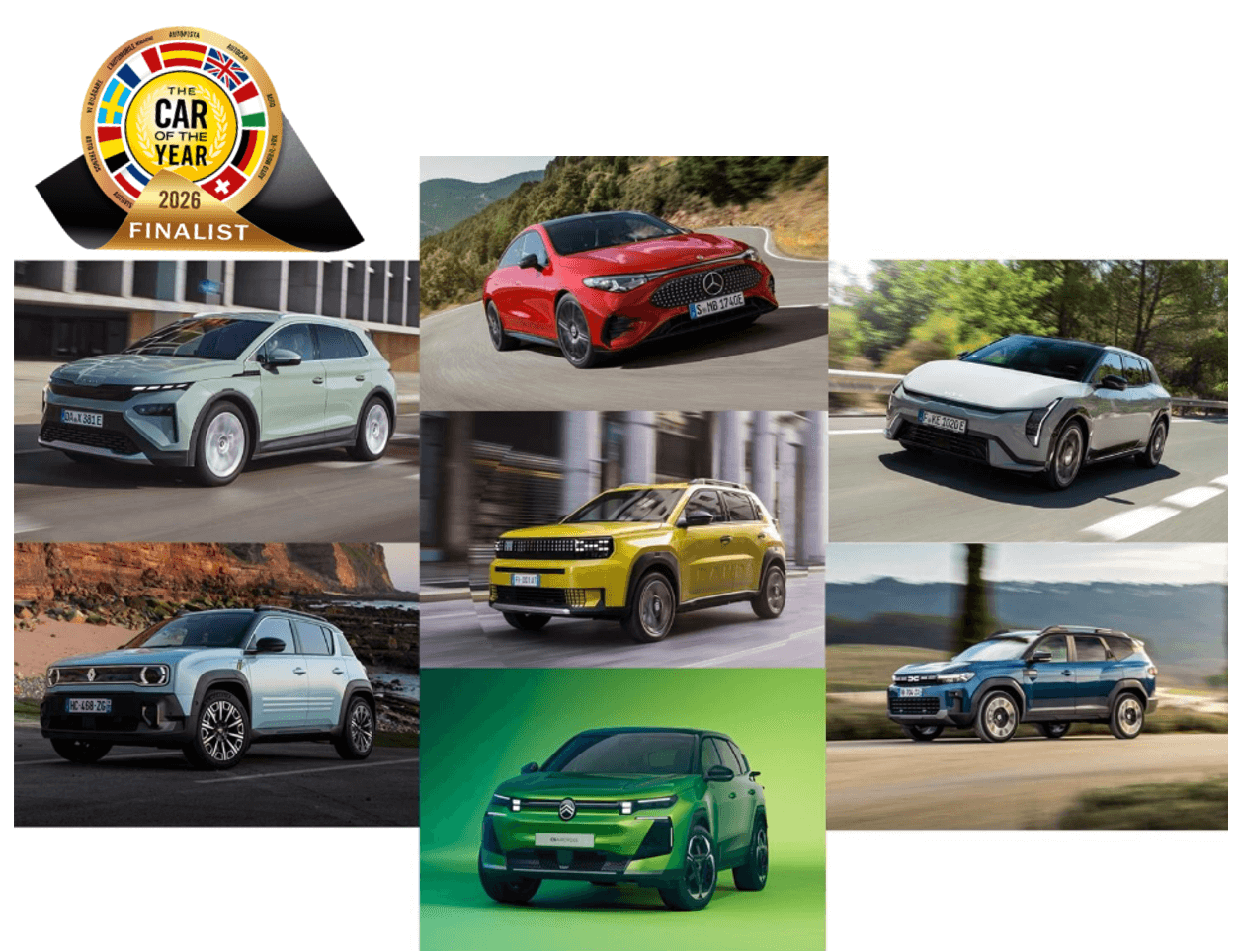
It’s time to take a look at the interiors of the seven finalists for Europe’s 2026 Car of the Year. Some of the finalist-vehicle interiors we have covered in previous DVN articles – and some not.
Designing car interiors isn’t easy, especially the cockpit area. There are so many requirements to fulfill and human ergonomic aspects to consider. But seeing this years array of interiors is very refreshing since there is still so many possible ways to be creative within those restrictions and the finalists are a good representation of that.

Škoda’s Elroq comes with a ‘bathtub’ approach: the upper door beltline smoothly blends into the windshield defroster panel in a nice generous curve. Nothing new, but well executed here. A minimal instrument panel is dug into the dashboard in a classic way – no freestanding thin screen.
But the 13″ Infotainment screen is freestanding and has a nice landing on the dashboard.
Air vents are in the expected locations and there is a row of physical buttons below them in the middle. H’mm. Hooray for real buttons, but they’re quite low and all the same size and shape…probably still requiring the driver to look down away from the road.
Interior materials look well curated.

We covered the MB CLA interior last March. A very different approach of the dashboard, with its massive coast-to-coast screen that can be hyper-personalized. Steering wheel with 2 rows of buttons on separate wings, very unique solution. The air vents are located where we’d expect to see them.

We’ve previously covered the Kia EV4. A hamburger approach of the dashboard, nicely executed with a large freestanding screen with twin 12.3″ screens covering both the instrument cluster functions and infotainment.
Buttons appears to be a mix of touch and physical on the dashboard, with some physical ones in the center-stack area.

The Renault 4 has a dual screen layout connected in one housing. A layered dashboard approach with focus on a soft appealing ‘hamburger’ in the middle. Plenty of physical buttons, and air vents in the expected positions.

See our previous coverage of the Fiat Grande Panda. A very bold and different dashboard with a lot of visible Bamboo Fiber Tex material that gives it a fresh and different look. Instrument and infotainment screens are surrounded by oval shaped transparent rings inspired by the Fiat Lingotto test track on the roof of their old factory.
More of an industrial-design approach here, reminding of products other than cars.

Dacia’s Bigster comes with a more conventional-looking dashboard, but has managed to do it in a very nice way with all the detailing and signature shapes in door panels and air vent chrome details.
The instrument cluster is integrated the good old way, but freestanding infotainment screen. Air vents where you would expect them. Nice steering wheel.

The C5 Aircross, which we have previously covered, has maybe the most unusual dashboard of the seven finalists. With its upright technical layered dashboard and straight-flat top, it is unique.
Air vents are all in the top layer. Underneath you have a soft, appealing ‘hamburger’. The waterfall center stack connects the two elements in a free-floating fashion that was seen for the first time in the Volvo S40 and C30 back in the days, leaving ample space for storage behind.
A very fresh and very French design if one dare say so.
Officially, Car of the Year is an internationally recognized organization that annually awards a prestigious trophy to the most exceptional new car released in the European market. The winner is selected by an independent jury composed of professional automotive journalists from various countries, overseen by a “Jury Committee” to ensure fairness and integrity in the voting process.”
It will be very interesting to see what the 60 jurors will conclude in a couple of days on 9 January, when they will pick the winner.


