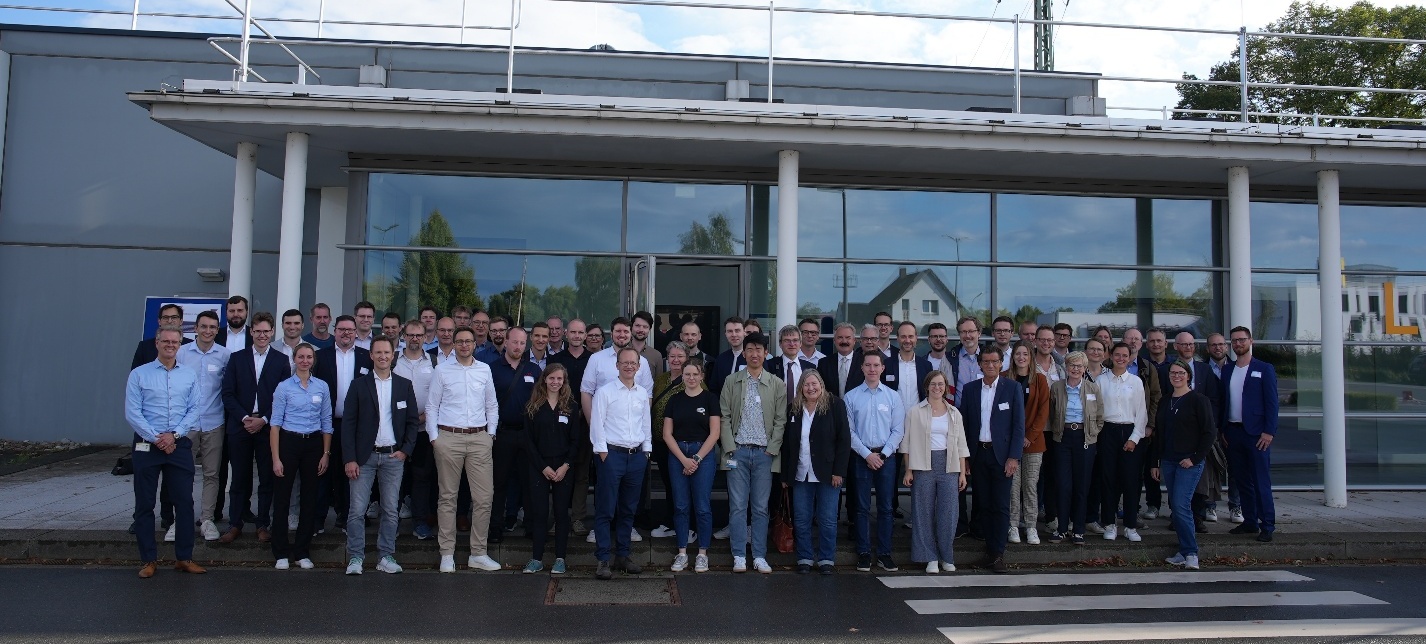
On 11 – 12 September, the L-LAB – Research Institute for Automotive Lighting and Mechatronics – celebrated its 25th anniversary, marking a quarter-century of pioneering work at the intersection of science and industry.
Founded in 2000 as a public/private partnership between the University of Paderborn and Hella, the L-LAB has grown into a vibrant hub of interdisciplinary research. In 2015, the partnership expanded to include Hamm-Lippstadt University of Applied Sciences (HSHL), further strengthening its academic foundation.
The roots of the L-LAB trace back to an initiative by Jürgen Behrend. In 1999, the Stifterverband spotlighted public/private partnerships in research, awarding 50,000 DM (pre-Euro German currency) in seed funding to the joint proposal ‘PPP in the Light Laboratory’ by Hella and the University of Paderborn. This initial support sent a strong signal, encouraging both partners to invest further. The breakthrough came with the approval of a research lectureship in “Mechanical Engineering, Active Systems,” also funded by the Stifterverband.
The anniversary celebration took place across three symbolic locations: HSHL, the Hella Light Tunnel, and the Hella Globe. Around 70 guests attended, including current and former L-LAB and Hella employees, professors, university representatives, and key partners. The program featured expert talks, a guided tour of the light tunnel, and presentations of current doctoral research projects, including:
- Light-based Internal Human-Machine Interfaces (iHMI) for Automated Vehicles
- Modelling the Circularity of Automotive Headlamp Systems
- Development of a Hybrid Optical Simulation Approach Considering Coherent and Incoherent Light Sources
- Environment Analysis Using active Camera-Headlamp Systems
- Development and Evaluation of Energy-Optimized Headlamp Light Distributions in Urban Areas
Over the past 25 years, the L-LAB has thrived thanks to its strong network of academic and industrial partners. This collaboration has led to numerous projects that extend far beyond the lab itself, including publicly funded research initiatives like Nanolux, VoLiFa, and NALYSES. These partnerships enable exploration in high-risk, high-reward areas of innovation. Both application-oriented and fundamental research are pursued, allowing for a broad spectrum of scientific inquiry that shape future technologies.
The L-LAB also serves as a unique platform for students, doctoral candidates, and companies to connect, exchange ideas, and build lasting relationships. Many young talents have taken their first professional steps here, later launching successful careers at Forvia Hella. This personal and professional networking is a key factor in the institute’s success.
Through its interdisciplinary work, the L-LAB has helped shape safety, efficiency, and design in automotive lighting technology. Looking ahead, it remains a place where new ideas are born – a centre for future innovation and a starting point for many professional careers in the field of automotive lighting technology.


