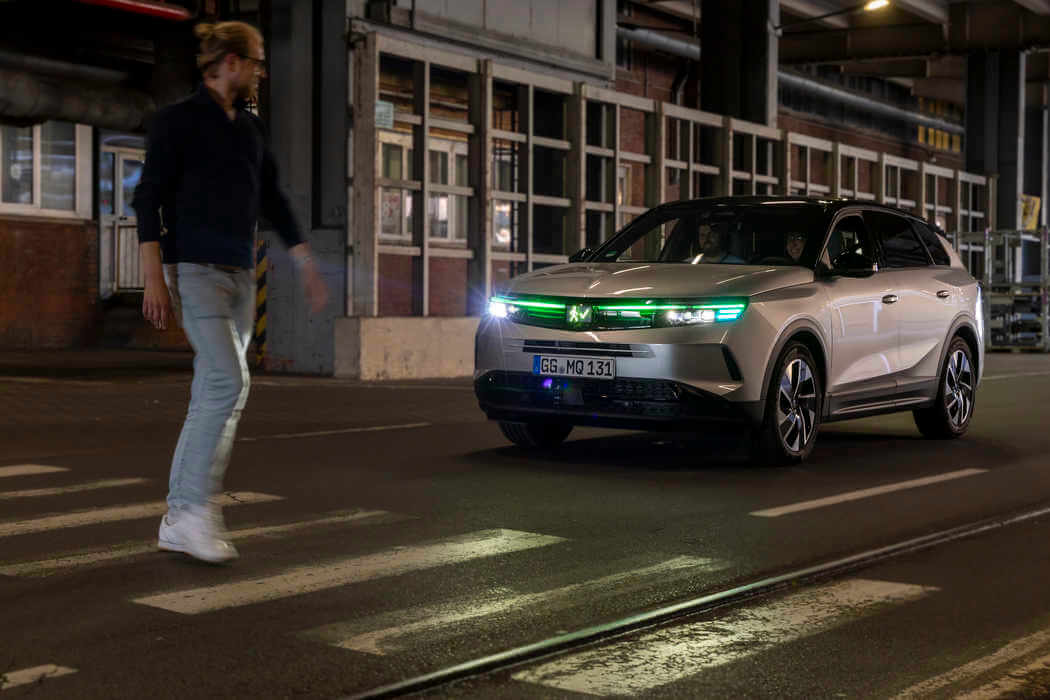
During ISAL, Opel, Stellantis and the Technical University of Darmstadt presented an Opel Grandland specially equipped to demonstrate how an SAE Level 3-capable (hands-off, eyes-off) AV could communicate with other road users via lighting systems. Stellantis Global Lighting Lead Philipp Röckl and Lead Innovation Engineer Julisa Le collaborated with the Opel Concept Workshop and students from TU Darmstadt to develop the Grandland demonstrator.
Röckl said, “Headlights clearly play an important part in increasing road safety, but modern lighting systems are capable of so much more. For example, lighting signatures can easily be animated and used for animations. And the illuminated Blitz on the Grandland can be substituted by a display that can both show the illuminated emblem and be used to communicate with other road users and pedestrians. By using existing lighting elements, it makes it easy to add communication features once we will introduce autonomous driving features in our cars”.
The team first defined use cases: ‘possible danger from a pedestrian or other situation’ (representing situations that most motorists have encountered, such as a child chasing a ball onto the road or a pedestrian emerging from between two parked cars) and ‘the situation is safe and the danger from a pedestrian is no longer present’. The Grandland was fitted with a camera system for object and gesture detection, as well as intention prediction using artificial intelligence.

When operating at Level 3 or higher, the front and rear turn signals shine steadily in cyan. The remaining signature lighting remains in the usual white. When the camera systems detect a pedestrian in the vehicle’s path, the signature lighting changes to magenta and the display shows a warning signal in the same colour, visually notifying the pedestrian the car is approaching. At the same time, the vehicle begins to decelerate. Once the Grandland has come to standstill, the signature lighting changes to green and the display shows a green walking figure, known from pedestrian crossing lights, to indicate that the car has recognised the pedestrian and stopped so the pedestrian may now cross. If the situation cannot be managed by the AI algorithm, the driver is prompted to take control of the vehicle, in line with industry standards for ADAS protocols.
Le said, “We specifically chose colours not already associated with other vehicle functions to avoid misunderstandings. For example, red is intuitively understandable, but it is already used for stop lights or the rear lights of cars. Cyan and magenta have been thoroughly evaluated for perception purposes and are currently not present in any traffic situations. Both ensure clear, unambiguous communication with other road users”.
This innovation is said to reflect Opel’s commitment to accessible, intelligent safety for all road users while building trust in autonomous vehicles.
Opel, Stellantis and TU Darmstadt started joint research into new lighting technologies in 2022, as part of the global Stellantis research network with respected universities. In the ‘OpenLabs’, scientific knowledge is gained for use in technology systems of future vehicle generations. The strategic partnership with TU Darmstadt is designed to enable a new era of lighting technologies. In addition, Stellantis is currently funding three doctoral students at the university’s Department of Electrical Engineering and Information Technology.


