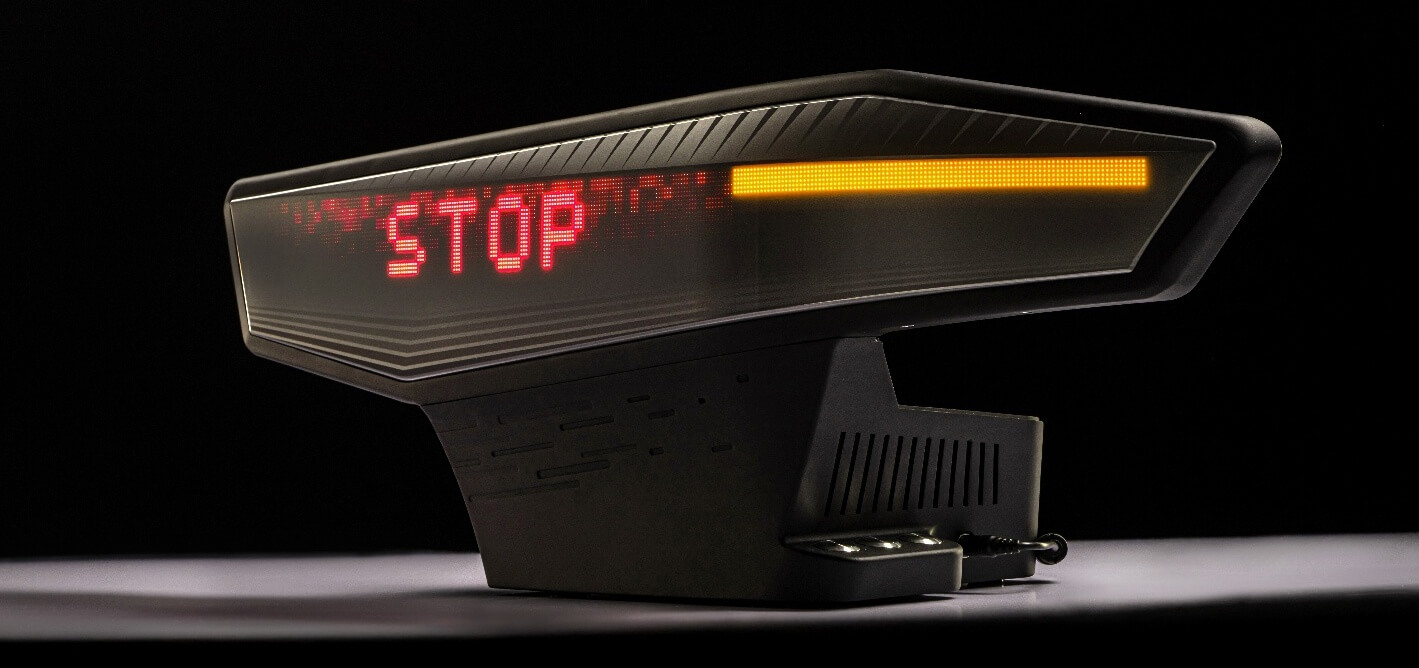
At ISAL, ams Osram presented a new demo board for Aliyos, glued on B-surface The foils are stitched together so the LED pitch of 2 mm is almost maintained at the edges of the neighbouring foils. The minimum bending radius is 200 mm. Thus, the prototype exhibits 562 segments in super-red and 50 segments in yellow. Since the transmittance of the decorated cover is approximately 30 per cent in the red and 23 per cent in the blue spectral ranges, the RCL is designed so that only 20-25 per cent of the Aliyos segments, driven at 1.5 mA per LED at maximum brightness, are needed to fulfil the taillight function. The remaining ~400 segments in the emission area can be used to display additional information, symbols, or lettering for communication.

Progress has also been made towards the integration opportunities of LED foils. The combination of ams Osram’s Aliyos technology with Leonhard Kurz’s capabilities for in-mould decoration (IMD) and functional foil bonding (FFB) opens new opportunities and ways to address trends.
The coloured RCL outer lens is manufactured using IMD, wherein a decorative single-image transfer film is back molded with a transparent plastic injection material and the lacquer layers release and adhere to the plastic by the pressure and temperature in the process. A fully decorated component is produced in a single step, including automotive-grade surface protection. The transfer film design is executed as a single image with a semi-transparent, hidden-until-lit effect and a light-blocking area for light shielding
After a 100-per-cent visual inspection of the IMD decorated RCL lens, the functional Aliyos foil is integrated on the backside of the 2.5D-curved component using the automized FFB adhesive process. During this integration process, the Aliyos foil is picked up by a robot-system, a transparent UV adhesive is applied, and in rolling motion the LED foil is integrated to the curved surface of the part. The FFB adhesive is then cured using UV light.


